
I wanted to love this. I really did.
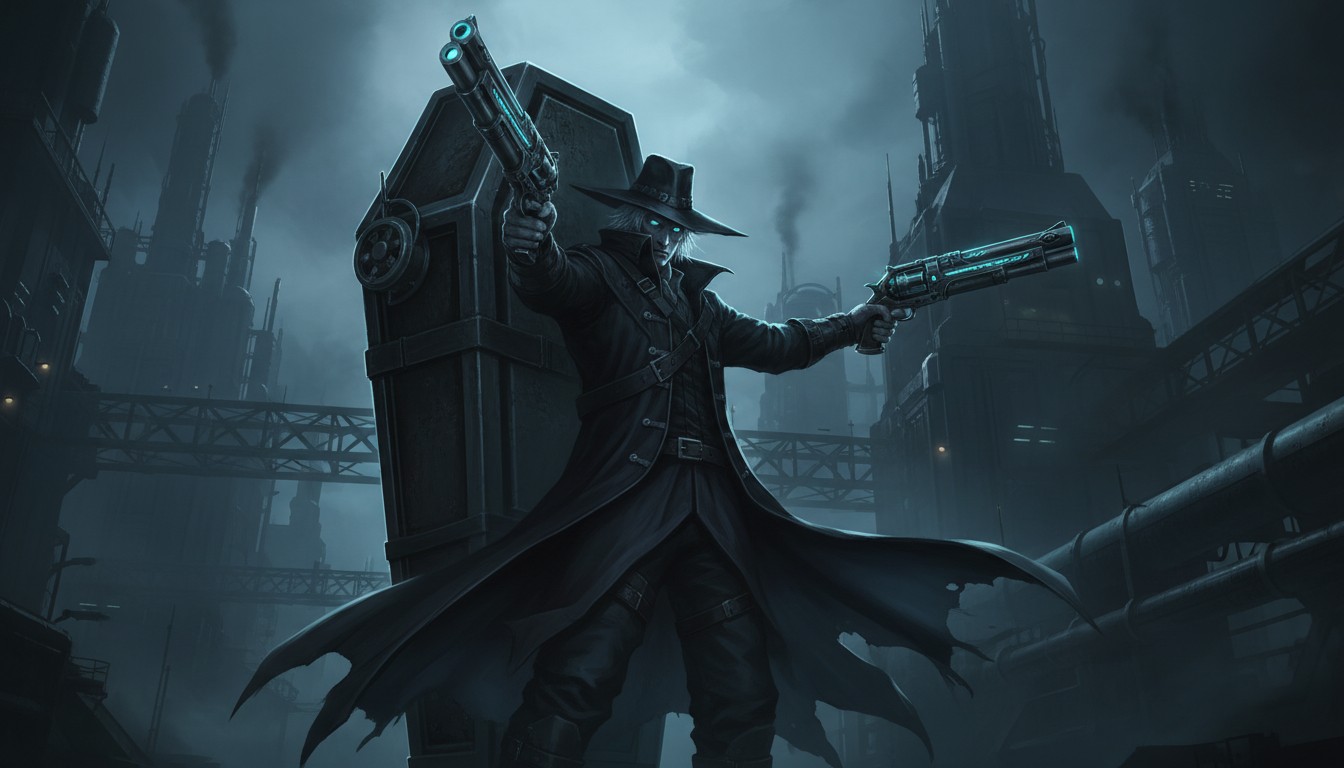
Gungrave on the PlayStation 2 was a stylish, stupid, glorious thing — a third-person shooter about a mute gunslinger with unlimited ammo, a coffin on his back, and a body count that would make John Wick blush. It was pure anime excess, the kind of game that knew exactly what it was and never apologized for it. When I heard the franchise was getting a VR revival, I assumed someone had figured out how to translate that spectacle into something you could actually step inside.
What we got instead was a $20 experience that lasts about as long as a decent podcast episode and controls like it was designed by committee in 2015.
The VR Reality
Gungrave VR is an official standalone release — not a mod, not a framework experiment, not a VorpX profile. It launched on PSVR in December 2018 and came to PCVR via Steam in March 2019. That matters because this had actual development resources, actual publisher backing (Marvelous/XSEED), and actual time to figure out what works in VR. And yet the result feels like a prototype that accidentally shipped.
The game is split between third-person arena combat, first-person on-rails shooting galleries, and — in its U.N. expansion — side-scrolling segments that have absolutely no business being in a VR headset. You play as Beyond the Grave, the resurrected gunslinger, mowing down waves of enemies in small enclosed levels while a story that barely exists happens around you.
Here’s the thing: this is a VR game that does not support motion controllers. On PSVR, you play with a DualShock 4. On PCVR, you need a gamepad. In 2019. For a VR shooter. That alone should tell you how badly the fundamentals were misunderstood.
How It Actually Plays
Aiming is handled by looking at enemies with your head. Your crosshair follows your gaze, not your hands. In practice, this means you spend the entire game nodding and craning your neck like you’re trying to inspect a suspicious mole on every enemy’s forehead. After twenty minutes, the neck strain is real. After forty, it becomes genuinely uncomfortable. On PCVR with a Quest 2 or similar headset, the disconnect between where your hands are and where you’re aiming is even more disorienting — the game was clearly built around PSVR’s tracking limitations and never properly adapted for PC hardware.
Camera rotation uses click-turning in 45-degree snaps via the right analog stick. There is no smooth rotation option in third-person mode. For a game that throws enemies at you from every angle, this is a baffling choice. Combat becomes a staccato rhythm of snap-turn, shoot, snap-turn, shoot, with each camera jerk chipping away at your sense of orientation. Reviewers across both platforms described it as dizzying and disjointed — some to the point of near-unplayability.
The core loop itself is aggressively simple: walk into an arena, enemies spawn, you hold the fire button until Grave’s guns overheat, dodge roll occasionally, repeat. The original PS2 games had a rhythmic quality to their destruction — you managed your heat meter, timed your dodges, felt the flow of the carnage. Here, the controls feel stiff and unresponsive. Animations play out in full before attacks register. Dodging has a delay that gets you hit more often than it saves you. The 360-degree coffin melee attack is theoretically cool and practically unreliable.
The first-person on-rails segments are even less inspired. You sit in a vehicle or on a fixed path and shoot at things as they appear. These sections strip away what little agency the third-person combat offers and replace it with the kind of light-gun boredom arcades stopped serving twenty years ago.
What Doesn’t Work
The problems pile up faster than the bodies. The campaign is roughly 60 to 90 minutes long — shorter than most films, with none of the narrative payoff. The U.N. expansion adds maybe another 30 minutes and was received even more poorly, sitting at “Mostly Negative” on Steam compared to the base game’s already unimpressive “Mixed” rating.
Visuals look like early last-generation assets. Environments are bland, character models are simple, and the whole thing lacks the visual punch that made the anime and original games memorable. Loading times are reportedly horrendous on PSVR. The story is incoherent at best, essentially nonexistent at worst — just enough cutscenes to remind you that someone wrote dialogue for this, but not enough to make you care.
Comfort is a genuine concern. The combination of head-tracked aiming, click-turning, and fast-paced combat creates a recipe for motion discomfort that multiple players reported. There are no comfort options to speak of — no smooth rotation toggle, no vignetting during movement, no adjustment for the snap-turn intervals.
The most damning assessment, repeated across multiple reviews: this game has no reason to be in VR. The third-person perspective offers only marginal immersion benefits. The head-tracking aiming is a compromise, not a feature. The first-person segments are on-rails shooters that existed in flat games decades ago. Nothing about the design leverages what VR actually does well.
The One Thing That Almost Works
If I’m being fair — and I try to be — the anime aesthetic itself is at least consistent. Grave’s design, the coffin weapons, the over-the-top enemy designs: these are faithful to the source material. For a die-hard Gungrave fan who has memorized every episode of the anime and can quote the original games, there is a faint pulse of recognition here. The problem is that recognition is all there is. The soul of the franchise — the stylish destruction, the rhythmic combat, the unapologetic spectacle — got lost in translation to VR.
The Call
I cannot recommend Gungrave VR to general VR enthusiasts. It fails at basic comfort hygiene, it ignores motion controller support in a genre that desperately needs it, it offers less than two hours of content, and its core gameplay loop is dated and repetitive. The PCVR version does not fix the foundational design errors. The PSVR version does not benefit from the platform’s better-supported exclusives. There is no PSVR2 port and no indication one is coming.
The only audience I can imagine tolerating this is completionist Gungrave fans who need to experience every piece of franchise media regardless of quality. For that extremely narrow group: it is technically functional, it is cheap when on sale, and it will not demand complex setup. Everyone else should skip it and play the original PS2 titles instead, or wait for a VR shooter that understands why aiming with your hands feels better than aiming with your forehead.