
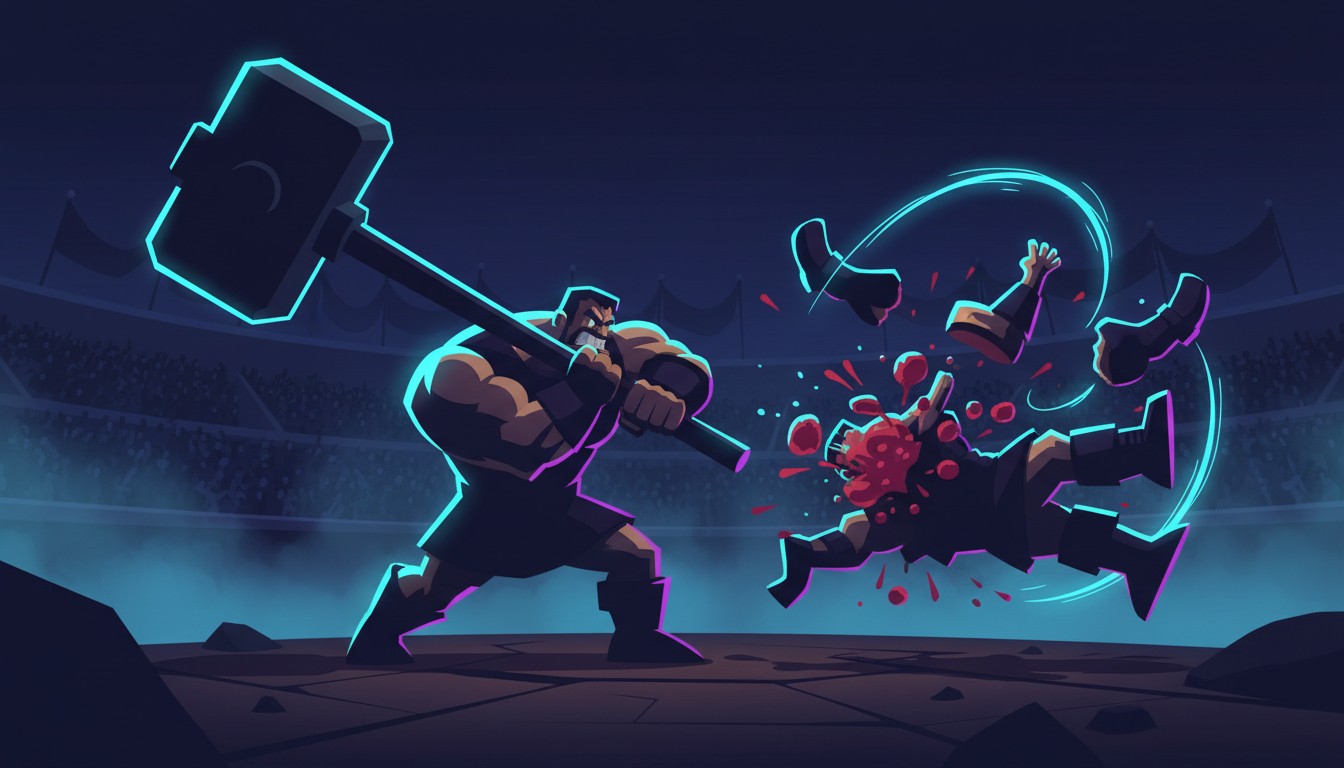
The first time I ripped a gladiator’s arm clean off and beat his friend with the wet end of it, I stopped and laughed out loud in an empty room. That’s Gorn in one sentence: a cartoonishly violent VR gladiator simulator where the physics engine is the star, the weapons behave like they’re made of rubber and jelly, and the gore is so over-the-top it loops back into slapstick.
Here’s the thing, though. For every moment of pure, stupid joy — impaling three charging enemies on a single spear, watching a two-handed mace bend like a pool noodle mid-swing, throwing a severed head into the crowd and hearing them cheer — there’s a good chance you’ll also spend part of your session fighting the movement system instead of the enemies.
Gorn is a native VR game from Free Lives, built for headsets from day one. It’s not a mod, not an injection profile, not a tacked-on VR mode. You buy it on SteamVR, Meta Quest, or PSVR2, put the headset on, and you’re in a gladiator pit facing an infinite supply of poorly-armored opponents who crumple when you hit them hard enough. The campaign strings together wave-based arena fights across different settings — a standard pit, a pirate ship deck, a giant’s dinner table, a throne room — with the simple goal of murdering everything that moves until the crowd is satisfied.
The combat system is genuinely special, and I don’t say that lightly. Every weapon is fully physics-driven. Swords don’t just clip through enemies — they stick, they slide, they get lodged in bone. You can pin a guy to a wall with a thrown spear and watch him dangle. You can chop legs out from under someone and watch them crawl toward you. Two-handed warhammers feel genuinely heavy because you actually need two hands to control the swing arc, and if you let go mid-swing the thing goes flying. Even the absurd weapons — crab claws, nunchucks, a bow that fires toilet plungers, throwing knives, wrist-mounted crossbows — obey the same rubbery physics logic. Nothing feels precise in the traditional video game sense, but it feels physical in a way most VR melee games still don’t manage. The dismemberment system is completely ridiculous and completely consistent. Arms, legs, heads, torsos — it all comes apart, and the ragdoll system means bodies collapse in ways that are grotesque and hilarious in equal measure.
But look, I’m not gonna lie: the movement system is divisive, and for some people it’s a dealbreaker. Gorn uses arm-pull locomotion — you reach out with a controller, hold a button, and physically pull yourself through the world. The intent is to keep you grounded in your playspace and give you a genuine workout, and it absolutely succeeds at that. After thirty minutes my arms are burning and my shirt is soaked. But in the heat of combat, when you need to dodge a charging brute or reposition for a swing, it’s fiddly. Some players adapt within an hour and treat it like second nature. Others report getting VR sickness from it even when they’re completely fine in smooth-locomotion games. A comfort mode narrows your field of view while moving, which helps some people. But if you’re sensitive to motion sickness at all, this is a real, serious caveat — possibly enough to skip the game entirely.
The structure is straightforward to a fault. You clear an arena, unlock a new weapon, move to the next arena. The campaign runs maybe three to four hours if you take your time. The real longevity comes from Custom Mode, where you dial in enemy counts, crowd sizes, gravity strength, and weapon loadouts to create your own ridiculous scenarios. Endless Mode is exactly what it sounds like — waves until you drop. Hardcore Mode cranks the difficulty for players who want the combat without the hand-holding. There’s also local multiplayer where a second player can control a gladiator with a gamepad, either teaming up or fighting against you. It’s a nice extra for couch sessions, but it’s not the main event.
Performance-wise, Gorn is surprisingly efficient. The cel-shaded cartoon art style keeps it looking clean and readable even on standalone Quest hardware, and it generally maintains solid frame rates. On PCVR it’s smoother still, with more blood effects and higher enemy counts in the arena. The Quest version scales back the gore particle effects and limits how many bodies can pile up, but the core physics and combat are fully intact. It runs well on mid-range hardware and holds up fine on standalone headsets.
So who is this actually for? If you want a structured, story-driven campaign with progression systems and narrative stakes, Gorn will disappoint you in about two hours. If you want precise, simulation-grade melee where every swing lands exactly where you expect, the rubbery physics and floppy weapons will frustrate you. But if you want a ridiculous, physically engaging brawler where you can tear someone’s heart out with your bare hands and throw it at their friend while the crowd chants your name? Gorn delivers that better than almost anything in VR. It’s a fantastic party game — hand someone a headset who’s never tried VR and watch them lose their mind. It’s a genuine upper-body workout disguised as entertainment. And it’s one of the few VR titles where the jank doesn’t feel like a bug — it feels like the point.
The original Gorn has been stable since its full release, though it’s quiet now. Free Lives released a sequel, shifting development focus to the new title. The first game still works fine, still sells at a lower price point than its successor, and still delivers the core experience that made it a VR staple. It won’t replace your favorite structured adventure, but for anyone who enjoys melee combat in VR and can handle the arm-pull locomotion, it’s absolutely worth the time.