
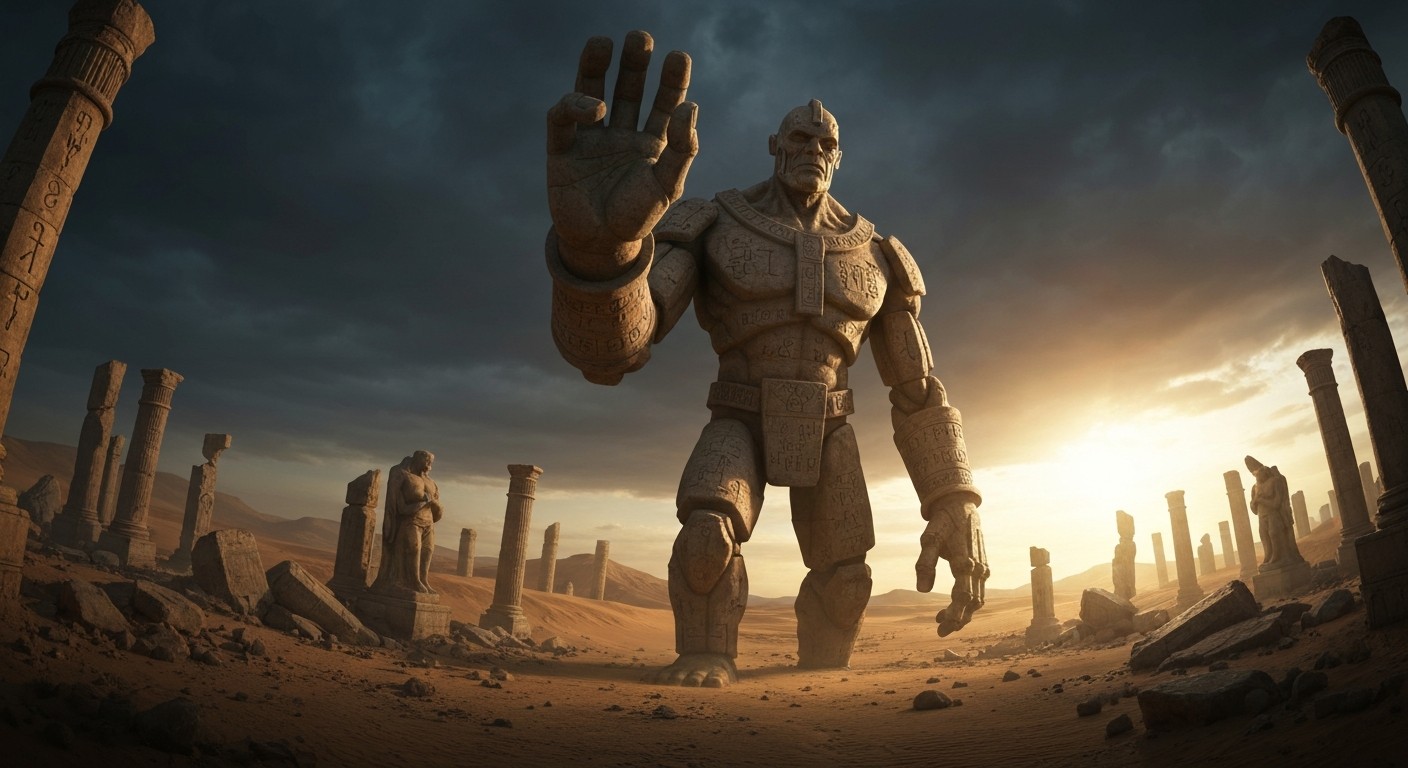
The first time you swing a sword in Golem, something clicks.
Not because the tracking is perfect — it isn’t, not always. Not because the movement system makes sense — at first, it really doesn’t. What clicks is the weight. Your golem’s arm rises with genuine heft. You block an incoming blow and feel the impact shudder through that stone frame. You feint, wait for the opening, and land a counter on an exposed shoulder. This is 1:1 melee combat with real skill expression, and on PSVR’s Move controllers, that’s a rare thing. Most VR melee on this platform amounts to waggle. Golem demands timing, positioning, and pattern recognition.
That’s the core of what makes this game exceptional. The rest — the atmosphere, the soundtrack, the sheer scale of the architecture — amplifies it.
Yeah, the launch was rough. The “Incline” head-leaning movement system was genuinely disorienting. Leaning toward your PS Camera to move forward felt like trying to will a shopping cart uphill with your forehead. Gaming Trend called it “painful to play.” UploadVR’s reviewer was nearly done before patch v1.02 added DualShock 4 analog stick movement as an alternative. But once you get past that initial friction — and with the patch, you can — what remains is one of the best action-adventures on PSVR.
What You’re Actually Getting
Golem is a native PSVR title from Highwire Games — a Seattle studio founded by Bungie veterans Martin O’Donnell and Jaime Griesemer. Announced in 2015, delayed repeatedly, released November 2019 as a PS4 exclusive. You need a PSVR headset, PS Camera, and at least one PS Move controller (or a DualShock 4 post-patch). This is a purpose-built VR experience, not a mod or injection. Highwire treated the PSVR hardware as a canvas, not a limitation.
Playing as a Mountain of Stone
You are Twine, a bedridden child who discovers she can project her consciousness into massive stone golems. Through their eyes — heavy, deliberate, crushingly powerful — you explore the ruins of an ancient city and uncover your family’s buried history. The premise sells itself, and the execution commits to it. These golems feel big. The city feels old. The environmental storytelling through collectible glyphs and audio logs builds a world you want to understand, not just one you move through.
Combat is where Golem earns its tier. You swing with 1:1 Motion controller tracking, blocking and feinting against hostile golems with distinct attack patterns and weak points. When the tracking cooperates — and post-patch, it mostly does — there’s a heft and satisfaction to the melee that few VR games on any platform match. Reading an enemy’s windup, timing your block, landing a counter on an exposed shoulder — this is real combat, not waggle. Push Square called it one of PSVR’s best-looking games. The VR Grid, after updating their review for v1.02, called it “an unparalleled VR experience marred by early VR issues.” They got the order right: unparalleled experience first, issues second.
The Friction Is Real, But It’s Not the Story
I need to be honest about what doesn’t work. The checkpoint system is punishing — almost roguelite in its item-loss mechanic, and the spacing feels arbitrary rather than intentional. Combined with slow golem movement and no in-game map, backtracking through respawned enemies can grate. Click-turning in 30-degree increments breaks immersion during extended sessions, and smooth turning was never patched in. Combat occasionally suffers from hit detection hiccups, and because dying strips your equipped items and sends you back to the last checkpoint, one unlucky moment can cost you twenty minutes of progress.
The story, well-acted and intriguing as it is, ends abruptly. It feels like the first act of something larger that Highwire never got to make. For a $40 launch title, that stings.
But here’s the thing: these are footnotes to a genuinely exceptional game, not definitions of it. The slow movement helps with comfort. The click-turning is a PSVR1-era constraint, not a design failure. The checkpoint system is demanding but not broken. And the incomplete story, while frustrating, doesn’t erase the hours of atmosphere and combat that precede it.
Why It’s Worth Your Time
Golem is one of the best-looking games on PSVR. The character models, the lighting, the environmental detail — Highwire clearly poured resources into making this platform sing. Marty O’Donnell’s soundtrack doesn’t just set mood; it literally helps you navigate, since the game refuses to give you a map. The combat, when it’s firing on all cylinders, offers depth and weight that most VR melee can’t touch. This is a game made by people who understood what VR combat should feel like, and they built it on hardware that barely let them do it.
The Bottom Line
Golem is one of the best melee combat experiences on PSVR, wrapped in an atmospheric adventure that understands what makes the medium special. The design quirks — click-turning, sparse checkpoints, slow movement — demand patience, but what they lead to justifies every minute. This is an A-tier game on a platform that rarely saw them.
Who should play it: PSVR owners who want a narrative action-adventure with combat depth they won’t find elsewhere on the platform, patient players who can adapt to early-VR design conventions, and anyone who values atmosphere and weight in their VR experiences.
Who should skip: Anyone without PSVR hardware, and players who need smooth locomotion or can’t tolerate click-turning.