
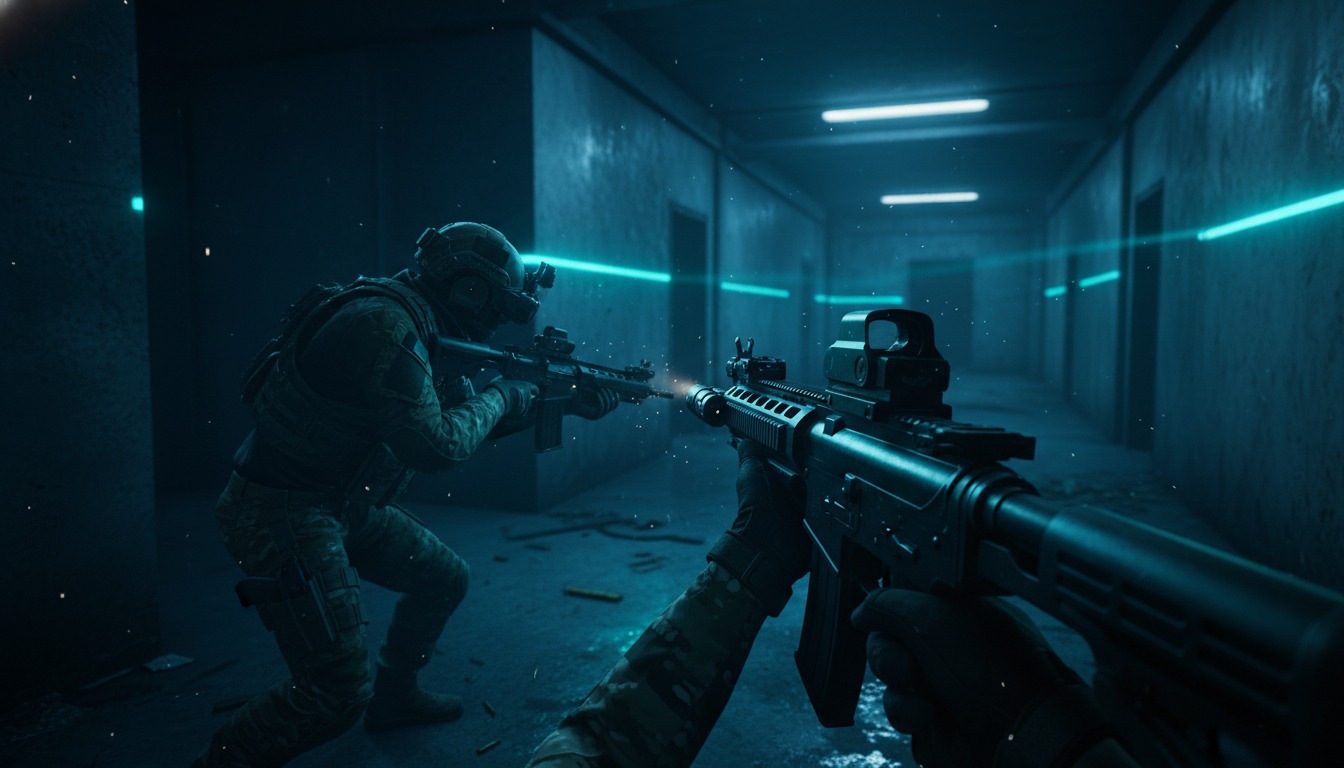
The first time you physically raise the PSVR Aim Controller to your shoulder and lean around a corner, expecting an ambush, something clicks. Not just the controller’s mechanical feedback — something in your brain. Firewall Zero Hour makes you perform the actions that other shooters only ask you to button-press. Checking corners, blind firing, holding a position while your teammate hacks a terminal. Your body is doing the work. That physicality is the entire point.
First Contact Entertainment built this game exclusively for PSVR, and they built it around a single idea: competitive tactical shooting feels fundamentally different when your hands, arms, and head are all tracked in 1:1 space. There is no flat version. No hybrid conversion. You play with the Aim Controller or the DualShock 4, but let’s be direct about this — the DualShock 4 is a compromise, and the Aim Controller is the reason the game exists. This is a VR-native tactical shooter in a market that had, until this point, barely proven the concept was possible.
The Contract
Each round of Firewall Zero Hour is a four-on-four contract. Attackers, operating under the callsign “Mother,” must locate a laptop hidden somewhere on the map, hack through a firewall, and extract sensitive data. Defenders, “Father,” must stop them or eliminate the entire attacking team. The catch is simple and brutal: one life per round. No respawns. No second chances. When you die, you watch the rest of the round through your teammates’ perspectives, relaying information over voice chat like a ghost in the room.
That structure generates a tension that flat competitive shooters struggle to replicate. In Rainbow Six Siege or Counter-Strike, the stakes are high, but your body is still parked on a couch holding a gamepad. In Firewall Zero Hour, your physical posture matters. Crouching behind cover actually lowers your virtual body. Leaning left or right lets you expose less of yourself when checking an angle. The Aim Controller’s tracking means your rifle moves exactly as your hands move, and that precision changes how you think about every engagement. You don’t just aim at a doorway. You physically position yourself to minimize exposure.
The maps are designed with this in mind — tight interiors, multiple breach points, verticality that rewards players who actually look up and around. Smart teams coordinate loadouts and entry points. Rushing in alone is a fast way to spend the round as a spectator.
The Tools
Twelve contractors make up the roster, each with a unique primary skill and an editable secondary ability. The differentiation is meaningful — some contractors excel at breaching, others at area denial or support. Loadouts are fully customizable: primary weapon, secondary, lethal and non-lethal equipment. Progression earns experience and in-game “Crypto” used to unlock additional skills and gear. The economy is generous enough that dedicated players feel rewarded without gating power behind excessive grind.
The gunplay itself is where Firewall Zero Hour justifies its existence. Weapons feel weighty and distinct. The assault rifle handles differently than the SMG, which handles differently than the shotgun. Reloading requires a physical button press on the Aim Controller while you bring the weapon in, and the timing becomes muscle memory after a few rounds. Blind firing around corners — literally holding the controller around a wall and squeezing the trigger without exposing your head — is a technique flat shooters simulate with button prompts. Here it is a real tactic, executed with your actual arms.
The wrist tablet deserves mention. Instead of pulling you out of the world with a floating 2D menu, your in-game character raises a forearm-mounted display showing the mini-map, objectives, and team status. It is diegetic, immediate, and smartly designed. You can check it while maintaining situational awareness, which sounds small until you realize how many VR games break immersion with abstract UI layers.
What Holds
Voice communication is not optional. Firewall Zero Hour is built around team coordination, and the game assumes you are talking. Marking enemy positions, calling rotations, coordinating a simultaneous breach — this is where the best moments happen. Solo queue players can still find success, but the gap between a coordinated squad and four individuals is enormous. The game rewards investment in a way that casual drop-in multiplayer often does not.
Performance on base PS4 hardware is stable. The visual fidelity makes smart tradeoffs — interiors are detailed where it matters, character models read clearly at engagement distances, and the lighting does effective work establishing mood without taxing the system. The art direction prioritizes readability over spectacle, which is the right call for a competitive shooter.
The Friction
The PSVR tracking system imposes real limitations. The Aim Controller’s light sphere can lose tracking during rapid 180-degree turns or when the controller drifts outside the PlayStation Camera’s field of view. In a game where corner-checking and quick target acquisition determine who lives, a moment of drift is the difference between winning a duel and watching a killcam that never existed. Proper camera positioning and playspace setup mitigate this, but the limitation is hardware-level and never fully disappears.
The online requirement is another sticking point. Even the solo and co-op training modes demand an internet connection. If Sony’s servers hiccup or your connection drops, you cannot play at all. For a game with genuine solo training content, that decision is difficult to defend.
Solo players should also calibrate expectations. The training modes against AI are competent practice tools, but the heart of Firewall Zero Hour is competitive multiplayer. If you do not enjoy team-based tactical shooting or cannot commit to the communication loop, this game will not transform into something else for you.
The Call
Firewall Zero Hour is the best tactical multiplayer experience available on PSVR, and it makes a strong case that this genre has a real future in virtual reality. The physicality of the Aim Controller transforms tactics from abstract decision-making into embodied performance. Every round is a self-contained story of tension, coordination, and consequence. When everything works — the tracking holds, your squad communicates, the breach goes clean — there is nothing else on the platform that matches it.
This is not a game for everyone. It demands hardware investment, a stable internet connection, and a willingness to engage with team-based competitive play. But for PSVR owners who have been waiting for a shooter that treats the platform seriously, that builds systems around VR instead of bolting them on, Firewall Zero Hour delivers exactly what the hardware has been promising. Own an Aim Controller? This is why you bought it.