
EVE Gunjack: A Polished Turret Shooter Lost to Time
In the early days of consumer virtual reality, CCP Games bet big on the technology. While EVE: Valkyrie grabbed headlines as the flagship multiplayer space combat experience, its smaller sibling EVE Gunjack quietly established a new benchmark for what mobile VR could achieve. Built from the ground up in Unreal Engine 4 and released alongside the Samsung Gear VR in November 2015, Gunjack demonstrated that smartphone-powered VR could deliver console-quality visuals and satisfying arcade action.
The game is now delisted from all stores and its multiplayer servers went dark in August 2022. But the solo campaign still works for those who own it, and its legacy as one of the most polished early VR shooters remains relevant for anyone studying the evolution of virtual reality gaming.
What It Was
EVE Gunjack was an official native VR release, not a community mod or conversion. Developed by CCP Shanghai, it placed players in the role of a “gunjack” — a turret operator defending a mining vessel in the Outer Ring region of the EVE Online universe.
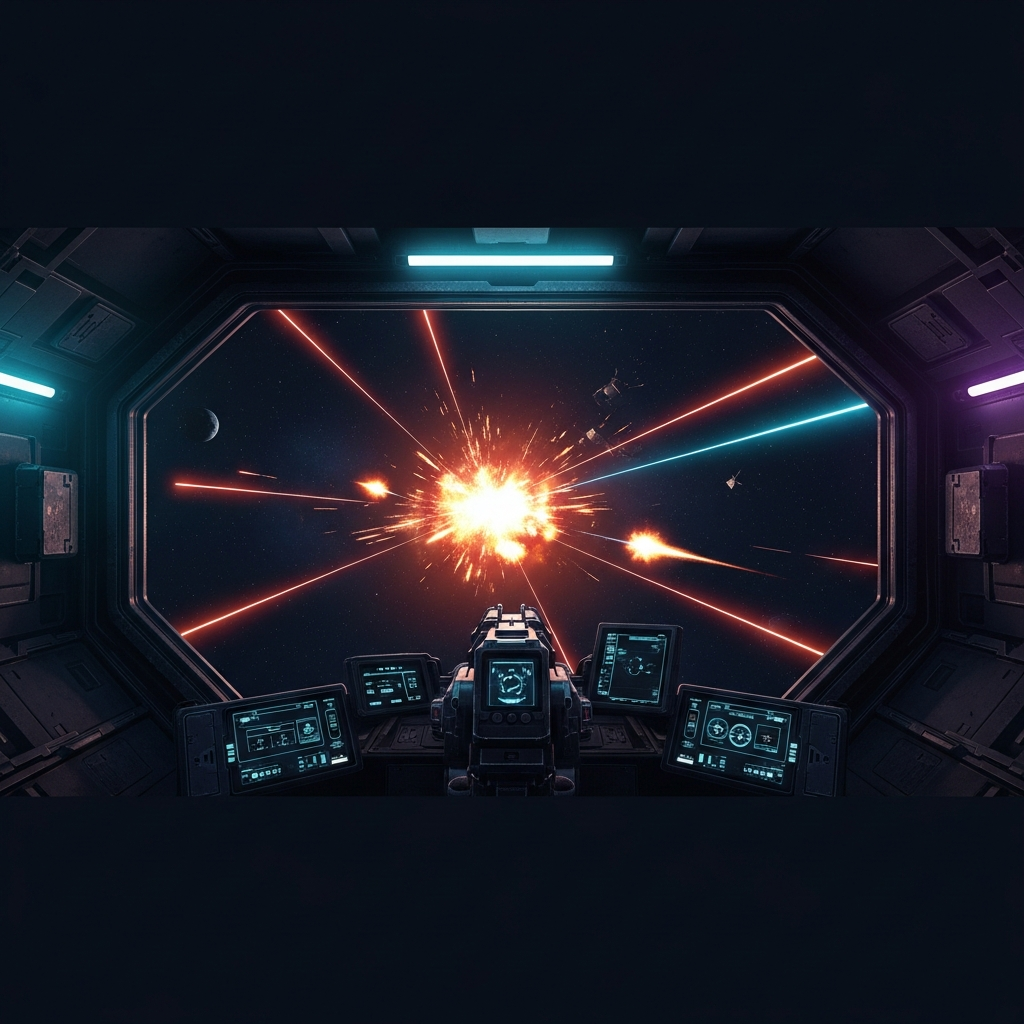
The premise was straightforward: waves of enemy ships warp into your sector, and your job is to eliminate them before they destroy your rig. You manned a stationary gun emplacement with dual gatling cannons, locking onto targets by looking and firing with either a gamepad or the Gear VR’s touchpad.
Release History
- November 19, 2015 — Samsung Gear VR (Oculus Store)
- April 5, 2016 — PC (Steam) with Oculus Rift and HTC Vive support
- October 13, 2016 — PlayStation VR (North America)
- January 24, 2017 — PlayStation VR (Australia, Europe)
A sequel, Gunjack 2: End of Shift, arrived in December 2016 for Google Daydream, though it never achieved the same visibility as the original.
How It Played
Gunjack was a turret shooter in the classic arcade tradition — think Operation Wolf or Beach Head in space, viewed from a first-person perspective inside a detailed cockpit.
Controls
The game supported multiple control schemes:
- Gear VR: Touchpad for firing, with head-tracking for aiming
- Gamepad: Traditional twin-stick style controls with shoulder buttons for weapons
- PC VR/PSVR: Full motion controller or gamepad support
The head-locked turret design meant your guns always fired where you looked, creating an intuitive point-and-shoot experience that worked particularly well on mobile VR hardware with limited inputs.
Gameplay Loop
Missions followed a simple structure:
- Select a level from a grid menu
- Watch your turret rise from the ship’s interior
- Defend against waves of enemy ships
- Earn 1-3 stars based on performance
As you progressed, the difficulty ramped up with more varied enemy types — stealth ships, repair drones, missile carriers requiring precise timing to counter. Green ships dropped powerup cubes containing homing missiles, laser cannons, artillery shells, and smart bombs.
The progression system was straightforward: complete missions to unlock new levels, chase higher star ratings for replay value. It was repetitive by design — an arcade score-chaser rather than a narrative campaign.
Visual and Technical Achievement
Gunjack’s most striking feature was its technical execution. Running on Unreal Engine 4 on a smartphone (Galaxy S6 era), it delivered:
- Locked 60 FPS gameplay with no visible frame stuttering
- Impressively detailed cockpit interiors
- Dazzling particle effects and explosions
- Smooth, responsive head tracking
Road to VR’s 2015 review noted that the game “sets the bar for visual fidelity in mobile virtual reality.” The turret interior modeled with loving detail, and the transition sequences as your pod rose from the ship’s belly to its exterior hull provided genuine “wow” moments in early VR.
What Worked
Technical Polish In an era of janky VR experiments, Gunjack ran flawlessly. The 60 FPS lock was maintained throughout, even as phones warmed under load. This was 2015 mobile VR — such performance was not guaranteed.
Intuitive Controls The head-aiming, touchpad-firing control scheme was simple enough for VR newcomers while still offering precision for skilled players. Physical gamepad support added depth for those who wanted it.
Production Values The EVE Online universe provided a rich backdrop, and the Unreal Engine 4 visuals punched above their weight class. The cockpit detail, weapon effects, and enemy designs all felt premium.
Satisfying Core Loop The shooting mechanics were tight. Tracing lines of enemies with the gatling guns delivered that classic arcade satisfaction, while the powerup system added strategic variety.
What Didn’t Work
Limited Depth The game was essentially 20+ waves of turret shooting with minimal narrative context. The EVE universe’s rich lore was barely utilized — the brief expository voiceover at the start was the extent of storytelling.
Locked Turret Perspective Once combat began, your viewpoint was locked to the gun emplacement. You couldn’t look around the cockpit, which diminished the sense of physical presence that VR excels at delivering.
Wasted Weapon System Powerups replaced your primary weapon temporarily, but you couldn’t manually switch between them. This meant wasting precious artillery shells on weak enemies while waiting for the powerup timer to expire.
Repetitive Structure Without multiplayer, narrative progression, or significant mechanical evolution, Gunjack was best experienced in short sessions. Extended play exposed its arcade simplicity.
The End: Delisting and Shutdown
On July 1, 2022, CCP Games announced that Gunjack (alongside EVE: Valkyrie – Warzone, Gunjack 2, and Sparc) was being removed from sale immediately. The official statement read:
“All good things come to an end, even to fearless turret operators. Today, we have begun the process of discontinuing support for Gunjack to focus CCP Games’ efforts and resources on new developments in our evolving portfolio of EVE Universe titles.”
The servers went offline on August 5, 2022, after which:
- Online leaderboards and multiplayer ceased to function
- Social media profiles were closed
- The official website went offline
- Customer support ended
- The solo campaign remained playable for existing owners
The delisting was part of CCP’s broader withdrawal from VR development following the closure of their VR-focused Newcastle studio in 2017. After years of maintaining games that had found only niche audiences, the company chose to focus resources on EVE Online and its upcoming projects.
Legacy and Context
Gunjack arrived at a pivotal moment for virtual reality. Released alongside the first consumer Gear VR headset, it demonstrated that:
- Mobile VR could deliver genuine gaming experiences, not just tech demos
- Unreal Engine 4 could scale impressively to smartphone hardware
- The turret shooter genre had natural affordances in VR
It also represented CCP’s experimental approach to the EVE universe — alongside EVE Online, DUST 514, and EVE: Valkyrie, Gunjack explored what the franchise could become in new mediums. That none of these experiments ultimately succeeded (DUST 514 shut down in 2016, Valkyrie lost its VR focus, Gunjack is delisted) reflects the broader challenges of VR game development in the mid-2010s.
What Remains
For the flat-to-VR community, Gunjack serves as:
- A historical reference point for early native VR shooters
- Evidence of how quickly even well-made VR games can disappear
- A reminder that official releases face their own sustainability challenges
There is no community mod, fan remake, or preservation project that has resurrected Gunjack for new buyers. Unlike flat-to-VR conversions that live on through community effort, this was a commercial product whose store presence is gone and whose online infrastructure is offline.
If you already own Gunjack, the solo campaign is still playable. If you don’t, there is currently no legal way to acquire it. Trailers, Let’s Plays, and archived reviews are the only ways to experience what CCP Shanghai accomplished in 2015.
The Verdict
Tier: D (Recommended with Caveats)
Game Quality: B+ For what it was — a mobile VR arcade turret shooter — Gunjack was excellent. The shooting felt good, the presentation was premium, and the technical execution was flawless. Its only sins were repetition and shallow use of the EVE universe’s potential.
VR Implementation Quality: B+ The head-locked turret sacrificed some immersion for usability, but this was a reasonable trade-off for mobile VR hardware. The cockpit detail and smooth performance demonstrated genuine VR craft.
Current Status: Delisted — Solo Playable, Multiplayer Dead
Gunjack is not a flat-to-VR conversion worth pursuing — it was never a flat game, and it is no longer sold. For existing owners, the solo campaign remains a competent if thin introduction to VR turret shooters. For everyone else, its value is historical: a well-crafted early VR shooter that proved mobile platforms could deliver real games, and a cautionary tale about the impermanence of server-dependent entertainment.
If you’re seeking a living turret shooter in VR, look to more recent releases. Gunjack’s time as a recommended purchase has passed, but it is not a dead experience for those who already own it.