
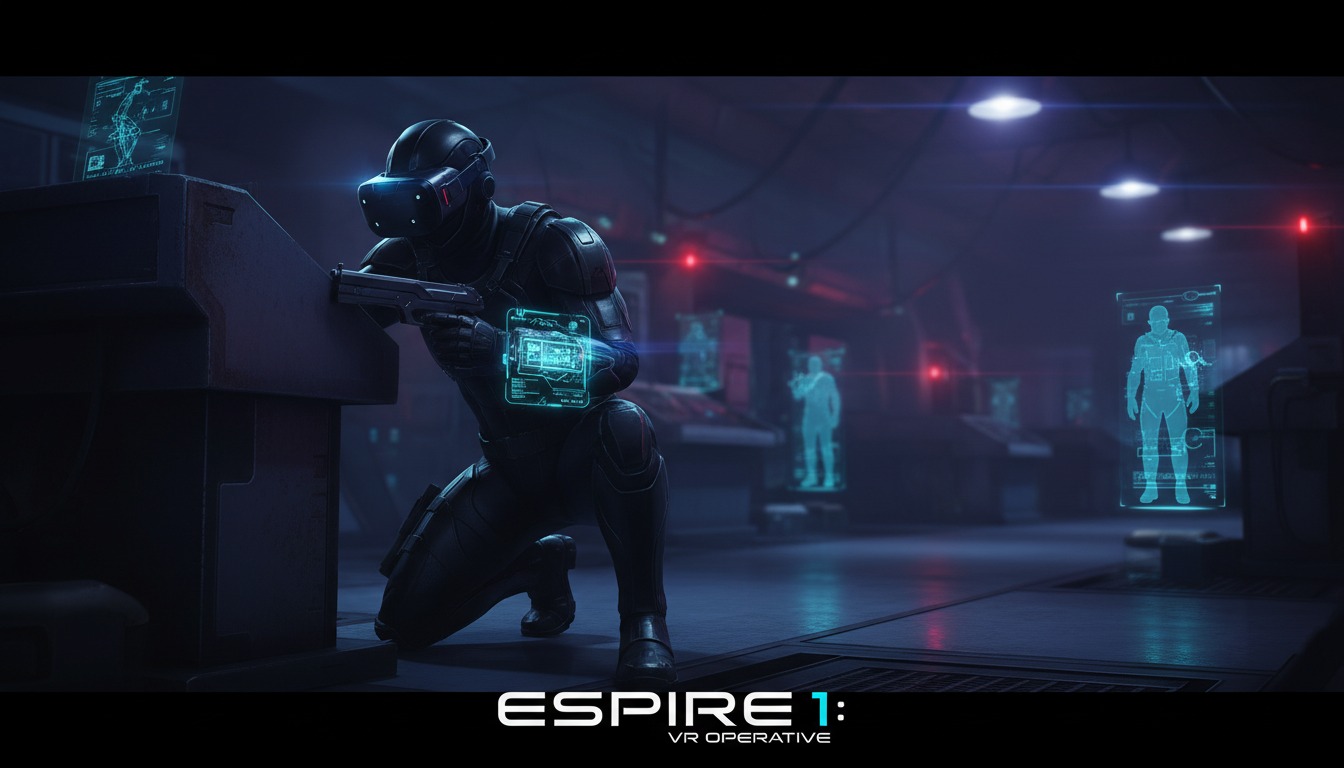
The first time you physically duck behind a crate, lean around the corner, and whisper “Freeze!” into your headset microphone while aiming a pistol at a guard’s head, you’ll understand exactly what Espire 1: VR Operative is trying to do. Digital Lode isn’t just porting a stealth game into VR. They’re trying to build one from the headset up, taking the fantasy of being a covert operative and mapping it to your actual body.
That fantasy is Espire 1’s greatest asset and its shield against its considerable flaws.
The premise is simple enough: you’re an Espire agent remotely piloting a robot infiltration unit through a series of facilities, tasked with sabotage, rescue, and quiet elimination. But the framing isn’t what matters. What matters is that nearly every stealth action is mapped to physical movement. Crouching means actually crouching. Leaning around cover means physically leaning. Climbing metallic surfaces requires reaching up, grabbing, and pulling yourself up hand-over-hand. Reloading means physically jamming your pistol down onto a magazine at your hip. It’s the most physically grounded stealth game VR has seen, and when it works, it feels like the genre finally has a native language in virtual reality.
The centerpiece is the “Espire Control” system — a comfort framing device that shrinks the world to a floating screen in your peripheral vision whenever you use artificial locomotion. The narrative justification is that you’re controlling the robot from a remote theater, but the practical effect is genuine: it dramatically reduces motion sickness without resorting to teleportation, letting smooth locomotion feel manageable even for newer VR users. You can still teleport if you prefer, or disable the theater entirely for full immersion, but the default approach is one of the smarter comfort solutions in the genre.
Voice commands round out the physical toolkit. Shouting “Freeze!” at guards can theoretically freeze them in place, adding a theatrical flair that no flat stealth game can replicate. Wrist-mounted cameras let you peek around corners without exposing your head. “Espire Vision” — activated by raising your hand to your temple — paints enemies and traps through walls. The gadget set is small but purposeful, and the physical gestures required to use them make you feel like you’re operating actual spy equipment rather than selecting from a menu.
But here’s the problem: the house that Digital Lode built these mechanics into is made of balsa wood.
The enemy AI is the most immediate betrayal. Guards will spot you through cover one moment, then walk directly past your outstretched legs the next. They’ll enter alert states for no discernible reason, or fail to react to gunshots in adjacent rooms. The inconsistency sabotages the careful planning that makes stealth rewarding. When you can’t trust the rules of detection, every crouch and corner-lean becomes a dice roll rather than a tactical choice. Several reviewers found themselves abandoning stealth entirely, opting for loud gunplay that the combat mechanics aren’t deep enough to support.
Performance is another chronic issue. Frame drops, texture pop-in, and occasional tracking hiccups plague both the PCVR and Quest versions. The Quest version takes a noticeable visual hit, with simplified geometry and muddier textures. Melee combat feels particularly unfinished — hit registration is spotty, and the lack of meaningful haptic feedback makes physical strikes feel like waving through fog. The voice command system, while novel, is unreliable enough that most players end up ignoring it after the first few failed attempts.
The story does the game no favors. What exists is generic military techno-jargon strung between missions, delivered with voice acting that ranges from passable to grating. You’re not here for the narrative, but the lack of compelling context means the campaign’s five-to-six-hour runtime eventually feels like a series of disconnected training exercises rather than an escalating espionage operation.
Despite all of this, Espire 1 is hard to dismiss completely. The core loop — physically infiltrating a space, tagging guards with your wrist camera, finding a ventilation shaft, climbing to an overhead position, and dropping silently onto a target — is genuinely satisfying in a way that no flat stealth game achieves. When the AI cooperates and the frame rate holds, the physicality of VR transforms stealth from a patience test into a body puzzle. You are the controller, and that integration is exactly what the genre needed.
Who should bother? VR stealth enthusiasts should absolutely try this. If you’ve been waiting for a game that treats your body as the input device, Espire 1 delivers that fantasy in fits and starts. Players with low tolerance for jank, inconsistent AI, or performance hitches should stay away — there are smoother VR shooters that won’t fight you at every turn. And if you’re new to VR and looking for a polished introduction, this isn’t it. The Control Theatre helps with comfort, but the overall roughness demands patience.
Espire 1: VR Operative is a first attempt from a small team swinging far above their weight class. It gets the fundamentals of VR stealth right in ways that matter — physical interaction, comfort innovation, and spatial immersion — while fumbling the execution on AI, performance, and polish. It’s not the definitive VR stealth experience. But it’s the first native VR stealth game that makes you believe that experience might actually exist someday.