
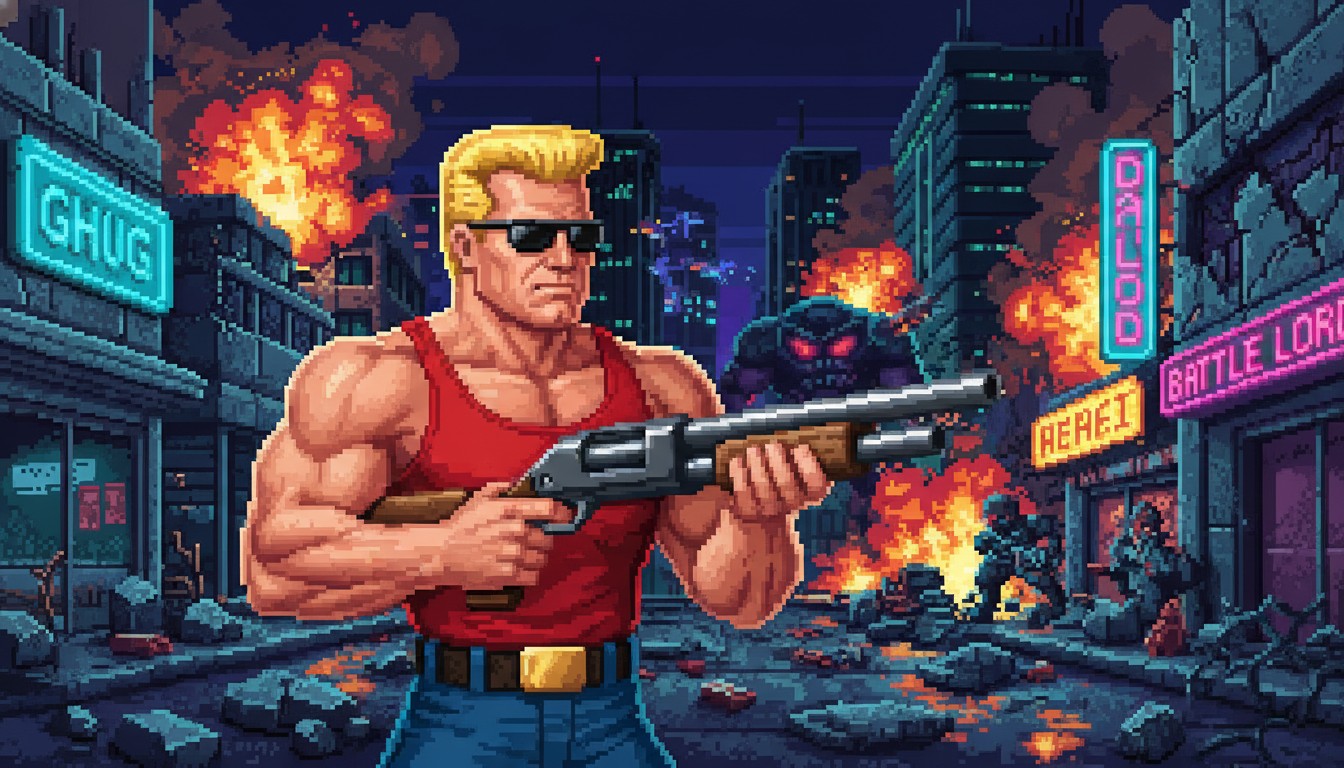
There’s a moment, about ten minutes into the first level, when Duke mutters “Damn, I’m looking good” at a bathroom mirror. In flatscreen, it’s a throwaway gag — a pixelated sprite winking at a pixelated reflection. In VR, you’re standing in that bathroom. You’re looking at yourself. And suddenly the question isn’t whether the level design holds up or whether the shotgun still feels good. It’s whether Duke Nukem’s entire personality — the cigar, the one-liners, the unapologetic 90s dude-bro swagger — can survive being worn like a headset.
Here’s the thing: it mostly does. And the way it does is through RazeXR, a standalone VR port of the Raze engine — itself a modern source port of the Build engine that powered the original 1996 release — built by the reliably excellent Team Beef. If you’ve played their QuestZDoom or Lambda1VR ports, you know what to expect: rock-solid 6DoF tracking, full motion controls, and a reverence for the source material that stops just short of being slavish.
What you’re actually getting
RazeXR is a native standalone Quest and Pico app, sideloaded via SideQuest. The download includes the shareware episode, so you can jump in immediately. To play the full game, you copy your DUKE3D.GRP file from a PC installation — Steam, GOG, whatever you own — into the headset’s razexr/raze/duke folder. The same RazeXR install also supports Blood, Shadow Warrior, Redneck Rampage, and Powerslave, so if you’re a Build engine completist, one setup unlocks a small library.
For PCVR users, the landscape is different. There is no standalone PCVR build of RazeXR — Team Beef has indicated they may consider one in the future, but for now, the Raze engine’s VR support lives on standalone headsets only. PCVR players who want Duke in VR should look at Serious Duke 3D, a total conversion mod for Serious Sam 3 VR: BFE that rebuilds Duke’s first episode in Croteam’s engine with 3D weapon models and redesigned levels. It’s a different beast — more of a reimagining than a port — and requires owning Serious Sam 3 VR. This article focuses on RazeXR as the primary path, but PCVR players should know the option exists.
How it plays
Team Beef’s standard control layout applies: left grip to run, right trigger to fire, right thumbstick for weapon selection, Y or B for the map. Weapons are motion-controlled, meaning you aim with your hands, not your face. The port runs at a stable frame rate even on Quest 2, and the sense of scale is immediately striking — the alien troopers that looked like action figures in 1996 now tower over you properly, and the larger enemies (looking at you, Battlelord) are genuinely intimidating when they’re filling your field of view.
The first thing that hits you is the speed. Duke Nukem 3D was built for keyboard strafing and mouselook at 30 frames per second. In VR, with smooth locomotion and instant head-turning, it moves fast. The jetpack levels in particular are a trip — suddenly you’re flying through corridors at ceiling height, looking down at enemies that used to be eye-level sprites. It’s exhilarating and, if you’re sensitive to smooth movement, potentially nauseating. Snap turn and comfort vignette options are available, but this is a game that wants you moving.
The sprite problem
Let’s talk about the thing everyone notices: the weapons are 2D sprites. In your hand, they look like flat photographs of guns, not objects in 3D space. Aiming still works — the 6DoF tracking is accurate — but there’s a persistent visual disconnect between the depth of the world and the flatness of the thing you’re holding. Enemies are also 2D sprites, which is less jarring since you’re looking at them, not holding them, but it does mean the game never fully resolves into a “modern” VR experience. Team Beef has discussed 3D weapon model support as a future update, but that’s hobbyist-timeline language. Don’t buy in expecting it.
This is the central tension of RazeXR. The engine is modern. The VR implementation is clean. The game underneath is a masterpiece of FPS design. But the visual layer is stubbornly, authentically 1996, and VR’s spatial depth makes that flatness impossible to ignore.
Does Duke hold up?
The surprising answer is yes, but differently than you’d expect. The one-liners — “Hail to the king, baby,” “Shake it, baby” — land with an odd intimacy in VR. You’re not watching Duke be a jerk; you’re inhabiting the jerk. The strip club level is genuinely uncomfortable in a way it never was on a monitor. The casual violence toward alien troopers feels more immediate. The game doesn’t become less problematic — it becomes more present.
But the level design shines. The interactivity, the secret walls, the verticality, the way every room has something to blow up or piss on — all of it translates beautifully to first-person exploration. Build engine games were always more spatially complex than their Doom-era contemporaries, and in VR, that complexity becomes tactile. You remember the layout of “Hollywood Holocaust” because you physically walked it.
The caveats
RazeXR’s shareware-first model is slightly awkward. You install the app, play the first episode, then dig out your GRP file from a PC copy to unlock the rest. It’s not difficult, but it’s a friction point. Add-on compatibility has also been reported as finicky — some expansion GRP files need repackaging to work correctly. And again: no native PCVR build. If you’re an Index or Vive owner, RazeXR isn’t an option unless you’re willing to buy a Quest.
The 2D sprites aren’t a dealbreaker, but they are a persistent reminder that this is a port, not a native VR redesign. Serious Duke 3D, for all its clunkiness and requirement to own a separate VR game, at least gives you 3D weapon models and modern geometry. RazeXR gives you the authentic original, warts and all, in properly tracked VR space.
Who this is for
If you owned Duke in 1996 and still remember the shareware episode by heart, this is probably essential. The speed, the attitude, the level design — it all works in VR in a way that feels like time travel with better tracking. If you’re a Quest owner looking for a fast, arcade-style shooter that isn’t another wave-based zombie gallery, RazeXR is an easy recommendation.
Skip it if you need modern visuals to enjoy VR. Skip it if you’re PCVR-only and don’t want to mess with the Serious Sam workaround. Skip it if Duke’s humor already made you roll your eyes — being inside it doesn’t make it funnier.
The bottom line? RazeXR is the best way to play Duke Nukem 3D in 2025, full stop. Not because it’s perfect — the 2D sprites, the Quest-only path, and the shareware friction are real limitations — but because the game underneath is that good, and the port is respectful enough to let it speak for itself. Duke’s personality is dated. His levels are not.