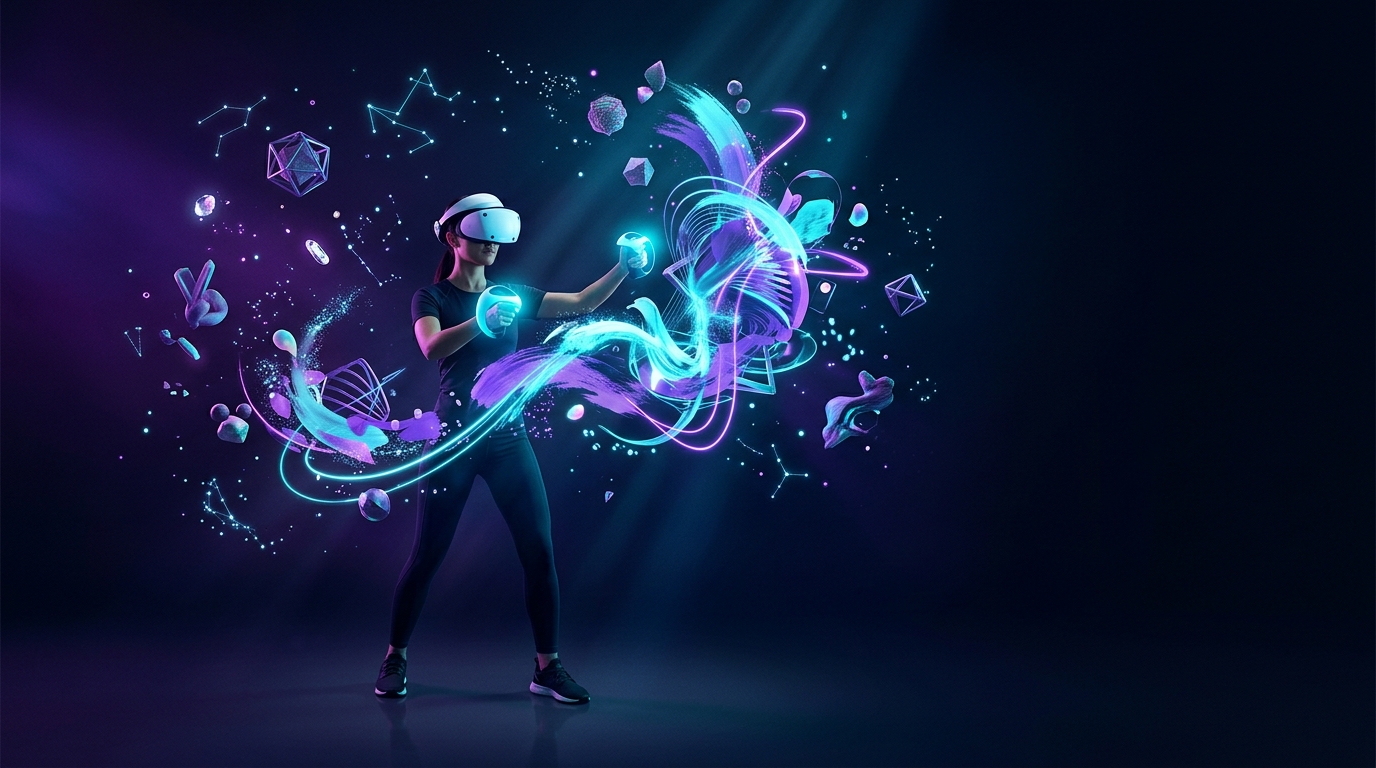
The first time you cup a virtual sculpture in your hands and rotate it to inspect an edge you just carved, Dreams VR makes sense. Not the platform, not the browser, not the 10,000 user-made fragments waiting in the Dreamiverse — the act of creation itself. Media Molecule built one of the most expressive digital modeling tools available on a console, and in VR it finally behaves the way your hands expect it to. The Move controllers become chisels and paintbrushes. You reach into the space in front of you and pull a shape out of nothing. That part works. That part works so well it almost excuses everything else.
Almost.
The VR Reality
Dreams launched as a PS4 creation platform in February 2020. Five months later, Media Molecule pushed the “Inside The Box” update — free for all owners — adding full PSVR support to every mode. Creation, browsing, playing: all of it functioned inside the headset. The studio even built a polished showcase experience called Inside the Box to demonstrate what was possible, a curated sampler of puzzle rooms, art galleries, and micro-games floating inside a mysterious cube.
The catch, and it is a significant one, is that Dreams is not a single game redesigned for VR. It is a platform where thousands of amateur and semi-professional creators uploaded their own projects, the vast majority built with no awareness that VR would ever exist. The VR update retroactively enabled headset support for all of it — the good, the bad, and the nausea-inducing.
This is an official hybrid in the truest sense. You do not buy a separate VR version. You do not install a mod. You plug in a PSVR headset, launch Dreams, and the game adapts. Media Molecule added comfort settings, teleport and smooth locomotion options, snap and smooth turning, adjustable vignette strength, and even a Cinema Mode fallback that kicks in automatically if a creation’s performance collapses. They thought about comfort seriously. They did not think they could quality-control the entire internet.
What It Feels Like to Use
Creation is where Dreams VR earns its keep. The flat version’s sculpting tools are already powerful, but mapping them to Move controllers in stereoscopic space removes the abstraction layer. You are not pushing a stick to rotate a camera around an object. You are standing inside your object, turning it with your wrists, adjusting scale by bringing your hands together or apart. The one-to-one correspondence between hand motion and tool response is the most credible thing about the entire VR package. Several experienced creators have noted that their sculpting improved in VR because spatial intuition replaced camera navigation.
The control scheme is not perfect. The Move controller’s button layout is idiosyncratic, and some creation workflows still favor the DualShock 4 despite the theoretical advantage of motion controls. But for pure sculpting and world-building, the VR mode is arguably the definitive way to use Dreams.
Playing other people’s content is a different story. The Dreamiverse in VR is a lottery. A well-optimized creation by someone who understood frame budgets and comfort can be magical — immersive galleries, clever spatial puzzles, scenes that only make sense when you are standing inside them. But the next dream you load might drop to Cinema Mode within seconds because the original PS4 cannot maintain the framerate. It might use smooth locomotion with no comfort options and no warning. It might have a camera that lurches unexpectedly. Media Molecule provided the tools for creators to tag their work and filter by comfort level, but compliance is voluntary and inconsistent.
Performance varies not just by creation but by hardware. On an original PS4 or PS4 Slim, Dreams VR struggles. Dynamic resolution scaling produces blurry visuals, complex scenes hitch, and the game regularly retreats to Cinema Mode to protect the player from stutter-induced discomfort. The PS4 Pro improves matters but does not eliminate the problem. The real upgrade is PlayStation 5. Through backward compatibility and Game Boost, the PS5 pushes Dreams much closer to a consistent, clear, smooth VR experience. The difference is reportedly dramatic — higher resolution, better framerate stability, fewer Cinema Mode intrusions. If you are considering Dreams VR and you own a PS5 with the original PSVR headset, the calculus changes significantly. If you are on a launch PS4, the friction may outweigh the reward.
The Tradeoffs
The strengths are concentrated and real. No other console platform offers this volume of free, user-generated VR content. No other tool lets you sculpt, paint, animate, and publish a playable VR experience from the same device you experience it on. Media Molecule’s own Inside the Box showcase proves the engine can deliver polished, comfortable, visually striking VR when the content is designed for it.
The weaknesses are structural. The platform is only as good as its community’s output, and the community was never required to optimize for VR. Live support from Media Molecule ended in September 2023, meaning no future patches, no PSVR2 upgrade path, no continued quality-of-life improvements. What exists now is what will exist. For a platform built on ongoing creation and curation, that matters.
Tracking issues with PlayStation Move controllers — drift, lighting sensitivity, reflective surface interference — are hardware-level problems that Dreams inherits rather than causes, but they surface here because the game asks you to make precise three-dimensional motions for hours at a time. If your tracking environment is imperfect, creation sessions become frustrating.
Who Should Step Inside
Dreams VR is for two specific people. The first is anyone who already owns Dreams and a PSVR headset. The update is free. The creation tools are genuinely better in VR. There is no reason not to try it, particularly if you have a PS5.
The second is the creative type who wants to build 3D worlds and does not want to learn Blender or Unity. Dreams VR is the most accessible end-to-end VR creation pipeline on a console. You can sculpt in the morning, publish by afternoon, and watch someone else play it that evening. That loop is unique.
It is not for the VR player seeking a curated, consistently comfortable library of experiences. It is not for anyone expecting PSVR2 support. It is not for the player with a base PS4 and low tolerance for performance inconsistency. And it is not for someone who wants a living, growing platform — Dreams in VR is a preserved snapshot of what its community built between July 2020 and September 2023.
That snapshot contains real brilliance. It also contains a lot of blurry, uncomfortable experiments that should have stayed on a flat screen. Walking into the Dreamiverse with a headset means accepting both outcomes. For the right person, the highs are worth the filtering. For everyone else, Dreams remains a fascinating flat platform that happens to have a VR mode attached — sometimes excellent, often uneven, and now permanently finished.