
The first thing you need to understand about Downward Spiral: Horus Station is that it was built for VR before it was built for anything else. In 2018, when most developers were bolting motion control support onto flat games and calling it a day, 3rd Eye Studios — a team of veterans from Remedy and Moon Studios — went the opposite direction. They built a zero-gravity space station thriller where the very act of moving around is the point, then added a flat-screen mode almost as an afterthought. The result is one of the most comfortable and intuitive zero-G locomotion systems available in PCVR and PSVR, wrapped around a game that never quite figures out what to do with its best idea.
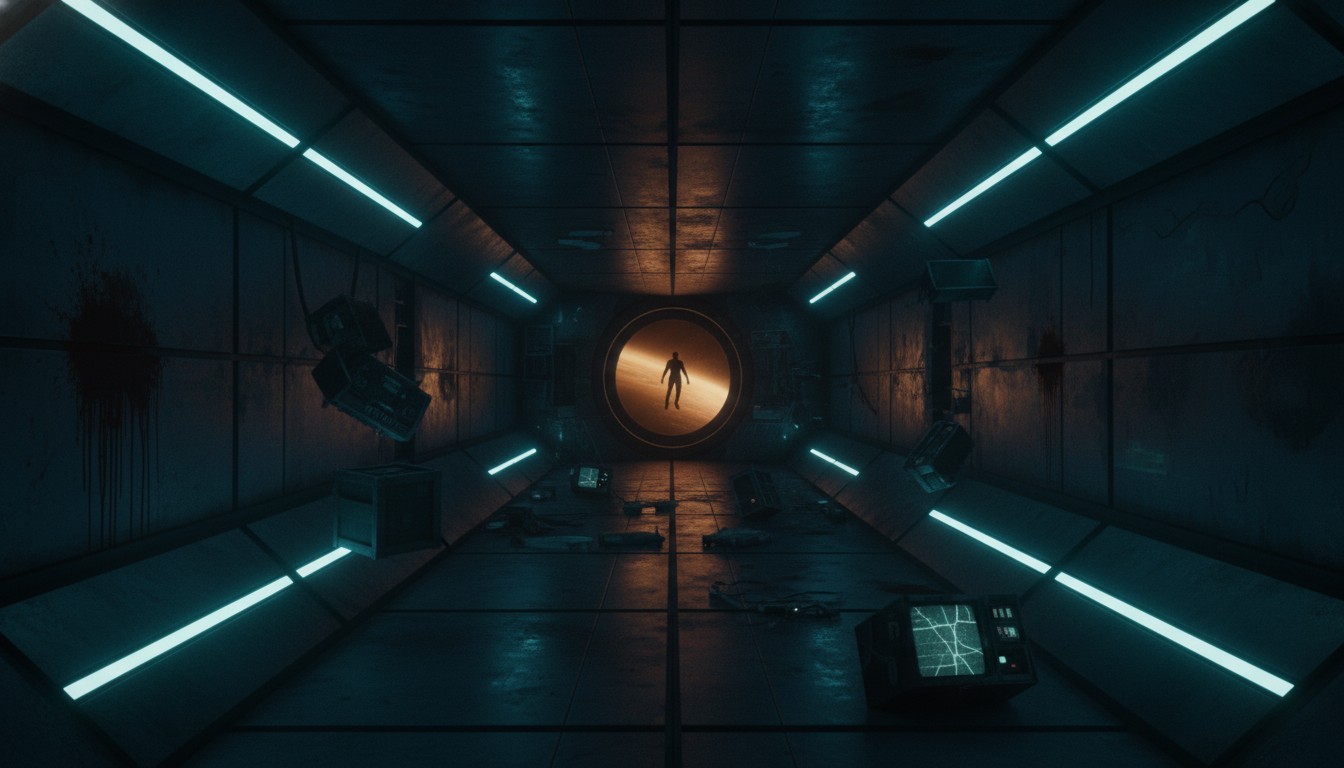
You play as a lone survivor exploring the abandoned Horus Station, a massive orbital facility whose human crew was wiped out by their own military drones. The story is told entirely through environmental cues: bloodstains on walls, frozen corpses drifting in corridors, flickering CRT terminals, and the occasional unsettling vision of the orange planet below. There is no dialogue, no cutscenes, no audio logs spelling out what happened. Multiple independent reviews note this approach creates genuine atmosphere — the kind of lonely, oppressive dread that makes VR’s inherent isolation work for it rather than against it. The environmental storytelling evokes comparisons to 2001: A Space Odyssey and Alien, and for long stretches it works. But the consensus across sources is equally blunt: the narrative remains thin. You piece together that something catastrophic happened, yet the details stay vague, and the station rarely rewards your close inspection with revelations that justify the effort.
Where the game undeniably succeeds is movement. Instead of artificial thumbstick locomotion, you propel yourself by grabbing surfaces and pushing off, exactly as actual astronauts maneuver in zero gravity. A grappling hook tool lets you reel yourself toward distant anchor points when arm-strength alone won’t close the gap. In VR with motion controllers — Vive wands, Touch controllers, PS Move, or Index knuckles — this feels immediately tactile and intuitive. Left hand snags a railing, you push off, drift through the void, catch a wall with your right hand, reorient, push off again. Reviewers across PCVR and PSVR consistently praised this system as surprisingly comfortable even for players normally prone to motion sickness. The physical act of grabbing and pushing creates just enough proprioceptive feedback to keep your brain anchored, unlike pure analog-stick zero-G games that often feel like nausea simulators with a sci-fi skin.
The issue is what waits at the end of each drift.
The campaign splits into two distinct modes. “Engage” adds combat against hostile drones using improvised tools — bolt throwers, arc welders, rail guns, magnetic grapples — that double as station repair equipment. “Explore” strips out every hostile entirely, leaving environmental puzzles and pure atmospheric traversal. This is not a difficulty toggle; it is a fundamental identity split, and it exposes the team’s uncertainty about whether they were making a shooter or a zero-G walking simulator. The combat in Engage mode is widely described as repetitive and uninspired. Enemy drones offer minimal tactical variety, and the makeshift weapons lack the punch, feedback, and enemy reaction to make encounters satisfying. Several reviews noted that after the initial novelty of firing a rail gun while floating upside-down wears off, the fights become interruptions that break the pacing rather than engagements that earn their place.
Explore mode, by contrast, leans into what the game genuinely does well: letting you float through a meticulously detailed, Kubrick-inspired space station while an electronic ambient soundtrack composed by Ville Valo — yes, the HIM frontman — shifts between haunting stillness and rhythmic tension. In this mode, Downward Spiral becomes a four-to-five hour zero-G sightseeing tour, and that is arguably its most honest form. The co-op support extends to both modes, allowing two players to tackle the entire campaign together online. Multiple sources suggest the co-op experience improves the atmosphere simply by adding another human presence to the lonely station, though organizing a session today may require planning ahead.
The multiplayer offerings beyond the campaign are technically present but functionally questionable. The game launched with eight-player PvP and PvE modes including Deathmatch and Horde, but with 3rd Eye Studios having moved on to other projects and the active community now sparse, finding populated lobbies through matchmaking is unlikely. The infrastructure remains for organized groups, but do not buy this for the multiplayer.
On the technical side, the VR implementation is polished and native. PCVR support through Steam covers Vive, Rift, Index, and WMR in a single purchase with full motion controller implementation. The PSVR version, released in September 2018, plays best with two Move controllers for independent hand control, though DualShock fallback is available. Performance is moderate and predictable on Unreal Engine 4; the environments are detailed without being demanding by modern hardware standards. Stability is reliable — this is a shipped, finished product rather than a mod or framework experiment, and no widespread reports suggest VR-specific crashes or major bugs.
The flat-screen version exists, but every available source agrees it is the inferior way to experience the game. The zero-G traversal loses its tactile satisfaction with a mouse and keyboard, and the atmospheric dread that thrives inside a sealed headset collapses into just another dark corridor on a monitor. If you are considering this title, the question is not whether to play it in VR — it is whether the VR traversal and atmosphere justify the purchase despite the thin storytelling and repetitive combat.
For VR enthusiasts who value locomotion innovation and atmospheric exploration over tight scripting and polished gunplay, the answer is a qualified yes. Play Explore mode first, treat Engage as a curiosity, and bring a friend for co-op if you can. For players seeking a narrative-rich sci-fi thriller or a mechanically satisfying shooter, this abandoned station holds more promise than payoff. It remains a remarkable zero-G sandbox in search of a better game to fill it.