
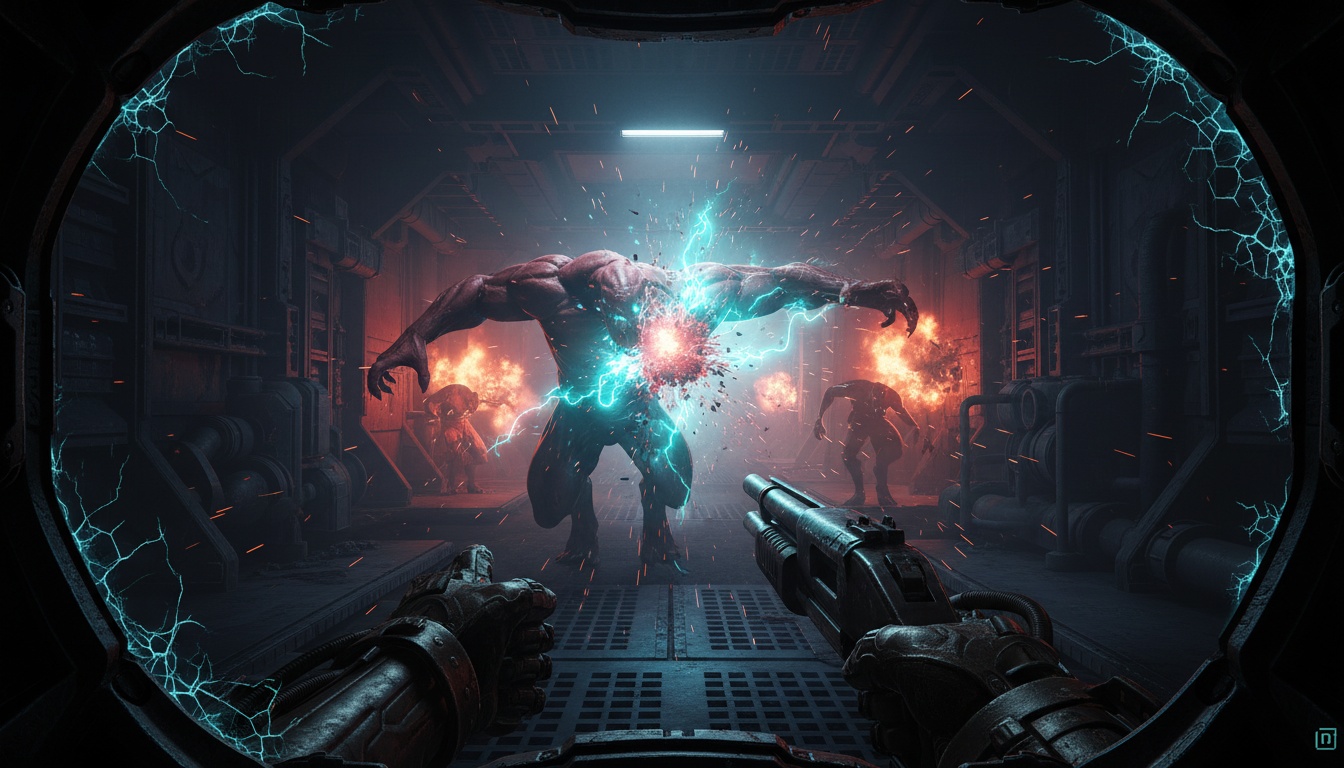
The first time you teleport through a charging pinky and watch it erupt in a shower of gore and health pickups, you understand the central gamble of Doom VFR. id Software did not port Doom 2016 into a headset. They built a new game around a single, violent idea: that moving in VR should be as aggressive as shooting.
Released in December 2017 for PSVR and later for PCVR via Steam, Doom VFR is an official standalone VR title — not a mod, not a hybrid patch, not a repurposed flat campaign. You play as Dr. Abraham Peters, a UAC scientist killed during the demon invasion of Mars whose consciousness is uploaded into a cybernetic combat chassis. Your mission is stabilizing the facility while the Doom Slayer handles the larger crisis elsewhere in the timeline. The game borrows weapons, demons, and environmental assets from Doom 2016, but the mechanics are rebuilt for headsets.
Movement is the defining feature. The default system combines teleportation with a short dash, and when you trigger a teleport the world slows to a crawl, giving you a breath to aim or plan an escape. Weakened enemies can be “telefragged” by teleporting directly into their hitbox, which acts as Doom VFR’s equivalent of glory kills and drops health and ammo. It is a tactical, spatial mechanic that only works in VR, and when it clicks it feels like a proper evolution of Doom’s aggression rather than a compromise.
When everything aligns, Doom VFR delivers something no other official VR shooter has replicated. The super shotgun racking in your virtual hands has physical weight. The BFG’s charge hum vibrates through the room. An imp at true scale is more unsettling than any flat-screen equivalent. The arenas are compact but chaotic, forcing constant repositioning through teleport-dashes while tracking multiple threats.
On PCVR with smooth locomotion properly enabled, the game approaches the speed and fluidity of its flat inspiration. On PSVR, the experience depends entirely on your controller choice. The DualShock 4 provides full smooth locomotion but ties aiming to head tracking, which feels alien until it doesn’t. The PSVR Aim Controller offers the most immersive gun-handling but suffers from stiff implementation — guns clip through your face when aiming down sights, and the off-hand grenade hovers disconnected from your controller. PlayStation Move controllers are the worst option, forcing teleportation-only movement with a baffling button layout and no smooth turning.
The PCVR version is visually cleaner, with sharper textures and more stable tracking, but it introduces its own friction. Smooth locomotion and smooth turning are buried or broken by default. Many players need to load community controller bindings in SteamVR or edit configuration files to get basic right-stick functionality. The game holds a “Mixed” rating on Steam largely because of this control barrier, not because the underlying combat is poor.
Weaknesses stack quickly beyond controls. The campaign lasts roughly three hours. The chainsaw is missing entirely. The narrative is a thin excuse to shuffle you between combat rooms. The levels feel like recycled Doom 2016 set pieces rather than purpose-built VR spaces. And critically, there is no PSVR2 backwards compatibility — the game remains locked to the original PSVR hardware, playable on PS5 only through legacy support.
Doom fans with patience and a PCVR headset will find a unique, brutal arcade shooter hidden behind a layer of control-tinkering. The telefrag system alone is worth experiencing for anyone interested in how VR can rethink combat movement. If you refuse to remap controllers or expect a full-length campaign with modern polish, this is not your game. PSVR owners without an Aim Controller or a high tolerance for teleportation-heavy design should look elsewhere.
Doom VFR is id Software’s fascinating, flawed experiment in translating Doom’s soul into VR. Its combat sparkles when the controls cooperate, but the control friction, short length, and lack of modern platform support make it a curiosity rather than a classic. Play it for the telefrags, not for the legacy.