
Doom 3 BFG VR: Fully Possessed — A Pioneer That Still Haunts
The VR conversion that helped define what a “full game mod” could be, back when the concept barely existed.
The First Dark Corridor
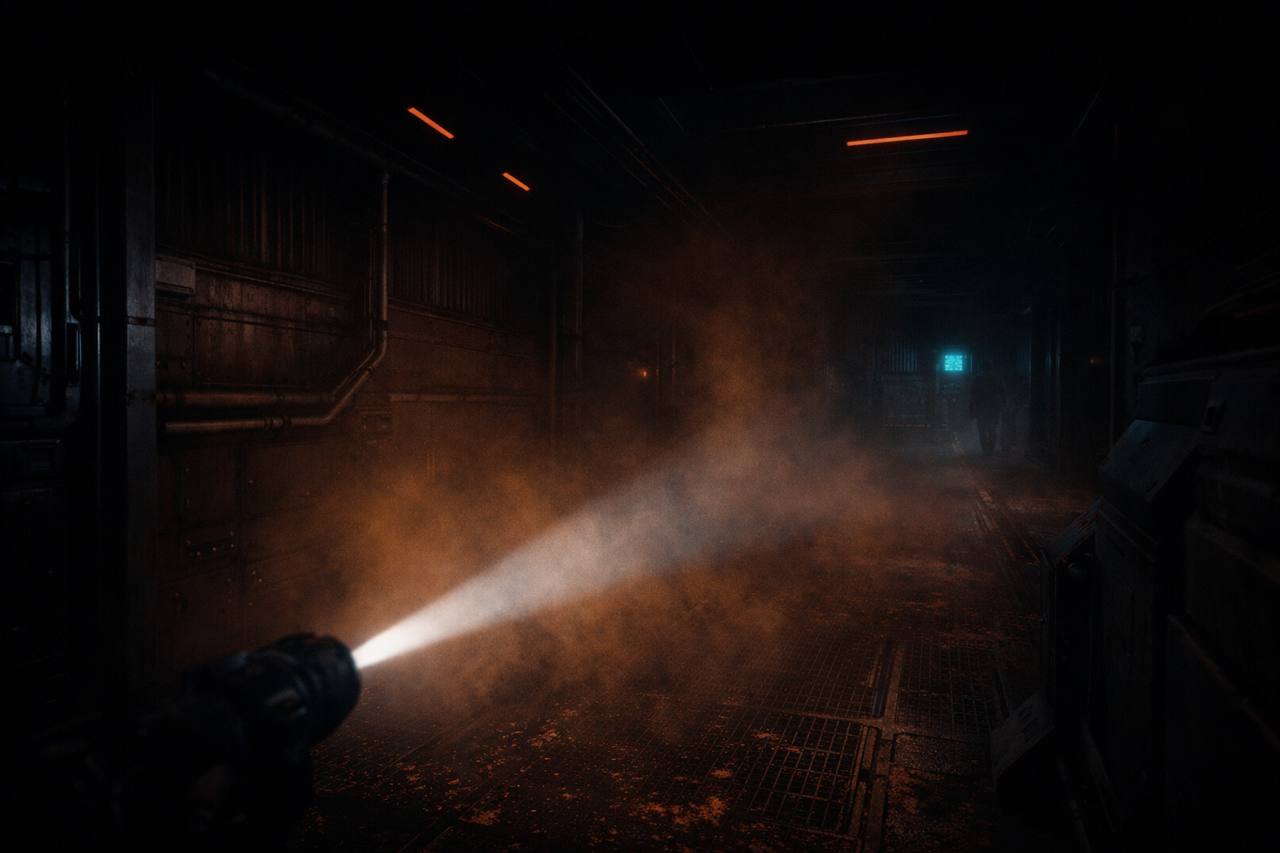
When you first step into Mars City in virtual reality, flashlight gripped in your left hand, pistol in your right, the transformation is immediate. The famous opening—walking through dimly lit corridors, hearing distant machinery hum, catching your first glimpse of something wrong in the shadows—lands differently when you’re actually standing there. The walls press in. The ceiling feels lower. And when the lights fail and you’re left with nothing but your flashlight beam cutting through the darkness, Doom 3’s deliberate, oppressive design becomes something it never was on a flat screen: genuinely terrifying.
This is the promise of Doom 3 BFG VR: Fully Possessed. It takes a game remembered mostly for technical controversy—too dark, too many jump scares, too different from classic Doom—and reveals that underneath, there was always a perfectly serviceable horror experience waiting for the right medium. VR was that medium.
What This Is — And Why It Matters
Doom 3 BFG VR: Fully Possessed is a full VR conversion mod, not an injection driver. The distinction matters. This isn’t a wrapper that hooks into an existing game and translates inputs—this is Doom 3 BFG’s source code, forked from the open-source RBDOOM-3-BFG project and rebuilt with native VR support. It runs its own renderer, its own input pipeline, its own stereoscopic view. When you’re standing in a Martian research facility watching a zombie lurch toward you through the visor of a headset, you’re looking at code that was written specifically for that moment.
The mod first appeared in March 2017, developed primarily by KozGit (Samson) with significant contributions from Carl Kenner. That date matters. The original Consumer Rift and Vive had launched less than a year prior. The “killer app” VR game library consisted of short tech demos, arcade experiences, and experiments. MotherVR—often cited as the landmark full-game VR mod—wouldn’t appear until months later. Doom 3 BFG VR: Fully Possessed was, for many early adopters, the first time they experienced a complete, campaign-length shooter designed from the ground up for motion controls and room-scale play.
In a space where VR conversions were often rough, janky proof-of-concepts, Fully Possessed released with features that would define the “proper VR port” for years: independent weapon and flashlight control, holster slots for physical weapon management, full room-scale support, and a surprisingly deep suite of comfort options. It wasn’t just making Doom 3 playable in VR—it was asking what Doom 3 should be in VR.
The Experience: Darkness Made Tangible
Atmosphere and Lighting
Doom 3’s infamous flashlight mechanic—that you can’t hold a weapon and a flashlight simultaneously—was widely criticized as artificial difficulty on a monitor. In VR, it transforms into something profound. Standing in a pitch-black corridor, you make the choice consciously: weapon raised and ready, but blind to what’s ahead, or flashlight out and vulnerable. The tension isn’t manufactured. It’s architectural.
The mod preserves the original lighting engine, which means dynamic shadows cast by your flashlight behave correctly. Point it at a doorway and shadows stretch away from the frame. Sweep it across a room and shapes resolve and collapse. In VR, this becomes genuinely unsettling. Something moves in your peripheral vision. You swing your light. Nothing there. Was it your imagination? A texture pop-in? Or something that retreated into the dark just before your beam arrived?
This is Doom 3’s design working exactly as intended, but now your body is there. You’re not watching a marine on a screen walk through Alpha Labs. You’re the marine. And you can feel how exposed you are.
Motion Controls and Physical Presence
The weapon handling feels good. There’s a weight to the aiming, a solidity to pointing your pistol down a corridor or hefting the shotgun. The independent control of your flashlight—held in your off hand—creates a natural tactical awareness. You can sweep for threats while keeping your weapon ready, just like in every flashlight-horror movie you’ve ever seen.
The holster system is a small touch that compounds. Weapons don’t disappear into an inventory wheel. You reach behind your shoulder to grab the next gun, or to your hip for your sidearm. The flashlight can be holstered on your chest or mounted to your head or weapon via options. These aren’t required interactions, but they create a physical relationship with your loadout that feels natural within minutes. You’re not selecting from a menu. You’re reaching for a tool.
Grenades deserve special mention: you hold the trigger, physically swing your arm, and release. The arc and force follow your motion. It’s simple, intuitive, and exactly how throwing should work in VR. The fact that this was implemented in early 2017, when many developers were still figuring out basic grabbing mechanics, speaks to the care that went into the conversion.
Voice Commands — An Oddly Perfect Fit
One of the most surprising features is voice command support. You can say “flashlight” to toggle your light, “reload” to reload, or call out weapon names—“shotgun,” “plasma gun,” “BFG”—to swap. It sounds gimmicky on paper. In practice, it’s surprisingly natural.
This isn’t a modern AI-powered voice system. It uses Windows Speech Recognition, which means you need to train it for accuracy. But once configured, calling out “shotgun” in the middle of a firefight while your hands are busy feels genuinely useful. There’s also the ability to “talk” to NPCs by simply speaking when you approach them—an immersive touch that’s more novelty than necessity but adds to the sense of presence.
Flicksync — Ready Player One Mode
There’s a feature called Flicksync, inspired by Ernest Cline’s Ready Player One. You select a character and act out the game’s cutscenes, speaking your lines at the right moments. It’s scored for accuracy, timing, and clarity. It’s a novelty mode, clearly labeled as experimental, and it’s the kind of thing that only exists because someone thought “wouldn’t it be cool if—” and then actually built it.
Is it essential? No. Is it charming? Absolutely. It’s the kind of feature that doesn’t need to exist but makes the whole package feel like a labor of love rather than a technical exercise.
The Complete Package — And What’s Included
It’s worth being clear about what you’re getting. Doom 3 BFG Edition includes not just the Doom 3 campaign but also the Resurrection of Evil expansion and The Lost Mission, plus the classic Doom 1 and Doom 2 (accessible through in-game terminals in VR). This is a lot of content. The VR conversion applies fully to Doom 3’s main campaign and expansions. Doom 1 and 2 run on a virtual screen within the game—playable but not a full VR conversion.
For anyone measuring content hours against dollars spent on the base game (Doom 3 BFG Edition is routinely on sale for a few dollars), Fully Possessed represents exceptional value. You’re getting dozens of hours of fully playable, feature-rich VR content for free, assuming you already own (or cheaply acquire) the source game.
Comfort Options — Ahead of Their Time
The comfort settings are extensive. Snap turning, smooth turning, teleportation, smooth locomotion, FOV reduction (a vignette effect during movement), slow-motion movement—these are all adjustable. You can play standing, seated, or with room-scale walking. The options acknowledge that VR comfort is personal, that what works for one player might make another sick, and that the only right answer is a menu full of toggles.
This philosophy—that VR conversions need robust comfort systems, not just one default mode—wasn’t universal in early VR mods. Fully Possessed approached it seriously. The result is a mod that can accommodate a wide range of preferences and tolerances.
Limitations and Caveats
Dated Design
Doom 3 itself is a product of 2004 game design. The corridors are linear, the encounters are heavily scripted, and the horror relies on jump scares. Players raised on modern immersive sims or open-world design will find the structure constraining. In VR, these limitations become more apparent. You can’t lean around corners to peek—the game doesn’t support it. You can’t physically interact with most objects. The world is detailed but static.
The flashlight mechanic, while powerful in VR, still imposes the same design constraints. Some sections are designed to be dark in a way that’s frustrating rather than atmospheric, requiring you to swap between light and weapon constantly. In VR, this is more immersive but also more exhausting.
Basic Body Presence
The mod includes body and arm IK (inverse kinematics), but it’s rudimentary. The developer documentation describes it as “extremely basic” and notes that poses often look incorrect. For some players, seeing a mismatched arm bend in a way that doesn’t match their own is distracting enough to break immersion. The options thoughtfully allow you to disable the body entirely, showing just hands and weapons. It’s a sensible compromise.
The Maintenance Question
The original KozGit development appears to have stopped around 2017, leaving features like dual-wielding and environmental object interaction partially implemented. However, a community fork by NPi2Loup has continued maintenance, fixing bugs, improving controller support, and merging features from the original unreleased updates. As of this writing, the fork remains the recommended way to play.
The continued community work means the mod is not abandoned, but it is no longer in active feature development. What you see is what you get. The features that were “being worked on”—like manual reloading animations or picking up objects—remain incomplete. What’s there is substantial and stable, but the vision wasn’t fully realized.
Setup Complexity
This is a source-engine-style mod installation. You need to own Doom 3 BFG Edition on Steam, download the mod, run an installer that places files in the correct directories, and configure your VR setup. It’s not drag-and-drop. The community has produced guides, and the process is well-documented, but it’s more friction than a native VR title. For players comfortable with file systems and configuration menus, it’s manageable. For players who expect a one-click install, it will require patience.
Performance is generally solid on mid-range and higher hardware. The underlying game is from 2012 (itself a remaster of 2004’s Doom 3), and while the VR conversion adds overhead, it’s not demanding by modern standards. The more significant variable is VR runtime compatibility—SteamVR and Oculus SDK are both supported, but specific headset and controller combinations may require adjustment.
The Historical Lens
To understand what Fully Possessed represents, you have to remember what VR was in early 2017. The first consumer headsets were months old. Valve’s The Lab was still new. Google Earth VR had just launched. The notion that you could take a complete, campaign-length shooter and convert it to VR with motion controls, room-scale support, and a full feature set was, if not unheard-of, then at least unproven.
Fully Possessed helped establish that “full game conversion” was possible. Not just a VR mode for an existing game, not just a proof-of-concept, but a substantial, playable experience that treated VR as a first-class platform. It wasn’t alone—others were experimenting in parallel—but it was one of the earliest, and it released with a depth of features that many mods still don’t match today.
The comparison to MotherVR is inevitable. MotherVR, which began releasing later in 2017, approached Alien: Isolation with similar ambition: take a flat game that had unused VR support and restore it with modern features. Both mods share the philosophy that VR conversions deserve more than just stereoscopic rendering. They deserve thoughtfully designed interactions, comfort options, and features that acknowledge the medium’s unique demands.
Fully Possessed went further in some areas. Voice commands. Holster slots. Full-body presence. A Flicksync mode for players who wanted to engage with the story in a different way. It was ambitious, maybe over-ambitious, and some features remain incomplete. But the scope of the attempt matters.
Why It Still Matters
For players who’ve never experienced Doom 3 in VR, the question isn’t academic. This is a playable, substantial mod that transforms a divisive game into something more effective than it ever was on a monitor. The horror works better. The tension works better. The flashlight-and-weapon dynamic isn’t a gimmick anymore—it’s a survival strategy that you feel in your hands.
For players interested in VR modding history, Fully Possessed is a landmark. It represents a moment when hobbyist developers looked at the promise of VR and decided they weren’t going to wait for official support. They were going to build it themselves, and they were going to do it right.
The fact that development halted before completion is a limitation, not a condemnation. What’s there is substantial, stable, and playable end-to-end. The community fork ensures it runs on modern hardware. The features that shipped are enough to make this one of the most complete VR conversions of any full-length campaign game.
The Verdict
Tier: A
Doom 3 BFG VR: Fully Possessed remains, years after its initial release, one of the most impressive VR conversions ever made. It transforms a game that was merely good into something memorable. It does so with a level of care and ambition that few mods achieve. And it’s free, requiring only a copy of Doom 3 BFG Edition—a game that routinely sells for under five dollars.
If you own a PC VR headset and haven’t played this, you should. Not because it’s historically significant (though it is), and not because it’s a technical achievement (though it was). Play it because it’s genuinely good. Because standing in a dark Martian corridor with a flashlight in one hand and a pistol in the other, listening to something move in the shadows you can’t see, is an experience that flat-screen gaming simply cannot deliver.
The mod isn’t perfect. The game isn’t perfect. But together, they achieve something that’s greater than either would be alone. That’s the best outcome a conversion can hope for.
Quick Reference
Platform: PC VR (SteamVR, Oculus SDK)
Input: Motion controllers (full support), gamepad, keyboard/mouse
Source Game: Doom 3 BFG Edition (Steam) — routinely on sale for under $5
Content: Doom 3 campaign + Resurrection of Evil + The Lost Mission. Doom 1 & 2 accessible via virtual screen.
Setup: Installer-based. Requires file management. Well-documented by community.
Performance: Efficient on modern hardware. Mid-range and above recommended.
Developer: KozGit (Samson) with contributions from Carl Kenner and others
Community Fork: NPi2Loup — continues maintenance and bug fixes
Cost: Free mod (requires base game)
Last updated: March 2026