
Donkey Kong Jr. VR
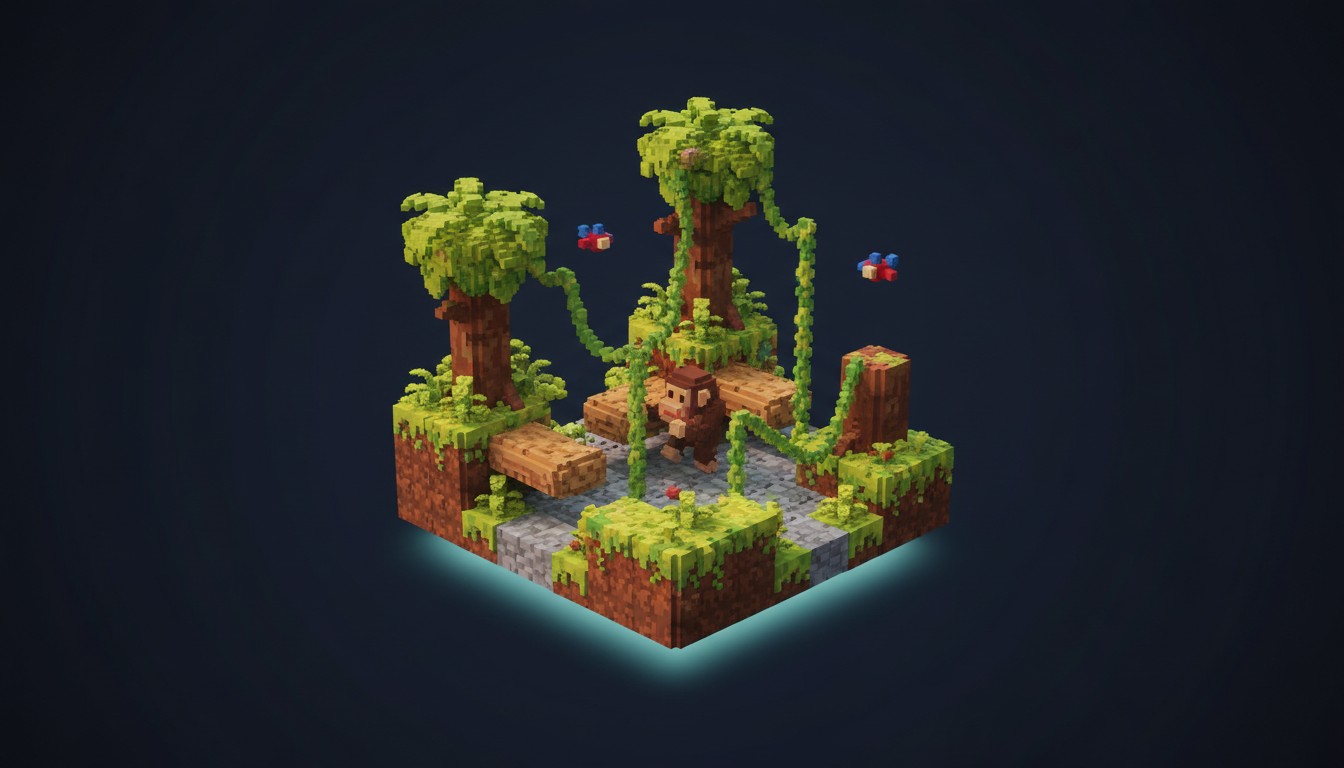
The first time I saw Donkey Kong Jr. floating in three dimensions, I just stood there and stared. Not at the gameplay — at the leaves.
Every sprite from the 1982 original has been pulled apart and rebuilt as a tiny voxel sculpture. The vines you climb have thickness. The platforms cast shadows. The birds that used to be four flat pixels now have little wingbeats you can see from the side. It’s like someone opened a dusty shoebox of childhood memories and turned the contents into a miniature world you can walk around inside.
That’s the 3dSenVR treatment, and for Donkey Kong Jr. it lands with surprising emotional weight. This isn’t a full remake. It’s the exact NES ROM running under the hood — same timing, same physics, same enemy patterns — but the visuals have been hand-translated into a 3D diorama that wraps around you. The result sits somewhere between playing a game and visiting a museum exhibit.
Four Stages and a Whole Lot of Charm
Look, I’m not gonna lie: Donkey Kong Jr. is short. Four looping stages, and a skilled player can burn through them in under fifteen minutes. The NES version doesn’t have the arcade difficulty curve that made the original a quarter-muncher. What it has is pure, distilled platforming — climb vines, dodge birds, grab keys, rescue your dad from Mario. (Yes, Mario is the villain here. The 1982 writers had range.)
In VR, that simplicity becomes part of the appeal. There’s no complex camera to wrestle with, no motion sickness from artificial locomotion — you’re looking at a diorama from a comfortable angle while the game plays out in front of you. The camera is static, the perspective is stable, and your only job is to appreciate how much care went into the conversion.
3dSenVR lets you zoom, rotate, and even lean into a first-person view if you want to see what the world looks like from Junior’s perspective. You shouldn’t — the first-person angle breaks the readability of a game designed for side-view platforming — but the option is there. Most people find a sweet spot about two feet back from the “screen,” where the 3D depth is pronounced but the action stays readable.
What the Framework Actually Does
3dSenVR isn’t a mod for Donkey Kong Jr. It’s an emulator framework that supports over a hundred NES titles, each with a hand-crafted voxel profile. The developer at Geod Studio didn’t just run the game through an upscaler. They rebuilt every visual element in 3D — the vines, the snapjaws, the chains, the fruit you drop on enemies — while leaving the logic and collision detection completely untouched.
That matters because it means the game plays exactly like you remember. The two-vine climb boost still works. The timing on dropping fruit is still pixel-perfect. But when you drop that fruit, it falls through 3D space and smashes into a voxel enemy with little bits of geometry flying around. It’s the same moment, but the presentation makes it feel new.
The framework also adds modern conveniences that the 1982 original never had. Quick save and load. Rollback if you mistime a jump. Fast-forward if you’re grinding for a better score. These aren’t transformative, but they remove the friction that keeps a lot of people from revisiting brutally hard arcade games.
The Caveats You Need to Know
You have to bring your own ROM. 3dSenVR doesn’t include any game files, which means you’re responsible for sourcing a legal copy of the Donkey Kong Jr. NES ROM. For most people that means buying it on the Nintendo eShop, extracting it, or using a homebrew dump of a cartridge they already own. The emulator has a ROM import system that’s functional but not elegant — the UI has been described as “rough around the edges” by users who otherwise love the experience.
And then there’s the value question. 3dSenVR costs $25. Donkey Kong Jr. is maybe twenty minutes of content. If this is the only game in the library that interests you, the math doesn’t work. The real value is in the catalog — Super Mario Bros., Metroid, Zelda, Contra, Punch-Out!!, DuckTales — and the knowledge that more profiles are still being added. But if you’re only here for Junior, you’re paying a lot for a short nostalgia trip.
Performance is a non-issue. NES emulation with voxel rendering runs on a GTX 960 and doesn’t break a sweat on modern hardware. Comfort is equally straightforward — no motion sickness, no intense moments, no stress on your system or your stomach.
Who Should Climb In
This is for retro enthusiasts first. If you have fond memories of the NES era and a headset gathering dust, 3dSenVR is one of the most creative uses of VR for classic gaming. It’s not a replacement for native VR platformers like Moss or Astro Bot — those were designed for the medium. This is something stranger and more specific: a time machine that lets you walk around inside a game you already loved.
For everyone else, the appeal is harder to justify. If you don’t already care about Donkey Kong Jr., a fifteen-minute voxel conversion isn’t going to change your mind. And if you’re looking for a meaty VR platformer with modern design, this is the wrong zip code entirely.
But if you’re the kind of person who gets genuinely excited about seeing a forty-year-old arcade cabinet reborn in立体像素? There’s nothing else quite like it. The leaves really are worth staring at.