
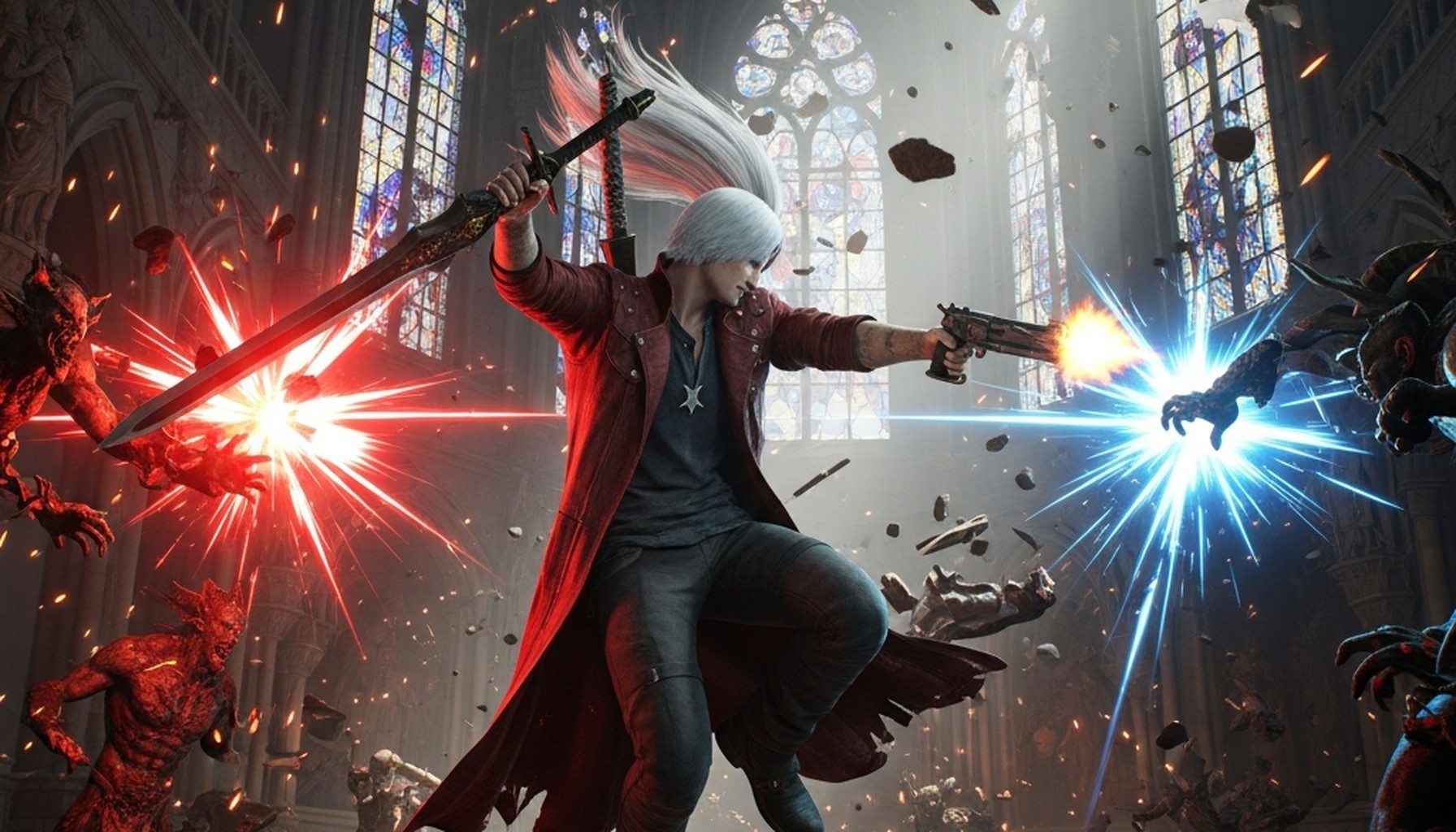
Devil May Cry 5 in VR: Stylish From the Front Row, Not the Driver’s Seat
Devil May Cry 5 is one of the highest-rated character-action games ever made. A kinetic showcase of combat depth, visual flair, and swagger that earned near-universal acclaim in its flat release. Running it through Praydog’s REFramework gives you stereoscopic 3D and full head tracking inside that world — and the result is genuinely cool to look at. But cool to look at and compelling to play in VR are different things, and DMC5’s VR implementation exposes the gap between them.
What This VR Option Actually Is
This is a framework-based VR implementation using Praydog’s REFramework. It provides:
- Full 6DOF head tracking with stereoscopic rendering
- First-person viewpoint within a third-person game
- UI and menus rendered in the VR headset
- Gamepad-only input — no motion controller support
It does not provide:
- Motion controls or hand presence
- A first-person camera mode (unlike RE2/RE3, DMC5 has no first-person toggle in REFramework)
- VR-native UI scaling or comfort features
- Any official support from Capcom
REFramework is actively maintained and supports both DirectX 11 and DirectX 12 rendering paths. The framework itself is well-documented and has a large user base across RE Engine titles. But DMC5 is a different beast from the Resident Evil games — it’s fast, it’s third-person by design, and its combat system was built around a flat screen and a gamepad.
How It Plays
Controls: Gamepad only. You play exactly as you would on a monitor — the same button combos, the same stick inputs, the same style-switching and weapon-cycling. Your head moves the camera independently of your character’s facing direction, which takes adjustment.
Comfort: Intense. DMC5 is a fast game with rapid direction changes, lock-on camera snaps, cinematic camera angles during certain moves, and frequent cutscene transitions. The third-person camera sits close behind the character during combat, and the action moves fast. Motion sickness is a real risk, especially during boss fights and style ranks that push the camera around. There’s no comfort vignetting, no snap-turn options, and no VR-native locomotion settings.
Performance: Moderate demand. RE Engine is well-optimized, and DMC5 runs smoothly on flat screens. In VR, you’re essentially rendering the game twice at headset resolution, which pushes hardware requirements up significantly. Mid-range systems can manage it with some compromise; a strong GPU makes the experience much smoother. The game’s locked 60fps target on flat means you’ll want substantial overhead for VR framerate targets.
Stability: REFramework for DMC5 is mature and stable relative to other framework-based VR implementations. Crashes are uncommon during normal gameplay. Game updates from Capcom can temporarily break compatibility, but REFramework updates tend to follow quickly. This is one of the more reliable REFramework-supported titles.
What Works Well
The spectacle is undeniable. Seeing DMC5’s combat arenas, demon designs, and particle effects in stereoscopic 3D is genuinely impressive. The RE Engine renders beautiful environments, and the depth perception adds a layer of presence that screenshots can’t capture.
Boss fights feel different. The scale of DMC5’s bosses — Urizen, Vergil, the various demon lords — lands differently when you’re physically inside the arena looking up at them. There are moments where VR makes the game’s production design shine in ways the flat version simply can’t match.
REFramework is well-maintained. The framework receives regular updates, has an active community, and Praydog has a track record of supporting RE Engine titles across patches and updates. This isn’t an abandoned experiment.
The core game is excellent. DMC5 is a legitimately great character-action game. If you already love it and want to experience it from inside the world, the VR option delivers that — you’re just trading some comfort and convenience for the immersion.
What Doesn’t Work
No motion controls. This is the fundamental limitation. DMC5’s combat is all about timing, combos, and style — and you execute all of it with a gamepad while your head floats in the scene. You’re not swinging Rebellion or twisting Red Queen. You’re watching Dante do it from three feet away. The disconnection between what your hands are doing (holding a pad, pressing buttons) and what you’re seeing (elaborate weapon swings and demonic power) is hard to ignore once you notice it.
Third-person camera in VR is awkward. The camera sits behind and above the character, which creates an odd viewing angle in VR. During combat, lock-on snaps the camera to face enemies, and the constant reorientation is jarring in a headset. During exploration, the fixed camera angles in certain corridors feel disorienting. The game was never designed for you to be inside the scene.
No first-person mode. Unlike RE2 and RE3 with REFramework, DMC5 doesn’t have a functional first-person option. This means you’re always the floating camera behind Nero, Dante, or V — never looking through their eyes. This limits immersion in a way that RE Engine horror games don’t suffer from, because those games have first-person as a viable viewpoint.
Cutscenes and UI. Cinematic cutscenes play out in a fixed camera that doesn’t respond to head movement well. The HUD elements — style meter, health bars, combo counter — are rendered flat and don’t scale for VR viewing. They’re readable but not designed for headset viewing.
Comfort hazards. Rapid camera shifts during combat, forced camera angles, and the close third-person perspective all contribute to a experience that can cause motion sickness, particularly for VR-sensitive players. There’s no built-in comfort mitigation.
Who This Is For
Good for:
- DMC5 superfans who want to see the game’s world from inside it
- VR enthusiasts who enjoy framework-based experiments and have strong VR legs
- People who already own DMC5 and are curious about VR viewing
- Anyone looking to show off RE Engine visuals in stereoscopic 3D
Not for:
- Players expecting motion-controlled sword combat (this isn’t that)
- VR newcomers or motion-sensitive users
- Anyone who doesn’t already enjoy third-person action games on a flat screen
- People looking for a native VR game experience with designed-for-VR interactions
The Verdict
Tier: C
Game Quality: A Devil May Cry 5 is an exceptional character-action game — one of the best in its genre. The combat depth, visual style, and encounter design are top-tier. This rating reflects the game itself, which is outstanding.
VR Implementation Quality: D Framework-based VR with no motion controls, no first-person mode, no comfort features, and a camera system that fights against VR viewing at every turn. The VR addition is essentially stereoscopic 3D viewing of a flat game — functional, but not meaningfully adapted for the medium.
Overall Tier: C DMC5 in VR is a fascinating novelty and a genuinely cool way to revisit a great game, but the VR layer adds immersion without adding interaction. You’re inside the arena, but you’re still playing with a gamepad, watching rather than wielding. For enthusiasts who want to see what RE Engine spectacle looks like in stereoscopic 3D, it’s worth experimenting with. For anyone looking for a compelling VR gameplay experience, this isn’t it — play DMC5 on a screen, where its combat systems actually sing.