
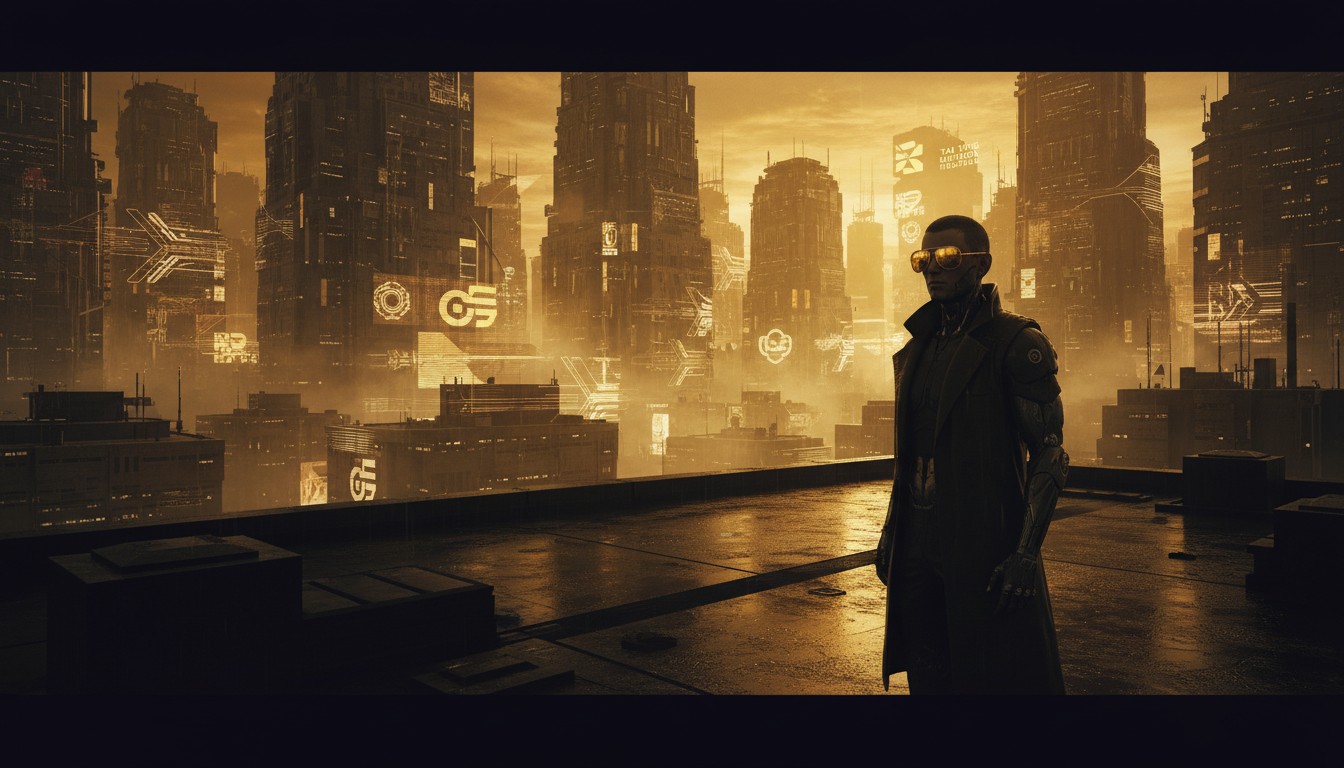
There’s a certain irony in using a third-party injection driver to strap a twenty-five-year-old immersive sim onto your face. Deus Ex is a game about bodily augmentation—about grafting machinery onto flesh and hoping the result feels like an upgrade rather than a hack. Playing it in VR through VorpX is essentially the same transaction, except the machinery is a $40 stereo-injection wrapper and the flesh is your patience.
Here’s the thing: it actually works. Not for every game in the franchise, and not without friction, but the best entry point—Deus Ex: Human Revolution Director’s Cut via VorpX—delivers a full campaign in Geometry 3D with head tracking that makes sneaking through Detroit feel surprisingly present. The shadows have depth. The vents feel cramped. Adam Jensen’s golden lenses stare back at you from mirror reflections with a fidelity the flat screen never quite delivered. It’s not native VR. It’s not even close. But it is the most viable way to experience this franchise in a headset right now, and for fans of the series, that matters.
What the Options Actually Are
The Deus Ex franchise has three distinct VR paths, and only one of them is worth your time today.
The original Deus Ex (2000) has a VorpX profile, but it’s broken in ways that make it effectively unplayable. The game’s Unreal Engine 1 renderer draws the UI, weapons, and background world in separate layers with independent Z-ranges, which VorpX cannot reconcile. The result is spatially separated elements that look wrong and feel worse. Community profiles have tried to patch around it, but the underlying architecture defeats the tool. There is a forward-looking project called Surreal 98 (formerly DXU24) that aims to run the original game through an Unreal Engine 5 translation layer with native VR support, but it remains in early development with a “Coming Soon” Steam page. Do not wait for it. Do not plan around it.
Deus Ex: Mankind Divided fares slightly better. VorpX can inject into the full game with Geometry 3D support, but it’s more demanding on hardware and the profile is less polished than Human Revolution’s. Separately, Square Enix released a free official VR Experience on Steam that lets you walk through four environments from the game—Dubai, Golem City, Jensen’s apartment—with full locomotion and motion controller support. It’s pretty. It’s also four rooms. Not the full game. A curiosity, not a solution.
Which leaves Deus Ex: Human Revolution Director’s Cut as the only serious option. The VorpX profile for this game is mature, actively maintained (version 25.1.5 included targeted fixes as recently as early 2026), and runs the full campaign in Geometry 3D with functional head tracking.
The Setup Reality
This is not plug-and-play. VorpX itself costs roughly $40, and the initial configuration demands attention.
The first hurdle is field of view. Human Revolution was built for monitors, not headsets, and the default FOV will feel like staring through a porthole. You need to push it to roughly 120 degrees, which means either editing registry values or using VorpX’s 3D FOV Enhancement tool. DirectVR can automate some of this, but users report inconsistent results depending on game version. Plan to spend time in the config menu before you spend time in the world.
Resolution is the next battle. In-game text, data pads, and subtitles are barely readable at standard resolutions inside a headset. You’ll want to run the game at 1920x1440 or higher to keep UI elements from dissolving into pixel soup. VorpX’s EdgePeek mode—activated by middle-click—lets you temporarily zoom out to read critical text, but it’s a compromise that breaks presence every time you use it. Think of it as squinting at a menu through binoculars, then lowering the binoculars to see the whole page.
Performance sits in the “moderate demand” bracket. Geometry 3D doubles the geometry load, and Human Revolution is not a lightweight game. A mid-range PC can handle it, but you’ll likely need to dial back some in-game settings to maintain consistent frame rates. This is injection-driver VR: you are asking your hardware to render a flat game twice, in stereo, while a wrapper intercepts the pipeline. Expect some overhead.
What It Feels Like to Play
Once configured, the experience is genuinely compelling in a way that flat-screen Human Revolution is not. The first-person stealth genre translates naturally to VR—peeking around corners actually involves moving your head, and the cover system’s third-person camera shifts become a deliberate choice rather than a detached camera trick. The Geometry 3D profile gives the world real volume. Dubai’s sun-bleached rooftops drop away beneath you. The Picus broadcast tower’s verticality becomes physical. Even the game’s gold-and-black art direction, often criticized as over-filtered on monitors, gains a warmth in headset displays that makes the aesthetic feel intentional rather than oppressive.
The controls are gamepad-only. VorpX does not translate motion controllers into Human Revolution’s input scheme, and there is no hand presence. You are playing a flat game on a virtual screen that wraps around your head, with head tracking added. For some players this is a dealbreaker. For others, the gamepad’s precision actually suits the stealth-gunplay hybrid better than waggle would. It depends on what you want from VR. If you need to physically reach for objects, this is not your route. If you want to inhabit a world while keeping the game’s original control fidelity, it works.
Comfort is manageable but not carefree. Human Revolution is a first-person game with smooth locomotion and no snap-turn or teleportation options. VorpX’s cinema and immersive screen modes can reduce intensity if needed, but the full VR experience expects you to handle traditional FPS movement in a headset. Experienced VR users will adapt quickly. Newer users should expect a settling-in period, particularly during the game’s tighter interior spaces and elevator rides.
Visual artifacts are present but not ruinous. Some users report minor lighting mismatches between eyes in certain scenes, slight halos around character models, and occasional reflection weirdness. These are the fingerprints of injection, not bugs you can patch out. They remind you, periodically, that you are playing a game through a translator.
The Honest Bottom Line
Deus Ex: Human Revolution Director’s Cut in VR is a good game experiencing a decent-but-limited technical wrapper. The underlying title is exceptional—one of the best immersive sims ever made—and the VorpX profile is mature enough that the full campaign is playable from start to finish with meaningful stereoscopic depth. But the limitations are real and they are structural: no motion controls, no native VR UI, text that fights you, and a $40 software tax on top of the game itself.
This recommendation is conditional. If you already own VorpX and you love Deus Ex, this is absolutely worth an evening of configuration. If you are buying into VorpX specifically for this game, the math is harder. The franchise deserves better than injection drivers, and someday it may get it—Surreal 98 is promising, and official VR support for these games would be an instant classic. But that day is not today.
Play this if you want to sneak through a cyberpunk conspiracy with real spatial depth and you’re willing to tinker. Skip it if you need motion controls, native VR polish, or a frictionless setup. The augmentation works, but you will feel the surgery.