
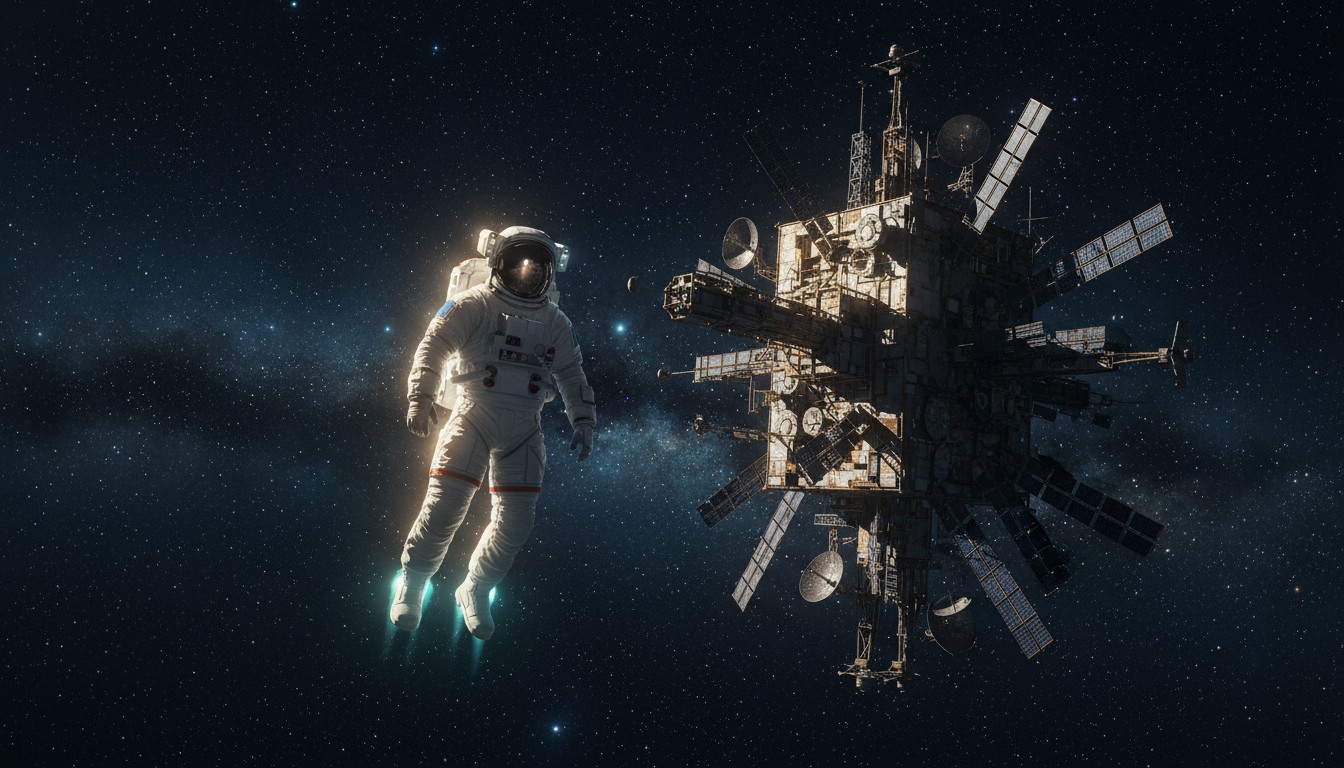
Detached VR
The Steam page for Detached opens with a warning. Not a content disclaimer or an epilepsy notice—a motion sickness warning. Anshar Studios literally advises consulting a physician before playing if you are prone to nausea. In a medium where most developers bury comfort toggles three menus deep and hope for the best, that kind of upfront honesty is almost refreshing. It also tells you exactly what kind of game this is: a zero-gravity spacewalk simulator that treats your inner ear like a stress test.
Released in May 2017 for PCVR headsets and later in 2018 for PSVR, Detached is a native VR experience built from the ground up around six-degrees-of-freedom movement. There is no flat-screen original to compare it against—this was designed for the headset first, with a non-VR edition tacked on later. That matters, because every interaction, every spatial puzzle, and every disorienting roll through a maintenance shaft was authored for someone wearing a display strapped to their face.
The Weight of Nothing
You play as a space hauler separated from your unit after a pirate attack, drifting through an abandoned station with a damaged suit and dwindling resources. The narrative is barely there—reunite with your partner, reboot systems, escape—and it functions more as scaffolding than storytelling. But the plot is not the point. The point is the movement.
Detached uses a six-point thruster system mapped to motion controllers. Pitch, yaw, roll, forward, back, strafe. In practice this means you are constantly reorienting yourself in three-dimensional space with no universal “up.” Push Square’s PSVR review noted that disabling the comfort settings entirely—specifically the vignette that narrows field-of-view during rotation—unlocks the full experience, though it remains impressively stable for those with established VR legs. For everyone else, the default comfort settings are aggressively restrictive, shrinking your view to a porthole during turns until the game is borderline unplayable. The so-called “Eagle Eye” comfort mode is essentially a pair of blinders: functional for training wheels, suffocating for actual navigation.
The locomotion is simultaneously the game’s greatest achievement and its biggest barrier to entry. Players report that the first twenty minutes are spent learning not to panic as the station geometry rotates around them while their body insists they are falling. The Arcade control scheme minimizes inertia and acceleration for those prone to discomfort, while Astronaut and Simulation modes introduce progressively more realistic physics. Even with comfort aids active, Detached is widely cited among the most nausea-inducing experiences in VR. The developers knew this. They warned you.
Atmosphere vs. Content
Where Detached genuinely excels is environmental presence. The station interiors are cramped, industrial, and claustrophobic. The exterior sequences—launching an escape pod at terminal velocity, tracking a distant drone against a starfield—leverage VR scale in ways that still hold up. The sound design does heavy lifting: the muffled thrum of thruster burns, the hiss of oxygen depletion, and a sparse cosmic score that makes the emptiness feel intentional rather than unfinished.
But atmosphere cannot fully compensate for quantity. The single-player campaign runs roughly two to three hours depending on how lost you get in the maze-like corridors, and it leans heavily on repetitive objectives. Navigate to a waypoint. Restore a system. Find the next airlock. The zero-G traversal keeps it from feeling entirely like a walking simulator in a spacesuit, but the puzzle design never escalates meaningfully beyond “float to the thing and interact with it.”
The Multiplayer Ghost Town
Detached shipped with a 1v1 multiplayer mode called Package Extraction—a zero-G take on capture-the-flag set in debris fields where players race to secure a package and deliver it to a moving ship. On paper it is the game’s most inventive idea, turning the thruster mechanics into competitive cat-and-mouse. In practice, the lobbies have been deserted for years. Steam reviews and community reports consistently note that finding a match is effectively impossible. The mode is technically present but practically absent, which is a genuine shame because the movement system seems tailor-made for this kind of asymmetric chase.
Who Should Suit Up
Detached is for the VR owner who has already logged serious hours in zero-G or high-intensity locomotion titles and wants something that genuinely commits to the fantasy of EVA spacewalking. It is not for newcomers testing whether they can handle artificial movement. It is not for anyone seeking a substantial single-player narrative. And it is definitely not for anyone hoping to find multiplayer matches in 2026.
The game is commercially available on Steam and PlayStation Store as a native VR title with no setup friction—buy it, launch it, immediately confront your own susceptibility to motion sickness. That accessibility is welcome, but it also means there is no mod community or framework patch to wait for. What you see is what you get: a confident, atmospheric, aggressively short zero-G experiment that respects your intelligence enough to warn you up front, then makes good on that warning.
If you have the stomach and the patience for a brief but uncompromising spacewalk, Detached delivers something few other VR titles attempt. Just do not expect to stay in orbit long.