
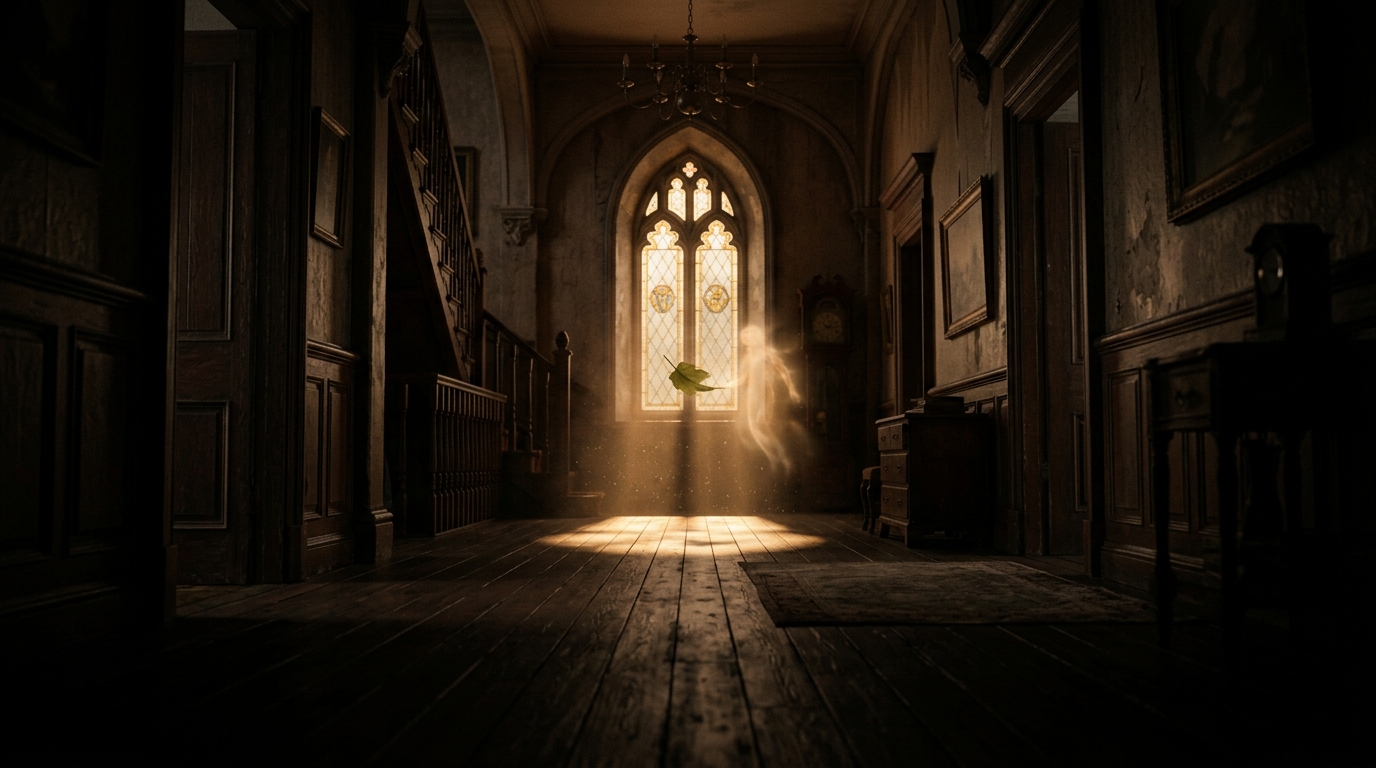
The first thing you notice is the stillness. Not the emptiness of an abandoned building, but the held breath of a moment frozen — a girl mid-gesture, a leaf arrested in its fall, the silence before someone speaks their mind. In Deracine, you are a faerie, invisible and untouchable, slipping through the seams of time inside a small boarding school. There is no sword here, no boss door, no death screen. FromSoftware, the studio that built its reputation on punishing combat and labyrinthine worlds, has made something gentle, small, and deliberately fragile.
Deracine is a narrative adventure built entirely for PlayStation VR. You inhabit a spirit that can perceive human lives but cannot directly alter them — at least, not in the ways you might expect. The boarding school becomes your diorama: a handful of students and their headmaster, each caught in private longing, moving through days that blur together. By pointing at figures and objects with your gaze, you interact, eavesdrop, and gradually uncover a story about mortality, memory, and the quiet cruelties of growing up.
The structure owes more to classic point-and-click adventures than anything in FromSoftware’s catalog. You explore discrete areas, examine items, and converse with characters. The twist is your ability to shift between different moments in time — a mechanic that turns the school into a modest puzzle box where the solution to a present problem might lie in yesterday’s overheard conversation. It is elegant, though never especially taxing. The puzzles are light, more interested in drawing you deeper into the characters’ emotional lives than in testing your logic.
In VR, this works better than it sounds on paper. The boarding school is rendered with a soft, storybook warmth that feels genuinely inhabited. Being physically present in these rooms — leaning in to read a diary entry, looking up at a window where afternoon light filters through — gives the small scale an intimacy that a flat screen would flatten. The DualShock 4 handles all input; there are no motion controllers, no hand presence beyond a faint glow where your spirit touches the world. For a game about observing rather than acting, this restraint makes sense, though it does limit your physical engagement with the space.
The pacing is where Deracine will either capture you or lose you entirely. This is a slow game — meditative to a fault. Characters repeat animations, walks between rooms take their time, and much of the runtime is spent simply existing in quiet spaces. When the atmosphere lands, it is transportive. When it drags, which it occasionally does, you feel every minute of its roughly four-to-five-hour length. There is little replay value beyond hunting for optional narrative threads, and no mechanical depth to reward a second visit.
What saves Deracine is its sincerity. This is not a cynical side project or a token VR experiment. The writing is tender, the voice performances understated, and the central mystery earns its reveals without resorting to spectacle. It asks you to sit with discomfort rather than fight it — a different kind of challenge from the studio’s action titles, but a challenge nonetheless.
If you own a PSVR headset and want something that treats VR as a space for storytelling rather than adrenaline, Deracine is one of the platform’s more distinctive offerings. It is not for players seeking interaction density, physical engagement, or length. It is for those willing to trade speed for mood, and systems for story. FromSoftware’s gamble is that presence alone can carry a quiet narrative, and for the most part, it does. Deracine remains a small, imperfect, and genuinely unusual entry in the PSVR library — a haiku where the studio usually writes epics.