
Death Stranding in VR
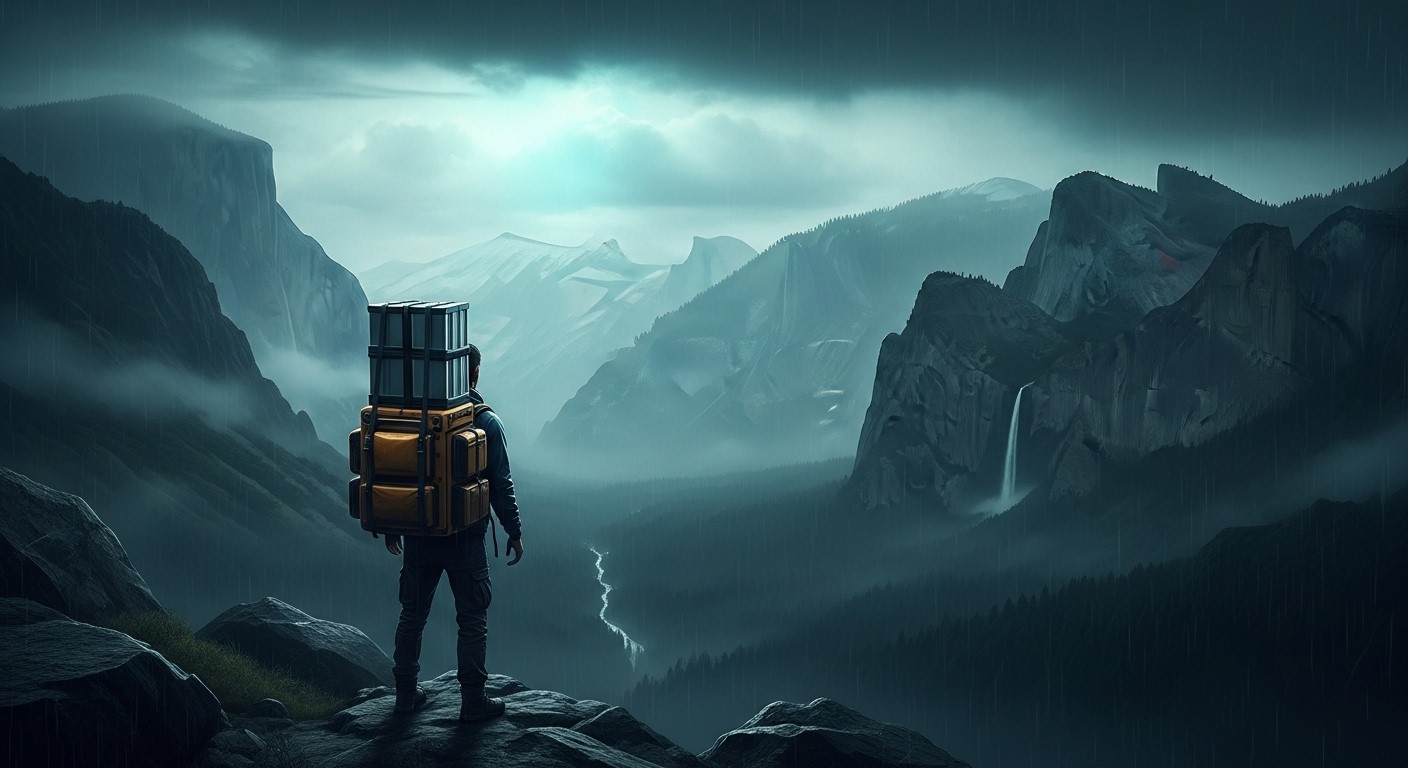
I have never wanted to walk uphill in the rain so badly. Death Stranding in a headset is the closest thing PCVR has to a genuine long-distance hiking sim: cargo on your back, ridges in the distance, and the nagging sense that one wrong step is going to cost you twenty minutes of careful progress. The R.E.A.L. VR injection for Death Stranding Director’s Cut does not turn Kojima’s traversal epic into a native VR game. It gives you stereoscopic depth, head tracking, and a camera that lets you stand inside the American wasteland. That is enough to make it one of the most memorable open-world experiences you can have in PCVR. It is also enough to make its limitations sting.
What R.E.A.L. VR Actually Delivers
This is a Luke Ross R.E.A.L. VR injection driver, not a hand-built mod. It hooks the Decima engine, renders the game in stereoscopic 3D, and maps head tracking to the camera. You still play with a gamepad. Every button press, balance adjustment, vehicle maneuver, and menu selection works exactly the way the flat game intended. There are no motion controllers, no hand presence, and no VR-specific interactions. You are not grabbing cargo or physically steadying Sam. You are looking around a flat game that has been pulled into VR by the eyeballs.
The driver supports both third-person and first-person cameras. Third-person keeps Sam on screen, gives you a better view of footing and terrain, and is the safer choice for long sessions. First-person plants you at Sam’s eye level and turns every incline, river crossing, and BT zone into something far more immediate. Both modes work for the full campaign. Neither mode fixes the game’s dense UI, its cinematic cutscenes, or the fact that menus were clearly drawn for a monitor two feet away.
The Director’s Cut Is the Edition to Buy
The PC version you want is Death Stranding Director’s Cut. The framework’s current supported-game entry targets Director’s Cut v1.004 from the Epic Games Store, with the same storefront version on Steam expected to work. The older base PC release is effectively deprecated for this purpose; the article covers the Director’s Cut because that is the version the R.E.A.L. VR framework is built against today.
There is one storefront caveat worth knowing before you spend money: the Game Pass version has reported compatibility problems. If you are buying specifically for VR, get it on Steam or Epic and treat the purchase as a hedge against storefront quirks. Once a working configuration is established, preserve that exact combination. Do not update the game blindly afterward. A new patch can break the injection, and because the framework is maintained as a broad catalog rather than a single dedicated mod, a broken version may sit unresolved until the next framework refresh.
How It Plays, From Ridge to River
In first-person, Death Stranding becomes a different kind of slow. You read the terrain the way you would on an actual trail: scanning for foot placement, judging slopes, flinching when Sam stumbles. The camera bob and sway that feel minor on a monitor become physical events in a headset. Timefall hits harder. BT zones go quiet in a way that makes the hair on your neck react. The sense of distance between safe houses is not abstract anymore; it is a real stretch of hostile ground you just crossed.
Third-person pulls back from that intensity but keeps the stereoscopic scale. Mountains still tower, waterfalls still drop, and the map still feels enormous. It is the mode I defaulted to after an hour when the first-person bob started wearing on me. Vehicles are more tolerable here too, though motorcycles and trucks still deliver more vestibular punishment than walking. If you try this, start seated and keep sessions short until you know how your stomach reacts.
Combat remains the weakest part of the design. Shootouts and BT encounters were already divisive in flat play, and the gamepad-only input makes them feel disconnected in VR. You can aim with your head somewhat, but every action still flows through controller buttons. Boss fights gain visual impact and lose mechanical precision. The moment-to-moment stealth loop is more successful: spotting BTs by tilting your head, reading odradek pulses in 3D space, and threading your way through tall grass all feel more spatial than they do on a monitor.
Your Stomach Will Have Opinions
This is an intense VR experience. Constant artificial locomotion, uneven terrain, camera sway, falling, sliding, and vehicle travel all hit the same comfort systems. The first-person mode is genuinely uncomfortable for long stretches unless you have strong VR legs. Third-person is more manageable but still features enough camera movement, cutscene transitions, and forced perspectives that comfort-sensitive players should probably skip it entirely.
The cutscenes are another comfort wrinkle. Death Stranding is packed with cinematic sequences, and they do not transition gracefully into VR. Some render in stereoscopic 3D and feel wrong; others flatten out and break the sense of being there. The frequent jumps between gameplay perspective and cinematic perspective keep reminding you that this was never designed for a headset.
The Version Trap and the Performance Tax
Death Stranding Director’s Cut is already a good-looking, demanding open-world game. Stereoscopic rendering roughly doubles the GPU workload, and the injection driver adds its own overhead. You will want a high-end PC to hold a steady frame rate, especially in outdoor areas with weather, volumetrics, and dense terrain. DLSS or FSR help, but they do not erase the fundamental cost of rendering this world twice. Shader hitches and frame-time inconsistencies show up most when entering new regions or during heavy weather.
Stability is decent once everything is configured, but configuration is the whole battle. The framework targets a specific game version, and a patch can invalidate that target overnight. There is no motion-control update on the horizon, no UI overhaul coming, and no guarantee that a future Windows or SteamVR change will not quietly break the hook. Treat the installation as a fragile equilibrium: back up what works, disable automatic updates, and accept that you are maintaining a version-locked configuration rather than installing a living mod.
Establishing a working configuration can still take substantial troubleshooting. Competing graphics injectors, overlays, stale configuration files, and store-specific binaries can all derail it. Plan on at least an hour of careful fussing before your first clean hike.
The Honest Bottom Line
When the injection is working and the weather rolls in and you are halfway up a mountain with too much cargo, Death Stranding in VR is hard to put down. The game was always about the physical weight of moving through a broken landscape, and a headset makes that premise literal in a way no monitor can. But the lack of motion controls, the abandoned-mod fragility, the intense comfort demands, and the performance tax keep the whole package grounded. It is a B-tier recommendation for VR enthusiasts who already love the game, own a strong PC, and can handle aggressive artificial locomotion. If you need hand presence, stable support, or a gentle introduction to open-world VR, this is not your answer.