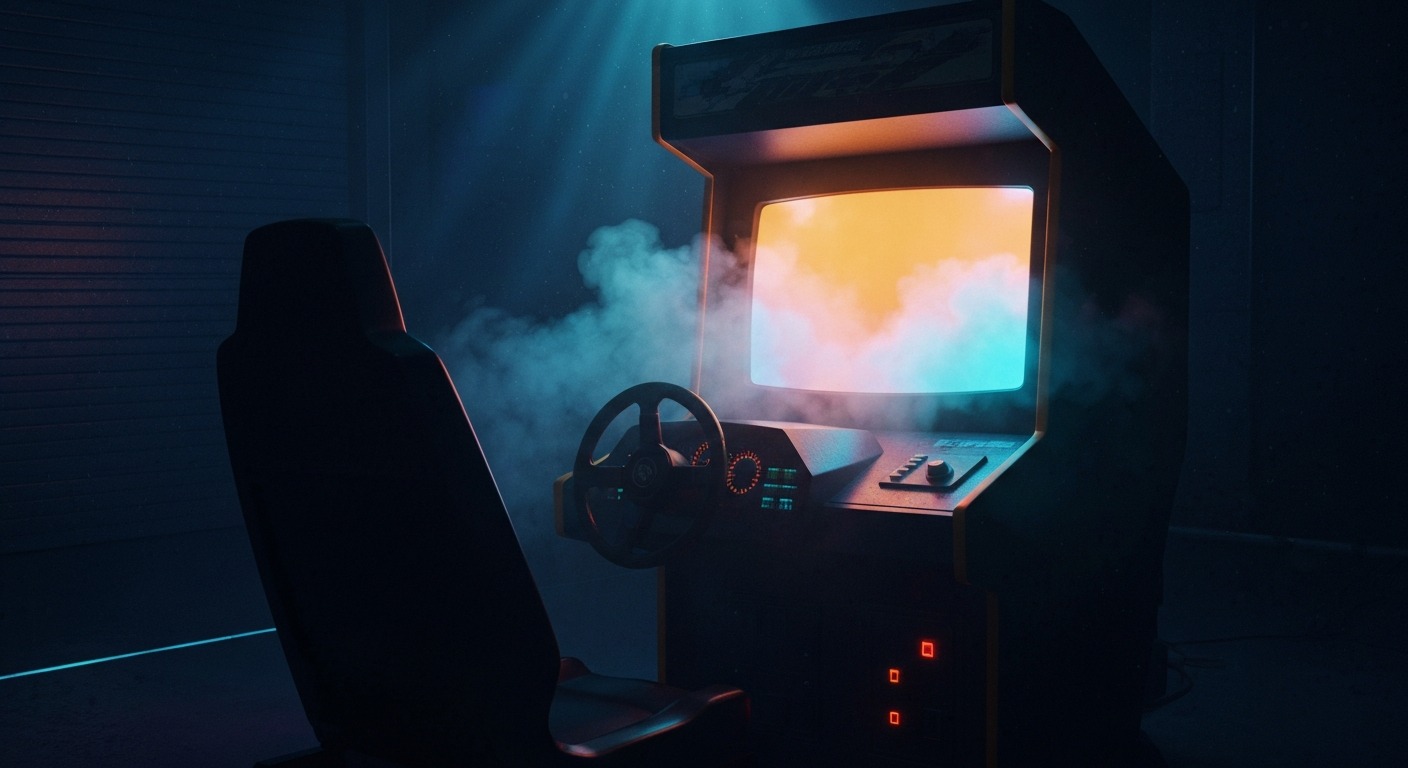
The first time I walked up to that cabinet in VRChat, the stoplights over the screen were flashing in time to “Let’s Go Away” and the Hornet was right there, d-pastel paint and all. It felt like finding a working Daytona USA machine in someone’s garage, except the garage was a virtual world and the machine was built from memory. That’s the whole pitch, really. Z0NE reverse-engineered the Advanced course from the 1994 arcade release, dropped it into a VRChat world, and gave Sega fans a way to sit in that seat again.
It’s not an official port. There’s no Sega license, no Model 2 emulation wrapper, no native VR mode buried in a PC release. The practical way to play Daytona USA in VR right now is to install VRChat, search for “Daytona USA VR (Advanced),” walk into the instance, and either approach the cabinet to race or teleport straight onto Dinosaur Canyon. On Quest 3 or PCVR you can look around the cockpit with your head, race solo or with friends, toggle AI opponents, or just free-roam the track while someone else is screaming through a time attack. The social wrapper is half the point.
The racing itself is immediately recognizable. The handling, the drifting, the checkpoint timer, the voice samples — it’s all close enough to the arcade original that your muscle memory kicks in within a lap. After Z0NE’s v1.2.0 update the world claims support for Xbox, PlayStation, and Nintendo-style controllers, so you don’t have to wrestle with keyboard WASD in VR anymore. That said, there is no proper racing wheel or pedal integration here. A real wheel makes Daytona, and the absence stings. People have already started hacking Arduino interfaces for Logitech wheels on arcade-controls forums, which tells you everything: the enthusiasts are doing the work the world doesn’t do natively.
Performance is the least of your worries. The recreation is light by modern standards and VRChat runs fine on Quest standalone or a mid-range PC. The catch is VRChat itself. Public instances can get messy with unoptimized avatars, network hiccups, and people standing on the hood while you’re trying to nail a corner. If you want a clean race, grab a private instance or hope your lobby is populated by people who respect the sanctity of the cabinet.
Comfort is moderate. You’re seated in a car, looking forward, with no artificial walking locomotion, so the nausea risk is lower than a free-roam VR game. But the drifting, spin-outs, and low-polygon 1990s geometry rushing past at arcade speed can still get to sensitive stomachs. There are no comfort vignettes or teleport options; it’s a raw driving camera, exactly like the cabinet, which is either a feature or a liability depending on your vestibular system.
The biggest limitation is scope. Only the Advanced course is playable. Z0NE has said Beginner and Expert might arrive if the world stays popular, but that’s a maybe, not a roadmap. You also won’t find the full arcade campaign structure or the exact nuance of original cabinet force feedback. What you get is one track, a surprisingly faithful handling model, a room full of friends, and the chance to stand in front of a virtual Daytona machine while someone else is racing on the big screen.
So who is this actually for? Daytona diehards who already own a headset, and VRChat regulars who want another weird, social destination. It’s not a reason to buy a Quest, and it’s not a replacement for the real cabinet or a proper racing sim. But if you loved this game in 1994 and you want to feel like you’re back in that seat for an hour, it’s a damn good garage-find.