
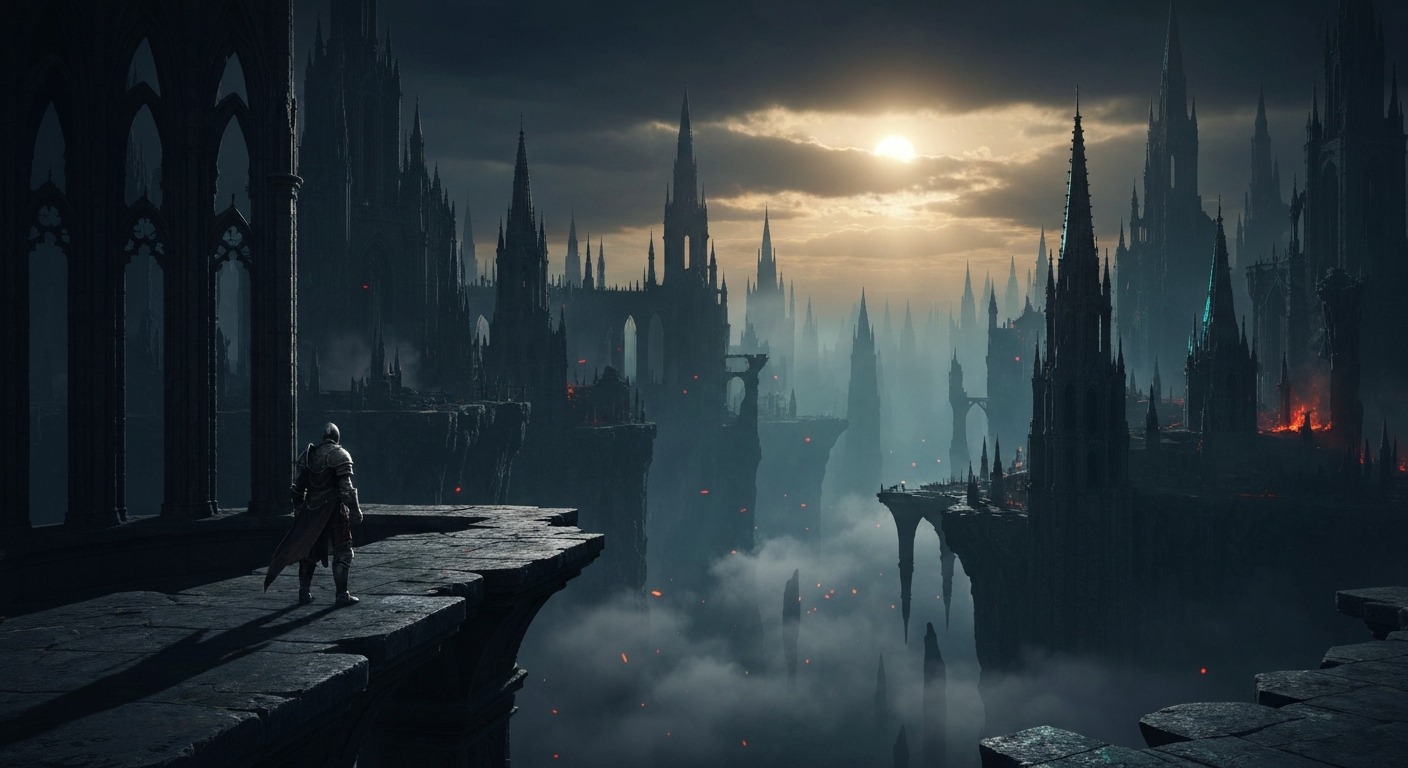
Standing on the ramparts of Undead Burg and looking down at the Kiln for the first time, I finally understood why people bother with VR mods for games this old. The architecture of Lordran — those impossible spires, the cathedral-sized hollows, the sheer verticality of Blighttown — was always impressive on a monitor. In a headset, at true scale, it’s genuinely humbling. You don’t just see the world. You feel small inside it.
That’s the promise of the Luke Ross R.E.A.L. VR mod for Dark Souls Remastered, released in mid-2022 and now freely available. It’s a dedicated flat-to-VR conversion that gives you 6DoF head tracking, a configurable first-person camera, and a closer third-person view than the original game allows. What it doesn’t give you — and this is the critical caveat — is motion controls. You’re playing with a gamepad, in a headset, with your hands invisible and your body still on the couch.
Here’s the thing: depending on what you want from Dark Souls in VR, that might be fine, or it might be a dealbreaker.
The mod installs cleanly. Download the files, drop them into your Dark Souls Remastered directory, launch through SteamVR. No BepInEx chains, no MelonLoader juggling, no binding files to wrestle with. For anyone who’s spent a weekend debugging a five-dependency mod stack, this feels almost suspiciously simple. Once you’re in, an in-game overlay lets you swap between camera modes — standard third-person, a closer third-person that puts you right behind your character’s shoulder, first-person, and a tourism mode that strips out combat entirely.
I want to talk about that first-person mode, because it’s the headliner and also the problem.
Walking through the Undead Parish in first-person is one of the most atmospheric experiences you can have in PCVR. The scale of the gothic stonework, the way torchlight flickers across your actual peripheral vision, the stomach-dropping vertigo when you look down from a ledge — it’s everything you imagine when you dream about this game in VR. But then a hollow swings at you, and you realize Dark Souls was never designed to be played from eye level. Enemy attack tells, hitbox geometry, and spatial positioning around your character’s body all depend on a detached third-person camera. In first-person, dodging becomes guessing. Parrying becomes nearly impossible. Boss fights, according to community reports from people who’ve put serious time in, range from overwhelming to genuinely nauseating as the camera whips around during grab attacks.
The mod’s default closer third-person camera is where it actually sings. You retain full head tracking to look around independently of your character’s facing, which changes how you navigate levels in subtle but meaningful ways. Peeking around corners before committing to a pull, tracking an enemy’s movement without turning your whole body — these are VR-native behaviors that map surprisingly well to Dark Souls’ deliberate combat rhythm. The gamepad controls feel correct because they are the original controls. You’re not pretending to swing a sword with a waggle. You’re playing Dark Souls, with your head inside it.
Performance is a non-issue for most modern PCs. Dark Souls Remastered is a 2018 remaster of a 2011 title, and the Luke Ross mod runs buttery smooth on hardware that can handle contemporary VR. AER (Alternating Eye Rendering), the technique used to generate the stereo image, can produce subtle flicker in darker areas or at lower frame rates, but the game’s stable engine keeps this to a minimum. The mod also supports DLSS upscaling for sharper image quality, which helps offset some of the softness inherent to AER.
Comfort is where your mileage will vary wildly. Third-person with decoupled head look is moderate intensity for anyone with solid VR legs. First-person rolling, backstabs, and the camera snaps associated with certain enemy attacks can push things into intense territory. There’s no teleport movement, no vignetting, no comfort crutches of any kind — this is a full smooth-movement experience. If you’re prone to motion sickness, start with the tourism mode. Wander Lordran, soak in the ambience, and decide if your stomach can handle the real game later.
The lack of motion controls is the obvious missing piece. You can’t physically raise a shield or swing a sword. There’s no hand presence, no physical interaction with the world. For a game about precise melee combat, that absence is felt. It’s a seated, gamepad-driven experience wearing a VR headset — not a native VR action game. If you go in expecting Blade and Sorcery with a Dark Souls skin, you’ll be disappointed.
But if you go in expecting an enhanced way to revisit one of the most atmospheric worlds in gaming, with your head actually inside it? There’s real magic here. The tourism mode alone justifies the download for any Dark Souls fan who owns a PCVR headset. Walking through Anor Londo, craning your neck up at those impossible silver knights, feeling the oppressive scale of the Abyss — these are moments that don’t exist in the flat version.
This mod is for Dark Souls devotees who want to see Lordran through fresh eyes, not for VR newcomers seeking their next action fix. Play it in third-person. Keep a gamepad handy. And don’t blame the mod when a Black Knight ruins your day — that part’s working exactly as intended.