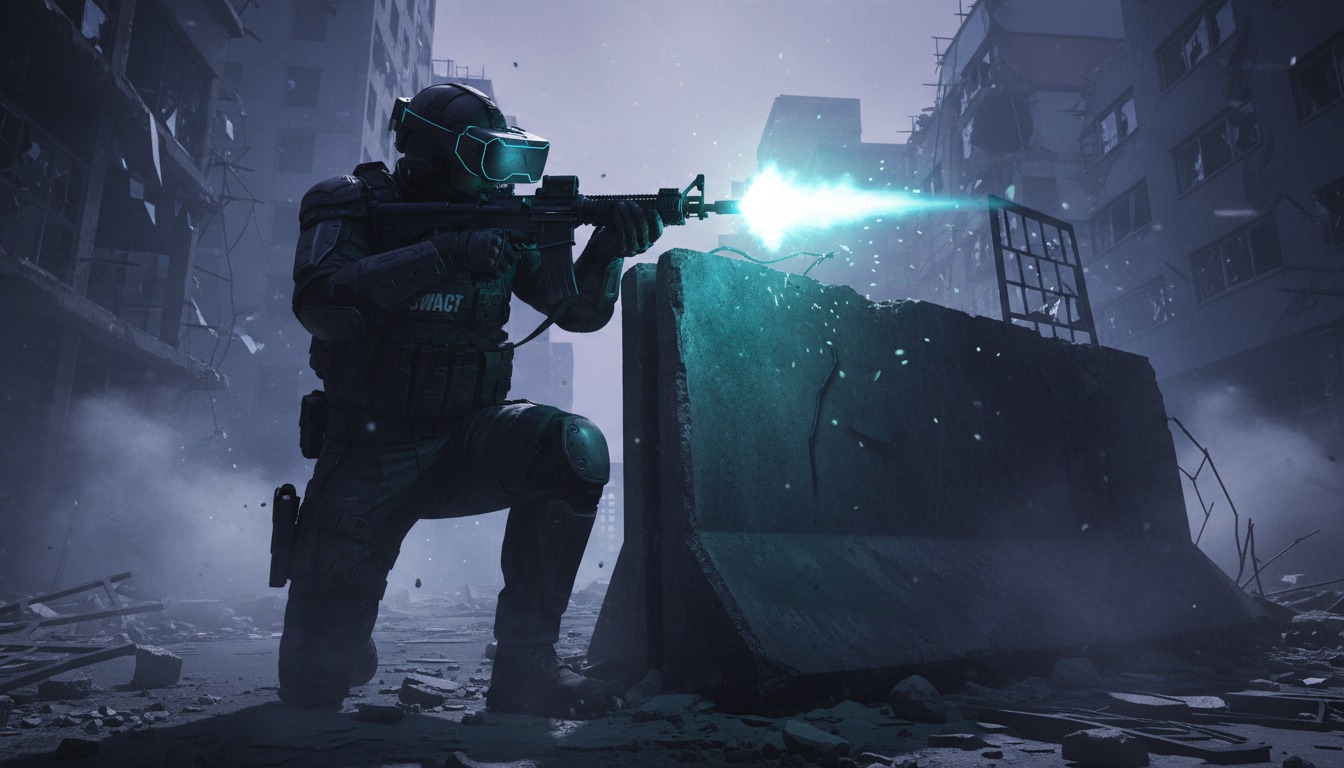
There is a moment, about three minutes into any given level of Crisis VRigade 2, when the polite fiction that you are a calm and collected tactical operator falls apart completely. You are on your knees behind a virtual desk. Your thighs are burning. The timer is ticking down from seven minutes, you have one life left, and an enemy with a grenade launcher just stepped onto a balcony you cannot see from your cowering position. Your magazine is empty. You reach for a fresh one from your virtual chest rig, praying your controller does not lose tracking at the worst possible moment, and you realize that this is not a game you play sitting on a couch.
Sumalab’s Crisis VRigade 2 is a native VR on-rails shooter that strips the genre down to its arcade bones and then makes you physically earn every second of it. Released in early access on PCVR in mid-2020 and spreading across PSVR, Quest, and eventually PSVR2 as Crisis Brigade 2: Reloaded, it is the closest VR has come to recapturing the sweaty-palmed urgency of a Time Crisis cabinet — for better and, depending on your knees, for worse.
What It Actually Is
This is not a hybrid port or a modded experiment. Crisis VRigade 2 was built for VR headsets from the ground up. You play as a SWAT operative moving through a series of fixed combat positions, automatically advancing to the next cover point once you clear the current wave. There is no smooth locomotion, no free movement, no open world to explore. You stand, you shoot, you physically duck behind cover, and you pray.
Each level gives you three lives and a strict time limit. One bullet is usually enough to kill you. Enemies pour in from windows, rooftops, side alleys, and behind cover. Some rush you. Others lob grenades. A few carry weapons that make your cover useless, forcing you to pop up and take them out before they take you out. The pacing is relentless. The arcade structure means every run is a compressed burst of tension — die, restart, learn the spawn pattern, try again.
The controls are fully motion-based. You aim with your dominant hand, reload by ejecting the spent magazine and grabbing a fresh one from your chest, and physically crouch or lean to use cover. On PSVR, the game supports the Aim controller, which turns two-handed rifles into the default and adds a satisfying heft to the iron-sight shooting. On Quest and PCVR, the Touch or Index controllers handle the same duties with room-scale tracking.
The Physical Toll
The most honest thing you can say about Crisis VRigade 2 is that it will hurt you, and it means to. There is no crouch button. If you want to hide behind that concrete barrier, you drop down in real life. After thirty minutes of squatting, popping up, kneeling, and scrambling to reload while your virtual life hangs by a thread, your legs will remind you that this is a workout disguised as a shooter. It is not comfortable in the traditional sense — not because of motion sickness, which is virtually nonexistent thanks to the lack of artificial locomotion, but because your body is doing actual labor.
That physicality is the game’s greatest trick. Leaning around a corner to snap off a headshot, ducking back as bullets chew into the wall where your face just was, feeling your heart rate climb as the timer ticks toward zero — this is what VR was built for. The fixed-position design removes all the usual VR comfort barriers while keeping the action intimate and immediate.
Unforgiving by Design
Crisis VRigade 2 is hard. Not “challenging but fair” in the way a well-tuned soulslike is hard. It is arcade hard — the kind of difficulty that expects you to die repeatedly, memorize patterns, and grind for incremental progress. Four difficulty settings range from Rookie, which offers aim assistance and danger indicators, up to Hell Mode, which strips away every training wheel and dares you to survive.
The progression system softens the blow slightly. You earn coins from every attempt, win or lose, which can be spent on permanent upgrades like extra starting lives, laser sights, or the riot shield — a piece of equipment so useful it fundamentally changes how you play. Consumable continues let you restart from the last checkpoint instead of the beginning, though early versions had bugs with this feature that could dump you right back into death. Those issues appear to have been resolved in later updates, but the core loop remains punishing.
Light on Content, Heavy on Replay
The honest weakness here is breadth. The original launch shipped with three main levels, a shooting range, and a time-attack mode. The Reloaded re-release expanded this with additional missions and refinements, but this is still not a game you play for the story or the scenery. You play it to master a level, climb the leaderboards, and survive co-op with two friends online.
And co-op is worth mentioning. Bringing two other players into the chaos transforms the experience from a masochistic solo trial into a genuinely fun team scramble. With more guns covering more angles, the difficulty curve feels less like a wall and more like a steep hill.
Platform Notes
On Quest, the wireless freedom is arguably the best fit for a game that demands this much physical movement. The Reloaded version on the official Quest Store is Quest 2 and Pro only, leaving original Quest owners on App Lab or SideQuest builds. On PCVR, higher resolution and better tracking precision make iron-sight aiming feel crisp, though the game scales well across hardware. PSVR and PSVR2 benefit from the Aim controller on Sony’s platform — it is genuinely the best way to handle the two-handed rifles — but PSVR in particular demands an optimized camera setup. If your camera is too low or poorly angled, you will lose hand tracking at the exact moment you need to reload behind cover, which turns an already difficult game into an exercise in frustration.
The Bottom Line
Crisis VRigade 2 is not for everyone. Casual players will bounce off the difficulty within the first level. Anyone looking for narrative, exploration, or variety will find the offering thin. Players with limited mobility or small play spaces should stay away — this game needs room to crouch, lean, and flail.
But if you miss the pure, coin-gobbling adrenaline of arcade light-gun shooters, or if you want a VR experience that actually makes your body work for the win, this is one of the most focused executions on the market. It knows exactly what it wants to be, strips away everything that does not serve that goal, and dares you to keep up. For arcade shooter enthusiasts and anyone who believes VR works best when it makes you move, Crisis VRigade 2 delivers a lean, sweaty, and genuinely thrilling action fix.