
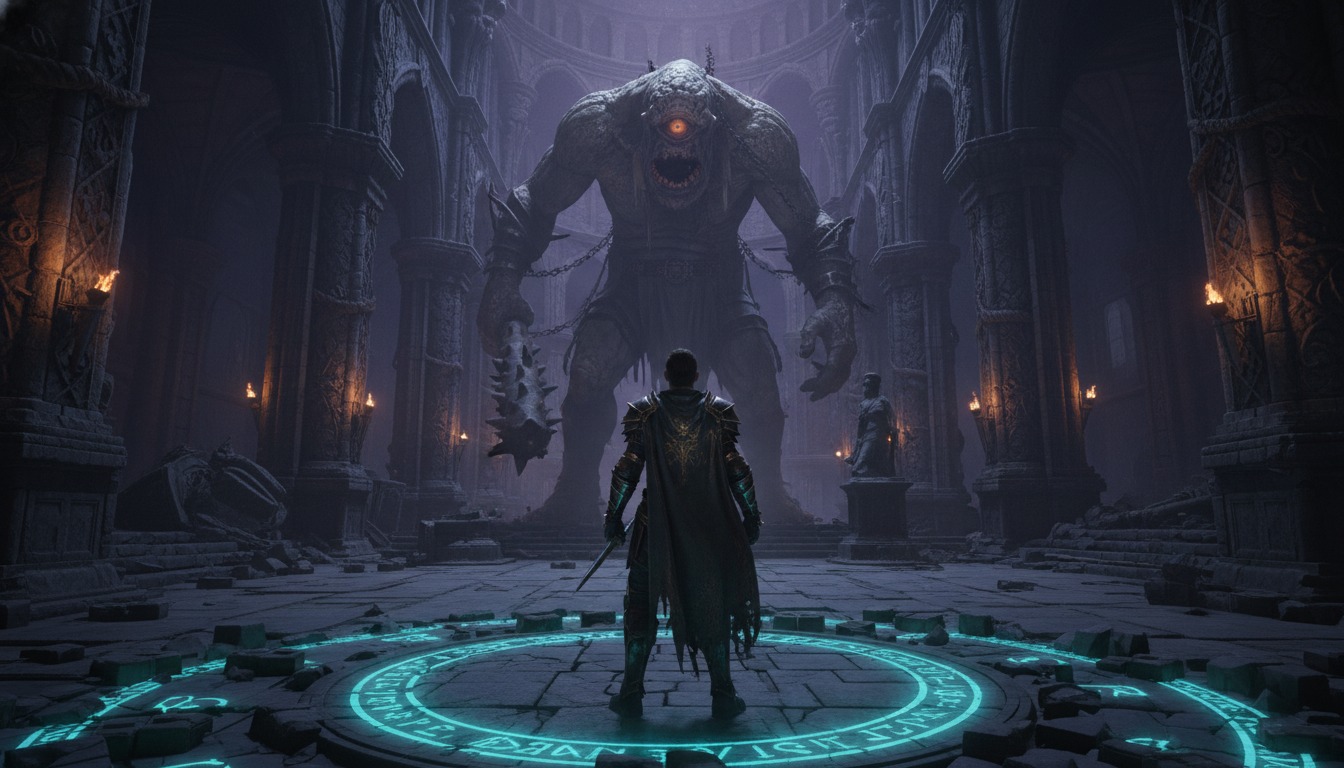
There is a particular kind of weight that comes from watching a character grow old. In most games, death is a reset — a breath, a loading screen, and you are young again. In Chronos, death is a sentence. Each time you fall in its labyrinthine halls, your hero is cast out for a full year. They return older. Slower, perhaps, but wiser. By the time you reach the final chambers, you may be staring at a gray-haired veteran who has learned to fight with arcane fire because their knees no longer trust a sword swing. That progression — from reckless youth to hardened elder — is not just a mechanic. It is the emotional spine of one of VR’s most quietly ambitious RPGs.
Gunfire Games released Chronos as a launch title for the Oculus Rift in March 2016, and it remains one of the few native VR games that dares to deliver a 15- to 20-hour action RPG without shrinking itself into a tech demo. This is not a wave shooter or a standing-room experience. It is a full dungeon crawler with interconnected levels, key-item puzzles, boss encounters, and a combat system that asks you to study enemy patterns, time your dodges, and treat every encounter with patience. The comparison to Dark Souls is unavoidable and mostly fair: the combat has that same deliberate rhythm, where rushing in gets you killed and mastery feels earned.
What makes Chronos unusual as a VR game is its choice of perspective. It is third-person, shot from fixed camera positions that shift as you move between rooms and corridors. Your headset becomes a window into a detailed diorama — you can lean in, look around, and appreciate the scale of a cyclops towering above your hero in a way that a flat screen simply does not allow. The fixed camera is a deliberate comfort choice: there is no smooth artificial locomotion pushing against your vestibular system, no camera yaw controlled by a thumbstick. For players sensitive to motion sickness, Chronos is one of the most comfortable lengthy experiences in VR. But that same design decision means you are not “inside” the world in the way modern VR players have come to expect. You are an observer with a very good seat, not a body in the room.
The controls reinforce that distance. Chronos was built for a gamepad, and it still expects one. There are no motion controls, no hand presence, no gesture-based combat. You move, dodge, and strike with traditional inputs while the camera watches from its assigned perch. In 2016 this was standard; today, it feels like a relic from an earlier era of VR design. The combat still works — the dodge timing is tight, the parry windows are rewarding, and the enemy variety keeps encounters tense — but there is a lingering sense that the game is being played at you rather than through you. That is not necessarily a flaw, but it is a limitation that defines who this game is for.
The aging system, however, remains genuinely brilliant. Every death adds one year to your hero’s age, capping at 80 when they become functionally immortal. Younger characters lean into physical stats — strength, dexterity, swift sword work. Older characters shift toward arcane abilities, trading raw speed for magical damage and defensive perks. Every decade brings a new perk, meaning that a player who struggles and dies repeatedly is not simply banging their head against a wall; they are slowly transforming their build into something that might suit their reflexes better. It turns failure into narrative progression. By the end of a difficult run, your elderly wizard is not a consolation prize — they are a different kind of power fantasy, one earned through attrition.
The world itself is worth the time. Chronos borrows the structural logic of a Zelda dungeon — keys hidden in odd corners, doors that demand items from other wings, environmental puzzles that only make sense once you have seen the whole map — and wraps it in a dark fantasy aesthetic that holds up surprisingly well. The boss encounters are the clear highlight: standing in VR while a monstrosity fills your view gives these fights a scale and intimidation factor that flat-screen Souls-likes struggle to match. The audio design is equally strong, with atmospheric soundscapes that make the labyrinth feel lived-in and ancient.
The problems are mostly contextual. Chronos is locked to the Oculus Store for PCVR, which means you need a Rift, Rift S, or a Quest headset running PC Link to play it. There is no standalone Quest version, and given the game’s age and the studio’s pivot toward non-VR projects, one is unlikely. Support is effectively frozen — the game is stable and complete, but Gunfire Games has moved on, and the VR version has not received meaningful attention in years. For a game that still sells at full price on a platform that is increasingly focused on standalone hardware, that silence matters.
Performance sits in a comfortable middle ground. It was built for hardware from 2016, so modern PCs handle it without strain, but it is not a lightweight title either. The visual fidelity — dense environments, detailed character models, dynamic lighting — was impressive for its era and still looks respectable. You do not need a top-end rig, but a potato machine will struggle.
So who is this for? Chronos is for the VR player who wants a real RPG — something with length, consequence, and design ambition — and does not mind that it plays like a traditional game wearing VR as a viewing lens rather than a reinvention. It is for Dark Souls fans who want that combat rhythm in a format where boss scale actually means something. It is for players who get motion sick easily and need a lengthy, comfortable experience that respects their physiology. And it is for anyone who finds the aging mechanic conceptually compelling, because the execution lives up to the idea.
Who should skip it? If you bought a VR headset for hand tracking, physical interaction, or the sense of “being there” with your own body, Chronos will feel like a high-quality flat game with a fancy screen strapped to your face. If you own only a standalone Quest without a gaming PC, you cannot play it at all. And if you expect modern live-service support or community modding, this is a finished artifact from 2016, not a growing platform.
Chronos is a strange artifact — a launch-era VR game that aimed higher than almost everything around it, executed with care, and then was left behind as the industry sprinted toward standalone headsets and motion control hand presence. It is not the future of VR gaming. It might not even be the present. But it is one of the medium’s most complete action RPGs, and its aging mechanic gives it a thematic weight that few VR titles have ever matched. For the right player — one with the hardware, the patience, and a tolerance for gamepad-driven third-person design — it is still a journey worth taking. Just be prepared to grow old along the way.