
Here’s the thing about Call of Duty: Infinite Warfare: the campaign everyone dunked on in 2016 is now widely considered one of the best in the franchise. It’s a tightly paced sci-fi war story that blends ground combat, zero-gravity sequences, and space dogfights into something that feels like it should be incredible in VR. And in one very specific, very brief way, it is. Everywhere else? You’re working for it.
The Free Demo That Teases What Could Have Been
The most honest VR option for Infinite Warfare is Jackal Assault, a free standalone mission released alongside the flat game in November 2016. It’s PSVR-exclusive — original PSVR, not PSVR2 — and requires zero setup beyond a PlayStation Store download. Developed by Paper Crane Games with Activision assets, it drops you into the cockpit of a Jackal fighter for roughly five to ten minutes of space combat.
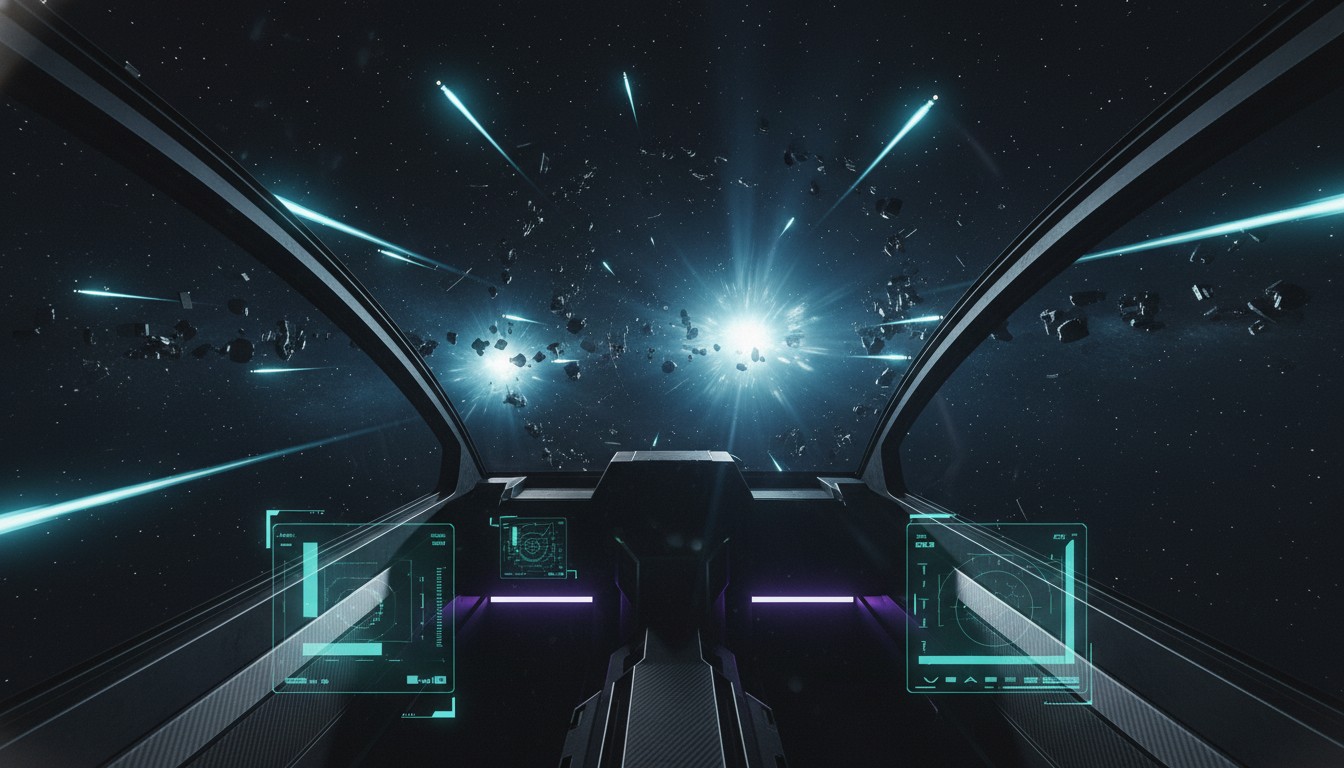
Head-tracking controls targeting: you look at an enemy to lock missiles, blast away with the DualShock 4’s R2 trigger, and boost through debris fields. The cockpit detail is solid, the controls are intuitive, and the action builds from a slow patrol to frantic 360-degree dogfighting. When missiles streak past your canopy and you track an enemy through a debris ring by actually turning your head, you get a genuine taste of what a full Call of Duty VR campaign might feel like.
Then it ends. You can skip straight back to the combat, but the mission is the mission — no progression, no narrative stakes, no campaign. It’s a polished tech demo that costs nothing and lasts about as long as a bathroom break. For original PSVR owners, it’s a neat curiosity. For anyone else, it’s tied to inaccessible hardware from two generations ago.
The Full Campaign, Via Injection
If you want the actual Infinite Warfare campaign in VR, your only option is VorpX.
The community G3D profile does work, and when it’s running well the campaign can look genuinely impressive. Stereoscopic depth gives the space environments real scale. The zero-G combat sequences translate surprisingly well to head-tracked aiming. Maximizing the in-game FOV to 120 helps with presence, and dialing shadows and post-processing back to minimum keeps things stable enough to be playable. But this is still injection-driver territory in every way that matters: no motion controls, no hand presence, no VR UI. You’re playing a flat first-person shooter projected into a headset, and every compromise that implies is present.
The performance picture is what sinks it. VorpX draws the entire scene twice for stereo 3D, and Infinite Warfare’s engine is already pushing dense environments, dynamic lighting, and large-scale space battles. Even on capable hardware, frame rates can start around 50 and degrade to the low 20s over longer sessions as the overhead compounds. Subtle shadow artifacts creep in. Jitter becomes impossible to ignore. What starts as “actually pretty good” can curdle into a nauseating mess if you push past an hour. Mouse and keyboard controls function fine — the profile handles input mapping cleanly — but you’re still playing a twitch shooter designed for a monitor, now with added VR latency and none of the native comfort accommodations that make fast FPS movement tolerable in proper VR.
The Real Shame
That leaves the recommendation in an awkward place. The flat Infinite Warfare campaign is genuinely excellent: a space opera that commits to its premise, builds characters worth caring about, and mixes mission types with the kind of confidence most Call of Duty campaigns lack. It’s the kind of single-player experience that should be celebrated, and in flat-screen retrospectives, it increasingly is.
But the VR reality is two separate things that don’t add up to a coherent whole. Jackal Assault is a fun, free ten minutes that makes you wish for more. VorpX unlocks the full game but asks for significant hardware, patience, and tolerance for performance degradation in exchange for stereoscopic novelty.
If you still have an original PSVR headset, download Jackal Assault. It’s free, it works, and it’s a neat snapshot of what Call of Duty in VR could have been. If you’re a PCVR owner with a VorpX license and a high tolerance for tinkering, the campaign is playable and occasionally impressive in G3D, but the performance ceiling and comfort compromises make it hard to justify over flat-screen play. Everyone else? Play the campaign on a monitor, where it belongs, and let this one stay a fascinating what-if.