
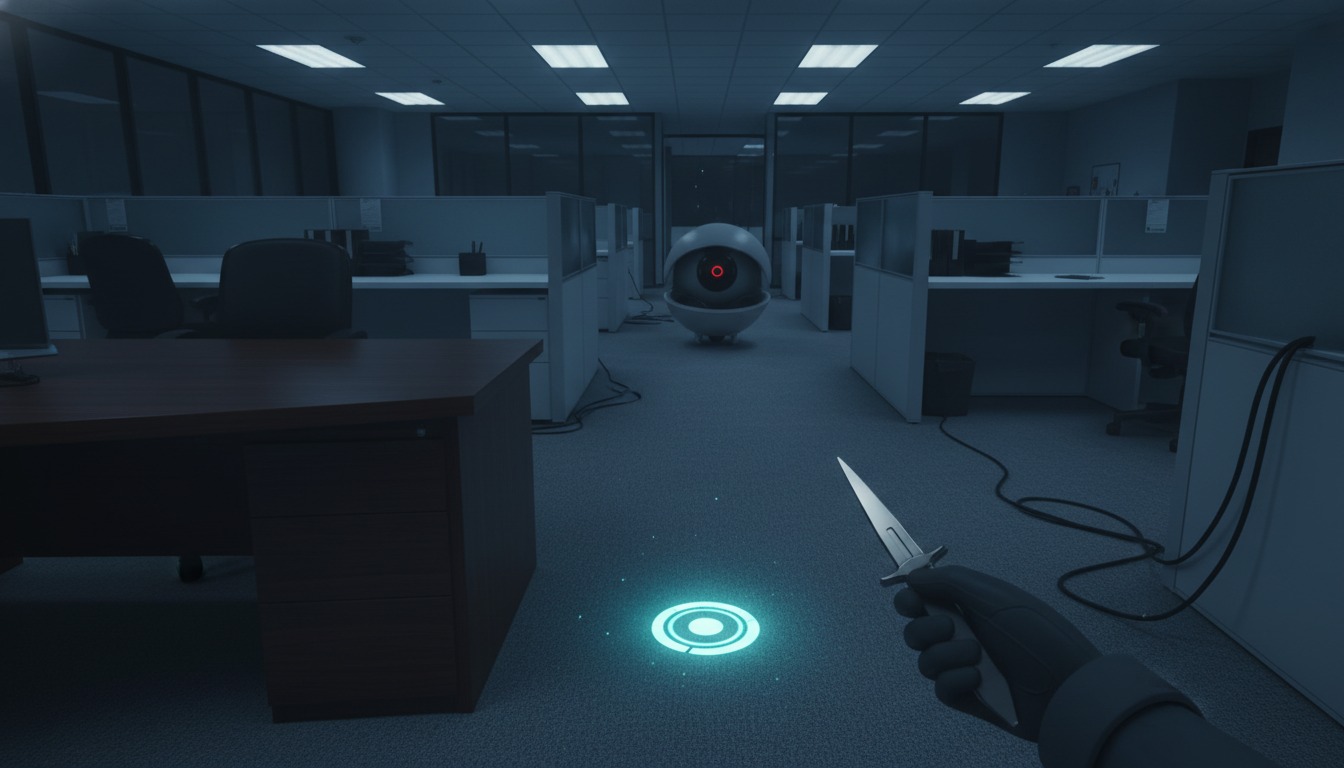
There was a period in 2016 when the Budget Cuts demo felt like the future. Neat Corporation’s spy-office stealth sandbox circulated through every Vive demo station and early VR YouTube channel, promising a kind of native design that flat games could never touch: you reached into drawers, grabbed letter openers and coffee mugs, and hurled them across rooms. You ducked behind photocopiers, peeked around cubicle walls, and used a portal gun to slingshot between cover points with the casual absurdity of a Saturday morning cartoon assassin. It was brief, but it was intoxicating — the kind of vertical slice that made you imagine what a full game might become after two years of development.
Budget Cuts arrives in June 2018 as that full game, and the first thing you notice is how immediately physical everything still feels. This is a native PCVR title built for the Vive and Rift from the ground up, with no flat version in sight, and it understands that stealth in VR works best when your body does the hiding. You physically crouch behind desks. You physically pull open filing cabinet drawers and rummage for throwing knives. You physically rear back and chuck office supplies at patrolling robot guards, aiming by eye and follow-through rather than crosshair. When it clicks, it feels like a spy simulator made by people who understand that presence and prop comedy share the same neural pathways.
The portal gun remains the star. Rather than fading to black or blinking across rooms, you fire a blue disc, your view switches to a floating camera at the disc’s location, and you confirm the teleport by squeezing the trigger. It is elegant, diegetic, and strangely theatrical — you get to survey your landing zone, time guard patrols, and slip into new cover with the satisfaction of a perfect drop. In a medium still arguing about whether smooth locomotion or teleportation is the correct default, Budget Cuts proposes something better: teleportation with spatial reasoning attached. You are not skipping traversal; you are planning it.
The fiction casts you as a disposable employee trying to escape a robot-run corporate hellscape, communicated through elevator intercoms and environmental propaganda. It is light, silly, and stays out of the way. The robots themselves are wonderfully physical — spherical, top-heavy, and satisfyingly fragile when a well-thrown knife finds its mark. Watching one spark and collapse after a desk-lamp ambush carries a slapstick brutality that only tracked hands can properly sell.
But the full campaign reveals the cost of that long development cycle. Budget Cuts is short — finishable in a single dedicated evening — and many of the systemic frictions that made the 2016 demo feel alive have been filed down. The robot guards patrol on rigid loops, the office environments offer fewer interactive objects than the prototype suggested, and the improvisational chaos of using any object as a weapon has been narrowed into a more prescribed stealth toolkit. You still grab knives from drawers, but you are less likely to wing a stapler at a security camera and watch the room descend into slapstick panic. The game wants you to play it cleanly, and that conservatism sits oddly against the anarchic physicality of its controls.
The brevity stings because the core loop is genuinely fun. By the time you have settled into the rhythm of portal-flanking and drawer-rummaging, the credits are approaching. There is little reason to return once the campaign concludes; no score attack, no sandbox mode, and no significant mechanical escalation across the levels. What you learn in the first twenty minutes is largely what you get for the entire runtime, which makes the wait feel disproportionate to the meal.
Performance on contemporary PCVR hardware is solid if unremarkable. The art direction favors clean corporate sterility over geometric complexity, which keeps frame rates steady on mid-range rigs, though dense office scenes with multiple active physics objects can hitch when guards collide or glass shatters. Comfort is generally manageable thanks to the portal locomotion, though the need to physically duck, weave, and rapidly teleport during alert phases will test the stomachs of newer players. There is no seated mode to speak of; this is a standing, room-scale experience that expects you to use your body, and the scale of the office spaces benefits from every inch of tracked floor you can give it.
The absence of a flat version is worth noting only because it underscores how thoroughly Neat Corporation committed to the headset. Every interaction, every menu, every narrative beat assumes two tracked hands and a tracked head. There is no concession to monitor play, and the game is better for it. This is VR as a primary platform, not a bonus feature.
So who is this for? If you bought a Vive or Rift for the fantasy of becoming a covert operative in a dystopian office park, Budget Cuts delivers the best version of that fantasy currently available. The portal gun alone justifies the price of admission for anyone interested in locomotion design. But if you are looking for a substantial campaign, a deep stealth sandbox, or the unruly systemic depth promised by those early demos, you will leave wanting. It is a brilliant prototype stretched to full-game length without enough new ideas to fill the gaps.
It is absolutely worth playing, but worth playing with measured expectations. The demo was legendary. The game is merely good.