
The first time I finished a twenty-minute BOXVR session, I had to sit down. Not because the headset was uncomfortable — though I was definitely sweating into the facial interface — but because my arms genuinely felt like I’d been through a boxing class. My shoulders ached. My heart rate was up. And I had the distinct sense that I’d just done something productive in VR, which is a rarer feeling than the marketing would have you believe.
That’s the thing about BOXVR: it’s not trying to be a game that happens to make you move. It’s a fitness tool that happens to be in VR. And for a specific kind of person — the one who wants to work out but can’t stand the gym — that distinction matters.
What You’re Actually Getting
BOXVR is a native VR fitness app developed by FitXR, released in 2019 for PCVR (Steam), PSVR, and later Oculus Quest. It’s built entirely around rhythm boxing: glowing targets fly toward you in time with music, and you punch them with jabs, crosses, hooks, and uppercuts while ducking and weaving around obstacles. Professional fitness trainers designed the routines, and the game tracks calories burned, punch accuracy, and streaks.
There’s no story mode. No progression system to speak of beyond unlocking longer workouts. You’re here to hit things to a beat, and the game never pretends otherwise.
On PCVR and PSVR, BOXVR is still available as the original product. On Quest, the app was rebranded as FitXR in 2020 and has since evolved into a subscription-based service with HIIT, dance workouts, multiplayer, and daily content drops. If you’re on Quest, you’re not buying BOXVR anymore — you’re buying FitXR. This article is about the original BOXVR experience, which remains the version you’ll find on Steam and PlayStation.
How It Actually Plays
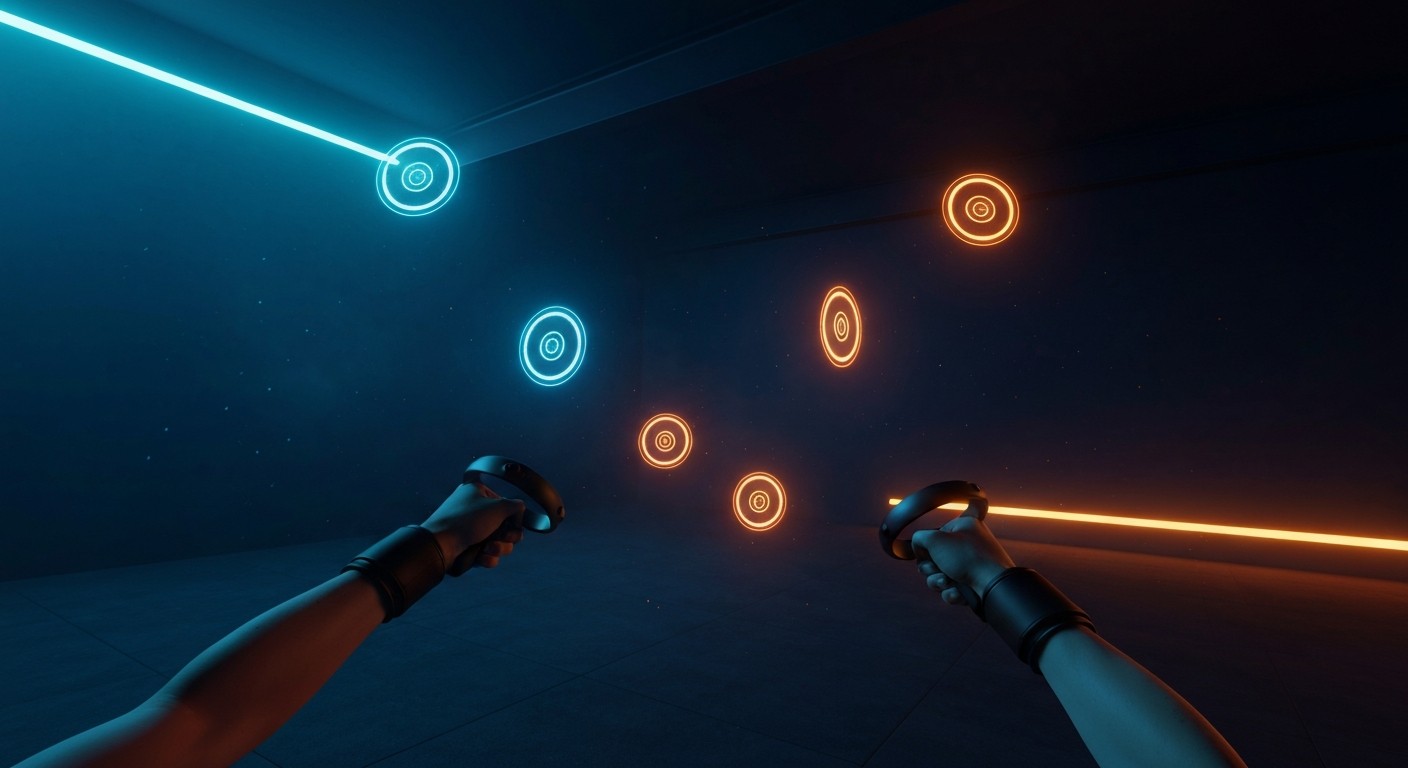
The setup is dead simple. Strap in, grab your controllers, and pick a workout. The game runs you through a quick calibration that mostly involves standing where it tells you and confirming your height. Then the gym fades in around you — a dark space with neon targets, pulsing lights, and the kind of generic-but-functional electronic soundtrack that won’t offend anyone.
The targets approach in lanes. Blue ones want a left-hand punch, orange ones want right. The shape tells you the strike: a circle for a straight jab, a wide arc for a hook, an upward curve for an uppercut. When the targets cluster in a horizontal line, you duck. When they stack vertically, you weave. The tracking is responsive enough that the game reliably registers clean hits versus sloppy swings, and that accuracy feedback is what makes it feel like a real workout rather than arm-flailing.
I found the shorter workouts — two to ten minutes — useful for warming up before other VR sessions. The medium ones, around twenty minutes, are where BOXVR starts to feel like actual exercise. Your arms get heavy. The ducking becomes less enthusiastic. By the time you hit the forty- and sixty-minute endurance sessions, you’re in full-on cardio territory. I couldn’t finish a sixty-minute session on my first try, which is either a statement about my fitness or about how effective the routines are. Probably both.
The custom playlist feature is the quiet standout. You can load your own music, and the game generates target patterns that match the beat. It doesn’t always nail the energy of a song — some tracks produce weirdly sparse patterns while others feel overcrowded — but when it works, it works. Working out to your own library removes the feeling that you’re grinding through someone else’s Spotify playlist.
Where It Shines
BOXVR’s biggest strength is its honesty. It doesn’t promise to make you a boxer. It doesn’t try to layer RPG progression or narrative hooks onto what is fundamentally a workout tool. The routines are designed by actual fitness trainers, and it shows. The pacing ramps sensibly, the movements target multiple muscle groups, and the calorie estimates feel grounded rather than inflated.
The comfort level is exceptional. There’s no artificial locomotion. You stand in one place and move your body naturally. I never felt motion sick, never felt disoriented, never had to take a break because the headset was doing something weird to my inner ear. For VR newcomers or people who struggle with traditional VR comfort, that’s a genuine selling point.
Performance is rock solid. The environments are simple — dark gym, neon lights, nothing fancy — which means it runs well on modest hardware. I’ve never seen a performance complaint about this game, and there’s a reason for that.
Where It Falls Short
The problem with BOXVR in 2025 is that it’s effectively a legacy product. On Quest, the app is dead — replaced entirely by FitXR. On Steam and PSVR, BOXVR still works exactly as it did in 2019, but it receives no new content, no new music, and no meaningful updates. What you buy is what you get.
That means the original soundtrack, while competent, gets repetitive quickly. The visual style — dark gym, neon targets — never changes. There’s no multiplayer in the original version. No competitive leaderboards that feel alive. The workout variety is solid but finite, and once you’ve worked through the available routines, you’re either loading custom music or repeating the same sessions.
The punching feedback is functional but not satisfying. There’s no haptic crunch when you land a clean hit, no sense of impact beyond the controller’s basic rumble. Compare that to something like Creed: Rise to Glory, where punches feel weighty and consequential, and BOXVR’s strikes feel like you’re swatting at holograms. Which, technically, you are.
The Real Question
BOXVR occupies an awkward middle ground. It’s a better pure workout than Beat Saber, which is more game than exercise. But it’s less engaging as a game than Creed or The Thrill of the Fight, which simulate actual boxing with opponents and stakes. If you want to sweat in VR, BOXVR will get you there efficiently. If you want to be entertained while you do it, the lack of progression or variety starts to grate after a few weeks.
On PCVR and PSVR, BOXVR is still a perfectly viable purchase if you know what you’re getting: a straightforward fitness tool with good tracking, comfortable design, and no ongoing support. On Quest, don’t bother looking for it — FitXR has completely replaced it, and while FitXR’s subscription model is a different conversation, it’s the only option on that platform.
The Bottom Line
BOXVR is the VR equivalent of a reliable treadmill. It does exactly what it says on the box, it does it well, and it won’t surprise you. For someone who wants a low-barrier entry point into VR fitness — someone who wants to put on a headset, punch things for twenty minutes, and feel like they accomplished something — it’s a solid recommendation.
But it’s a B-tier recommendation, not an A-tier one. The lack of ongoing support, the repetitive presentation, and the absent haptic feedback mean it never transcends its function. It’s a good workout app that happens to be in VR, and there’s nothing wrong with that. Just don’t expect it to be more than it is.
If you want the BOXVR experience with modern support and ongoing content, buy FitXR on Quest. If you want the original, uncomplicated, one-time-purchase version, it’s still sitting there on Steam and PSVR, waiting to make your arms hurt.