
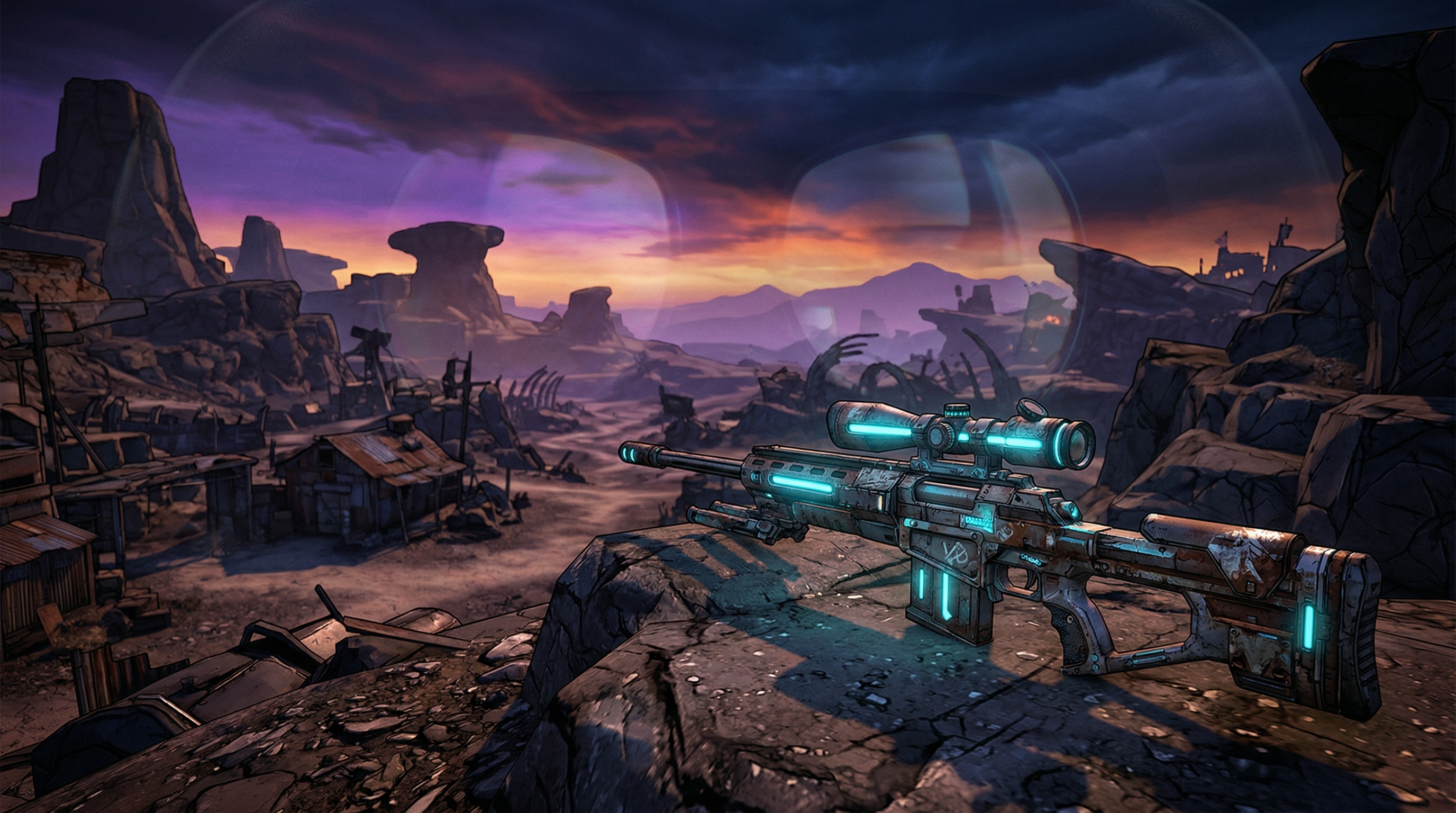
Standing on the edge of a cliff overlooking Pandora’s rust-colored wasteland, the scale of the thing finally makes sense. Borderlands 2’s cel-shaded world has always looked like a comic book come to life, and in VR that comic book wraps around the player. Bandit camps tower overhead. Skags charge from what feels like actual meters away. For a moment, the ambition is undeniable.
But then the framerate stutters on a head turn. Or a sprint across the Dust triggers a lurch in the stomach. Or you remember that the co-op partner who carried you through the flat version isn’t here — because co-op doesn’t exist in this version.
Borderlands 2 VR is a standalone VR release — not a patch or hybrid mode, but a separate SKU built specifically for virtual reality. Gearbox Software rebuilt the entire campaign for a single player wearing a headset, launching first on PSVR in December 2018 before arriving on PCVR in October 2019. It’s one of the most ambitious AAA conversions the medium has seen, and in places that ambition pays off. In others, it collapses under its own weight.
What This VR Version Actually Is
This is the full Borderlands 2 base campaign, start to finish, in a headset. Every story mission, every side quest, every boss fight, every legendary drop — all of it is present and accounted for. What isn’t present is almost everything else that made Borderlands 2 the phenomenon it was. The port strips out multiplayer entirely. No co-op. No matchmaking. No trading loot with friends. For a franchise built on the chemistry of four vault hunters combining their skills, this is a substantial amputation.
The DLC situation is also incomplete. Some DLC packs were added to the PCVR version after release, but the Commander Lilith & the Fight for Sanctuary expansion — the bridge between Borderlands 2 and 3 — remains absent. On PSVR, the DLC offering is even more limited. You’re getting the core campaign and a fraction of the post-launch content, which is a real value gap when the flat version has been bundled with everything for years.
Support is effectively frozen. Gearbox moved on long ago, leaving this port in maintenance mode. What you see is what you get.
How It Plays
Controls: A Mixed Bag
On PSVR, the game supports PlayStation Move controllers, DualShock 4 gamepad, and — after a March 2019 update — the PlayStation Aim controller. That Aim update was significant: it added more natural aiming and customizable movement options, and it arrived because early players made it clear that the Move implementation wasn’t cutting it. Before the update, the control situation was notably worse, and launch reviews reflect that frustration.
The Move controls still have problems. Movement requires pointing a controller and holding a button, which feels clumsy when you’re trying to strafe around a badass enemy. The lack of analog sticks makes precise positioning frustrating. After extended sessions, the controller tracking can drift, forcing a restart. Dual-wielding weapons has a physical immediacy that a gamepad can’t replicate, but everything else about the Move scheme fights you.
On PCVR, the game supports both motion controllers and gamepad input, but the motion implementation is not the immersive 1:1 gun handling of a made-for-VR shooter. Instead of physically aiming down sights, the game relies on a floating reticle that hovers in space and bounces with weapon recoil. It is the original game’s shooting mechanics, visually represented in 3D space. Some PC players have reported crosshair alignment issues with certain headsets — particularly Meta Quest hardware — requiring workarounds like playing through Virtual Desktop or disabling the crosshair entirely and relying on iron sights. Your mileage will vary based on your specific hardware configuration.
Many serious players on both platforms eventually default to gamepad play. It forfeits some VR presence but provides the strafing and camera control the combat was originally designed around.
BAMF Time and the Shooting Rhythm
The one genuinely smart VR addition is BAMF Time — BadAss Mega Fun Time — which slows combat to a crawl at the press of a button. In frantic firefights it turns chaos into a tactical shooting gallery, giving you room to line up critical hits, dodge grenades, or reload under pressure. It is a useful Band-Aid for the control compromises, and it can feel genuinely satisfying when you chain a slow-motion headshot into a second and a third. But it’s also an admission that the port’s controls can’t quite keep up with the pace the game demands.
Comfort and Performance
Gearbox packed the options menu with mitigations — snap turning, smooth turning, teleportation, free locomotion, optional jumping, peripheral blinders — but the base game is fast, vertical, and chaotic. Sensitive players may still find extended sessions uncomfortable, especially during vehicle sections or when jumping across rooftops in Sanctuary. The PlayStation Store lists the original PSVR version as “Intense,” and that label is earned.
On base PS4, the framerate holds up in enclosed spaces but buckles in open environments, with noticeable stuttering during head turns and aliasing that shimmers across the cel-shaded landscape. PS4 Pro improves things but doesn’t eliminate the inconsistency. On PCVR, performance is more stable on modern hardware — maintaining 90fps is achievable on mid-range systems — though some users still need to disable ambient occlusion to prevent frame drops in busier areas.
What Works
When the conversion lands, it lands hard. Pandora was already a memorable location, but seeing it in VR adds a sense of presence that flat screens can’t replicate. Handsome Jack’s smug face, the grotesque proportions of the enemies, the sheer size of boss creatures — all of it benefits from the dimensional upgrade.
The core loop survives intact. Shooting skags, collecting procedurally generated guns with increasingly absurd modifiers, leveling up your vault hunter’s skill tree — this is all still compulsively satisfying. The writing remains sharp, the voice acting remains excellent, and the moment-to-moment gunplay still feels good. If you somehow never played Borderlands 2, this is still dozens of hours of excellent single-player content.
What Doesn’t
The sniper scope implementation is the most egregious immersion-breaker. Instead of physically looking through a scope, activating aim-down-sights on sniper rifles projects a flat, 2D scope view onto a floating rectangle in front of your face. It looks jarring and feels disconnected from the weapon. A post-launch update added a toggle to use iron sights instead, which helps, but the core scope implementation remains a compromise.
The UI clipping is persistent. Every menu — inventory, skill trees, vending machines, mission logs — floats as a holographic panel in 3D space, and those panels clip through environmental geometry constantly. You will find yourself backing away from rocks or repositioning your body just to read your gun stats. For a game about constantly evaluating and swapping loot, this is a real annoyance.
The missing co-op cannot be overstated. Borderlands without co-op is like Left 4 Dead without co-op — technically playable, but missing the fundamental ingredient that makes the experience special. The banter between characters, the synergies between classes, the emergent moments of chaotic teamwork — gone. What remains is a solid but lonely single-player shooter.
Platform Differences
PCVR offers the cleaner technical experience: higher resolution, better performance, more controller options, and broader DLC support. The crosshair alignment issues on certain headsets are a notable caveat, but workarounds exist. PSVR lacks any PSVR2 upgrade path and remains locked to legacy hardware. On PS5 via backward compatibility the game runs more smoothly, but you’re still limited by the resolution and tracking of the original PSVR headset. For PSVR owners with an Aim controller, the post-update shooting experience is meaningfully better than the Move-only setup; without it, the controls are a slog.
The Bottom Line
Borderlands 2 VR proves that full-scale AAA games can exist in virtual reality. It also proves that getting them there without losing what made them special is harder than it looks. The world is genuinely impressive in VR, the campaign still delivers, and BAMF Time is a clever addition. But the missing co-op, the missing DLC, the rough scope implementation, the UI clipping, and the inconsistent controls keep this from being the definitive way to play.
For the solo vault hunter who can tolerate some jank for the sake of scale — especially on PCVR — this is still a worthwhile ride. For everyone else, the flat version with friends remains the best way to experience one of gaming’s best co-op shooters.