
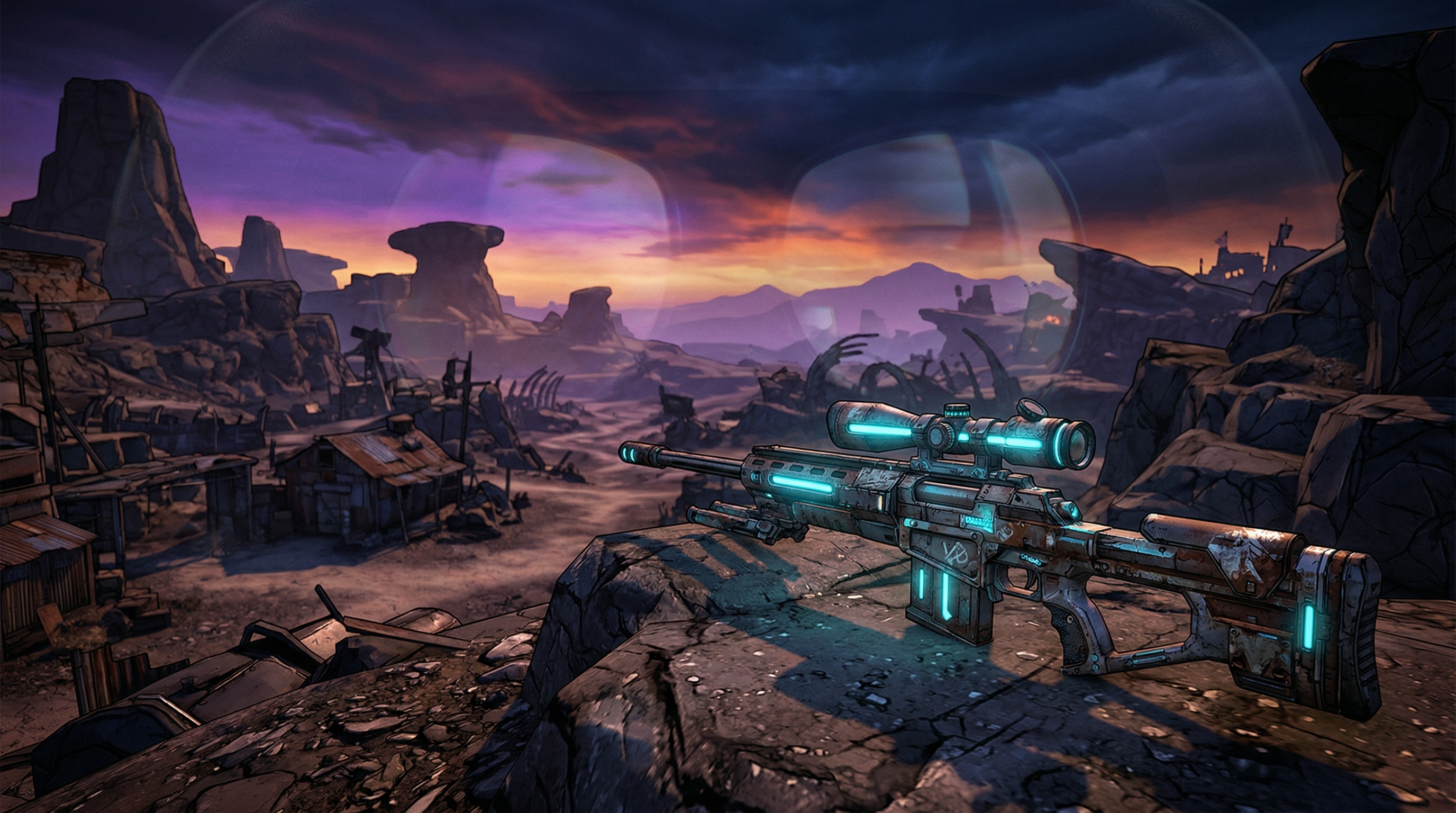
Standing on the edge of a cliff overlooking Pandora’s rust-colored wasteland, the scale of the thing finally makes sense. Borderlands 2’s cel-shaded world has always looked like a comic book come to life, and in VR, that comic book wraps around the player. Bandit camps tower overhead. Skags charge from what feels like actual meters away. For a moment, the ambition is undeniable.
But then the framerate stutters on a head turn. Or a sprint across the Dust triggers a lurch in the stomach. Or you remember that the co-op partner who carried you through the flat version isn’t here — because co-op doesn’t exist in this version.
Borderlands 2 VR is a standalone PSVR release — not a patch or hybrid mode, but a separate SKU built specifically for virtual reality. Gearbox Software rebuilt the entire campaign for a single player wearing a headset. It’s one of the most ambitious conversions the medium has seen, and in places, that ambition pays off. In others, it collapses under its own weight.
The Shooting, When It Works
The gunplay is where the conversion works best. Aiming with your head via the DualShock 4 feels surprisingly natural — more precise than you’d expect, and genuinely satisfying when you line up a critical hit on a psycho’s exposed face. The new BAMF Time (BadAss Mega Fun Time) mechanic, which slows combat to a crawl at the press of a button, turns frantic firefights into tactical shooting galleries. Dual-wielding weapons with PlayStation Move controllers has a physical immediacy that a gamepad can’t replicate.
But the Move controls are a mess in almost every other respect. Movement requires pointing a controller and holding a button, which feels clumsy when you’re trying to strafe around a badass enemy. The lack of analog sticks makes precise positioning frustrating. After extended sessions, the controller tracking reportedly drifts, forcing a restart. Many players will gravitate back to the DualShock 4 not because it’s more immersive, but because it’s more functional.
The Comfort Problem
Comfort is the real killer here. Gearbox packed the options menu with every mitigation they could think of — snap turning, smooth turning, teleportation, free locomotion, optional jumping, peripheral blinders — and yet extended sessions still leave players queasy. The head-locked HUD doesn’t help; your health, shield, and ammo float in front of your face like a dashboard sticker, and the disconnection between where you’re looking and where the UI lives creates a subtle but persistent sense of wrongness.
Even jumping, a staple of the flat game’s vertical combat, becomes a nausea trigger. Gearbox reportedly advised taking breaks every 15 to 20 minutes. When the developer is essentially warning you not to play their game for too long, that’s a problem. The PlayStation Store’s own comfort rating flags this as “Intense,” and it earns that label honestly.
Performance in the Wasteland
On a base PS4, the framerate holds up reasonably well in enclosed spaces but buckles in open environments, with noticeable stuttering during head turns and aliasing that shimmers across the cel-shaded landscape. PS4 Pro improves things but doesn’t eliminate the inconsistency. For a game where combat demands quick reactions and constant spatial awareness, those hitches are more than cosmetic — they’re distracting.
What’s Missing
Then there’s what’s simply not here. Borderlands 2’s co-op multiplayer, the beating heart of the franchise for most players, is entirely absent. Gearbox’s explanation — that they wanted to focus on a tailored single-player experience — doesn’t change the fact that this is a looter-shooter built around buddy comedy and shared chaos, now reduced to solo grinding. The base cast of vault hunters is present, but the DLC campaigns that extended the flat game’s life for years are absent. You’re getting the core campaign and nothing else, which is a significant value gap when the flat version has been bundled with everything for years.
The illusion shatters constantly. Cutscenes play on flat 2D planes. Menu screens are holographic projections that feel like floating webpages rather than diegetic interfaces. These aren’t dealbreakers on their own, but they accumulate, reminding you that you’re playing a port rather than a native VR experience.
The Bottom Line
So who is this for? If you’re a Borderlands die-hard with a PSVR headset and a stomach of iron, there’s enough here to justify the purchase. The core loop — shoot, loot, level up — survives the transition, and the world genuinely benefits from the sense of presence that VR provides. But if you were hoping for the definitive Borderlands 2 experience, this isn’t it. The missing co-op, missing content, comfort issues, and performance inconsistencies make this a curiosity more than a must-play.
Borderlands 2 VR proves that full-scale AAA games can exist in virtual reality. It also proves that getting them there without losing what made them special is harder than it looks.