
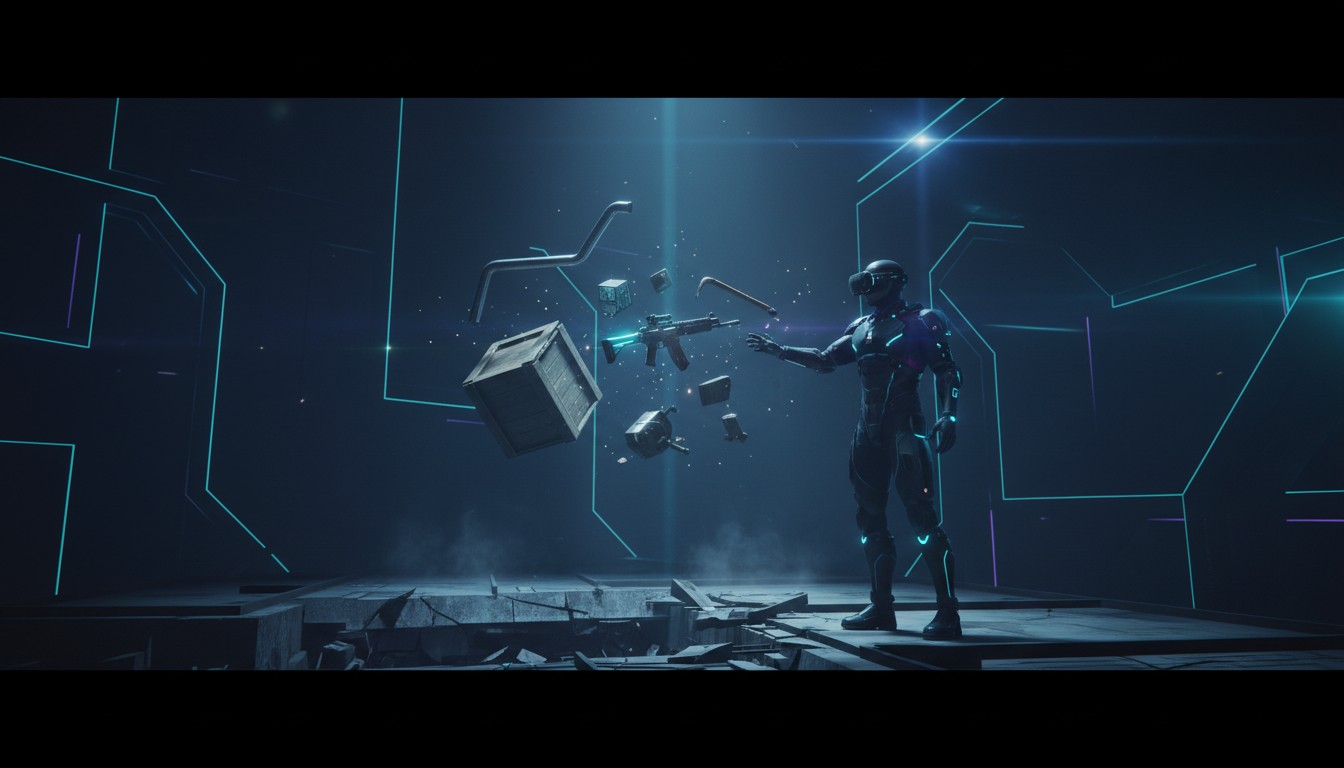
The first time I threw a crate at a headcrab—wait, wrong game. The first time I grabbed a metal pipe with both hands, felt the weight shift as I swung it into an enemy, and watched them stumble backward into a pile of physics objects that all reacted independently, I understood why people still talk about Boneworks six years after release.
Stress Level Zero didn’t just make a VR shooter. They built a simulation where your entire body exists inside the world. Not as an abstract hitbox. As a physical object with mass, momentum, and collision. You have legs. You have shoulders. You can duck behind cover and your actual virtual knees are tucked under actual virtual cover. It’s ridiculous. It’s also why nothing else in VR feels quite like it.
What This Actually Is
Boneworks launched in December 2019 as a PCVR exclusive—SteamVR and Oculus Rift—and there’s no flat version. This is a native VR title built from the ground up around hand presence, two-handed object manipulation, and full-body physics. The game runs on Stress Level Zero’s proprietary Marrow Engine, which sits inside Unity and handles the heavy lifting of simulating realistic object weight, material properties, and body physics.
You play as Arthur Ford, navigating MythOS City, a simulated universe created by Monogon Industries. The campaign takes you through levels that blend combat, physics puzzles, and environmental traversal. But the real star isn’t the narrative—it’s the systems underneath everything.
Every object in the world has physical properties. A pistol feels light and one-handable. A two-handed rifle requires both grips and has heft. A sledgehammer swings with momentum you have to account for. Doors open with realistic resistance. Ladders require you to physically climb them, grabbing rungs and pulling yourself up. It sounds like a small thing until you’ve played an hour and realize no other VR game makes you work this hard just to move through the world.
The Physics Are the Game
Here’s the thing about Boneworks: the physics aren’t a feature. They’re the entire design language.
Combat is improvised. You might start with a pistol, run out of ammo, grab a crowbar off a workbench, throw it at an enemy, then pick up their dropped weapon while they’re recovering. Environmental kills are not scripted events—they’re emergent consequences of a world that actually behaves like one. I can’t tell you how many times I’ve watched a YouTube clip of someone solving a combat encounter by knocking over a shelf and letting gravity do the rest.
The full-body simulation—Stress Level Zero calls it the “hexabody” rig—uses six-point inverse kinematics to approximate where your limbs are based on your head and hand positions. It works surprisingly well most of the time, but it’s not magic. Crouch wrong and your virtual legs might clip through geometry. Reach too far and the IK gets confused about where your elbows are. These aren’t dealbreakers, but they are constant reminders that you’re operating a physics puppet, not inhabiting a body.
And then there’s the sandbox mode. Unlock it by finding secret rooms and reclaiming items during the campaign, and you get an open playground with every weapon and tool in the game. This is where Boneworks transforms from a good campaign into a long-term destination. People have spent hundreds of hours in sandbox mode just experimenting with the physics, building Rube Goldberg machines, stress-testing the engine, and creating their own combat scenarios.
The Comfort Tax
Look, I’m not gonna lie. Boneworks is intense.
The full-body physics that make it special also make it one of the most motion-sickness-inducing VR titles you can buy. Your virtual body moves through the world with momentum and collision. If you physically walk into a wall, your virtual body stops and your head keeps moving relative to your body—which is exactly the kind of vestibular mismatch that makes people rip off their headsets.
Smooth locomotion is mandatory. There are comfort options, but they’re limited. The developers explicitly recommend prior VR experience, and they mean it. This is not the game you hand to someone who’s never been in a headset. I’ve watched experienced VR players need breaks after 30-minute sessions. The physics are immersive because they’re physical, and that physicality comes at a comfort cost.
Performance is another consideration. The Marrow Engine’s physics simulation is CPU-intensive. You’ll want a mid-range PC at minimum, and the more complex scenes with dozens of physics objects will push even good hardware. It’s not unplayable on modest setups, but it’s definitely not optimized for potato-tier machines.
Campaign vs. Sandbox
Boneworks’ campaign is better than it has any right to be. It’s not just a tutorial stretched across levels—it’s a genuinely engaging progression through increasingly complex environments that teach you the physics systems organically. The pacing is smart: early levels let you learn object manipulation and basic combat, later levels throw you into scenarios where you have to combine everything you’ve learned.
That said, the campaign is relatively short—maybe 6 to 10 hours depending on how much you explore. The real longevity comes from sandbox mode and community content. Boneworks has mod support, and while it’s not as extensive as its successor Bonelab’s ecosystem, there’s still a healthy community creating custom maps, weapons, and scenarios.
Speaking of Bonelab: yes, Stress Level Zero’s 2022 follow-up exists, and yes, it has better Quest optimization and broader mod support. But Boneworks still wins on campaign cohesion and PCVR visual fidelity. Bonelab’s textures and lighting took a hit to run on standalone Quest hardware. Boneworks, being PCVR-native, looks richer and more detailed. If you’re strictly on PCVR and want the better campaign, Boneworks is the choice.
The Bottom Line
Boneworks is six years old and still the reference point for physics in VR. When a new VR game launches with interactive objects, the comparison everyone makes is “but does it have Boneworks-level physics?” Usually the answer is no.
This is a game for people who already love VR and want to see what the medium can do when physics aren’t faked. It’s not comfortable. It’s not casual. It demands a decent PC, strong VR legs, and a tolerance for occasional jank. But what you get in return is a level of systemic interaction that no other VR title has matched.
If you’re new to VR, start elsewhere. Build your tolerance, learn your hardware, come back when smooth locomotion doesn’t make you sweat. If you’re a PCVR owner with some hours under your belt and you haven’t played Boneworks yet, you’re missing the game that defined what VR physics could be.
It’s demanding. It’s occasionally frustrating. It’s also the reason I still believe VR can be something no other medium can replicate. Boneworks doesn’t simulate a game world. It simulates a world, full stop, and drops you inside it with a gun and a physics engine.
That’s worth the setup. That’s worth the performance cost. That’s worth the occasional moment of “why is my virtual leg stuck in a doorframe.”