
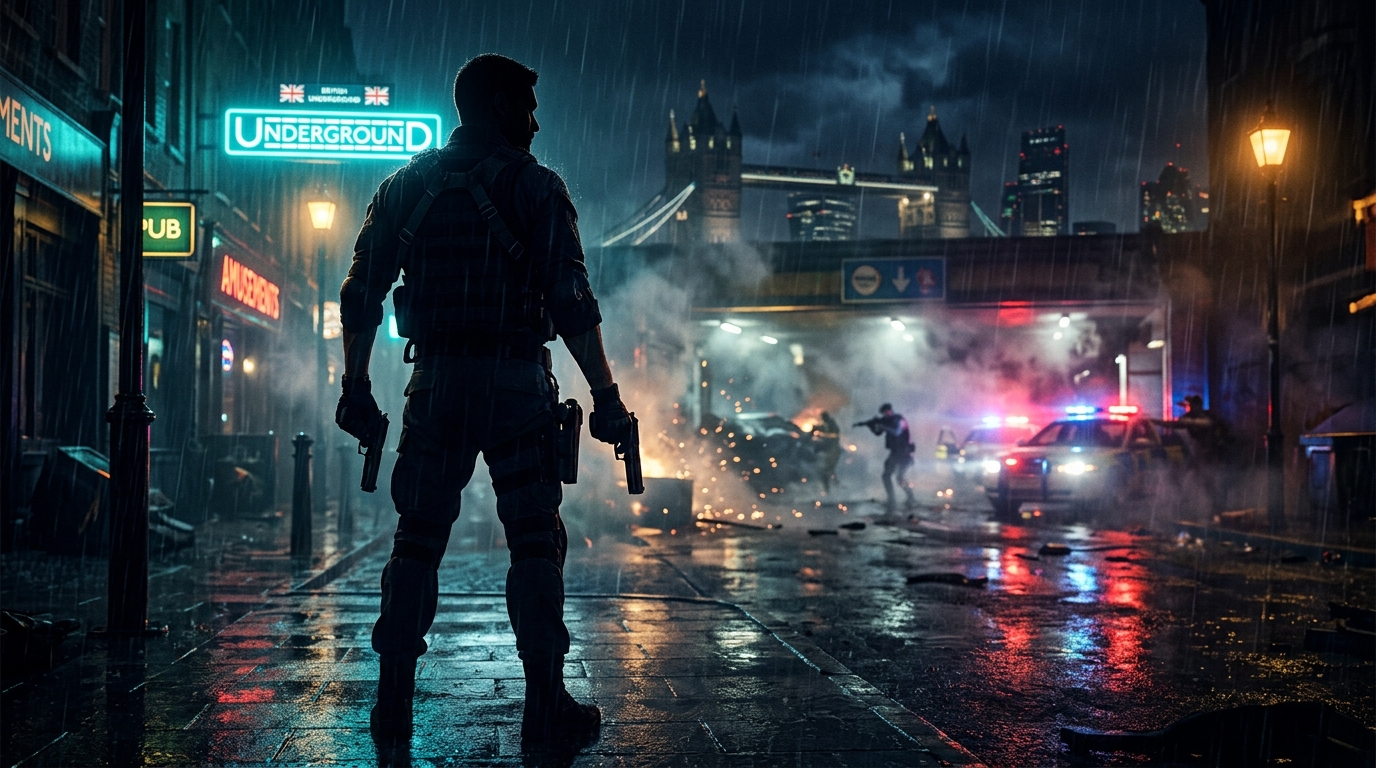
The first time you rack a shotgun by physically pumping it with two PlayStation Move controllers, then level it at a hired thug who actually flinches when you squeeze the trigger, the realization hits: Blood and Truth is not trying to evoke an action movie. It actually put you in one.
Developed by Sony London Studio and released exclusively for PSVR in May 2019, Blood and Truth is the rare first-party VR title built with the budget, talent, and sheer technical craft of a traditional console blockbuster. You play as Ryan Marks, an ex-SAS operative pulled back into London’s criminal underworld after his father’s murder. The setup is pure Guy Ritchie territory — working-class gangsters, family loyalty, and a lot of automatic weapons — but the execution is unmistakably native VR. Every reload demands you grab a magazine from your chest rig. Every door breach lets you kick it down yourself. Every hostile who corners you is looking at you, not at a flat-screen avatar.
That last point matters more than it sounds. Sony London Studio collaborated with Goodbye Kansas Studios to deliver full performance capture for over an hour of cinematics, including detailed facial animation that tracks individual muscle movement. In 2019, this was close to unprecedented for VR. Characters maintain eye contact, sneer with specificity, and react to your physical position in the scene. The voice cast — drawn from stage, television, and film backgrounds — delivers performances that feel earnest rather than the campy b-movie acting that plagued early VR narratives. When Ryan’s sister is in danger, the desperation in her voice actually registers because she is standing two feet from your face, studying your reaction.
What you’re actually strapping into
Blood and Truth is a native PSVR exclusive. There is no flat version, no PC build, no port — London Studio built it for the headset from the ground up, and it shows in ways a bolted-on VR mode never does. It grew out of The London Heist demo from PlayStation VR Worlds, the one bit of that collection everyone pointed to and said “make a whole game out of this.” Sony did.
The setup is pure console: a PS4, the PSVR headset, the PlayStation Camera, and two PlayStation Move controllers. No modding, no config files, no PC. You slot the Moves in, the game maps each one to a hand, and you’re holding guns. For a VR title this is about as frictionless as the medium gets — you buy it, you install it, you play it. Comfort options follow the standard PSVR cover-shooter model, with a vignette toggle if the leaning and ducking gets to you.
Because the movement is on rails, the nausea risk of free locomotion never really arrives. You look at a preset point, press a button, and glide forward; the camera never yanks you around without warning. Even the rappelling and vehicle sequences keep the horizon stable. On a base PS4 the game runs well; on a PS4 Pro it holds a solid 60fps with noticeably sharper image clarity in the headset. This is one of the best-looking titles on the platform, with detailed environments, realistic weapon models, and lighting that sells the grit of its London settings.
This is a PlayStation-only experience. If you don’t own a PSVR setup, there is no other way in. That says nothing about the game’s quality.
London, but you’re holding the gun
The world is the real draw. Blood and Truth commits hard to a British crime-thriller tone — think The Getaway with the ratcheted-up spectacle of a Bond opener. You move through a casino heist, a high-rise shootout, a car chase, a masked ball, and a final standoff that knows exactly what kind of movie it wants to be. The production values are first-party Sony, and the motion-captured performances land with a weight most VR titles never approach.
What surprised me is how much of the game is just being there. Walking into the casino in a tux, feeling the scale of the room, watching NPCs react to you — the presence does a lot of the heavy lifting. It’s a tightly scripted roller coaster, and the scripting is good. The story gives you a reason to care who you’re shooting, which is rarer in VR shooters than it should be.
The action is built around on-rails movement, and the limitation is immediate: you cannot explore, flank, or wander off the path. What you get in exchange is a carefully choreographed camera that swings you through a nightclub shootout one moment and dangles you from a rappelling line above a high-rise the next. The set pieces are elaborate — car chases through London streets, penthouse assaults, firefights in underground garages — and the pacing knows exactly when to let you breathe between explosions.
The campaign runs roughly five hours. That’s short for a flat game, but for a cinematic VR experience it’s about right — the intensity doesn’t wear out its welcome, and you finish it in a couple of committed evenings rather than letting it sprawl.
The gunplay is the point
Here’s where Blood and Truth earns its tier. The dual-wield Move controls are the whole game, and they feel great in the ways that matter. You hold a pistol in each hand, you reload by grabbing a fresh mag off your chest and slamming it home, you cock the slide, you aim by actually pointing. Want to fire two guns at once? Do it. Want to keep one hand steady on a rifle while you blind-fire around a corner? The game lets you. There’s a tactile logic to every weapon that flat shooters never give you — the gun is an object you manipulate, not a reticle you wiggle.
Lockpicking, climbing, and a few environmental interactions break up the shooting, and they’re all hand-driven. Picking a lock means working a tool with motion; climbing a ledge means reaching and pulling. None of it is deep, but it keeps your hands busy and your brain convinced you’re doing something real. The haptics on the Move controllers are loud and physical in the best way — every shot has a kick you feel in your palm.
Cover shooting is the core loop, and it works because the cover is real geometry you lean around. Pop out, fire, duck back. There’s a timing and a rhythm to it that clicks after the first few rooms. I came away from sessions genuinely sweating, which is the highest compliment I can pay a VR shooter.
The one hardware wrinkle is aiming down sights. PSVR’s single-point camera tracking occasionally drifts during precise movements, particularly when you bring a weapon close to your face. It is not a dealbreaker, but it is a recurring reminder that you are still working within first-generation tracking hardware.
Where it actually falls apart
The combat is thin under the hood. Enemy variety is low — you’re fighting the same handful of goons across the whole campaign, and their AI is barely there. They pop out, they shoot, they die. There’s no real tactics beyond “shoot them before they shoot you,” and the gunplay, while fun, doesn’t have the systemic depth of a proper VR tactical shooter. If you go in expecting Rainbow Six in VR, you’ll be disappointed. This is arcade shooting dressed in blockbuster clothing.
The shooting also gets a little loose at distance. Close and mid-range duels feel great; long corridor firefights where you’re plinking distant targets can feel imprecise, partly because the Move controllers aren’t the most accurate aiming devices ever made. It’s a minor wrinkle, not a dealbreaker, but it’s there.
The narrative is a straight line with almost no deviation. There are no side missions, no alternate routes, and no meaningful choices beyond which gun to empty first. The story hits every beat you expect from a London crime thriller — the loyal soldier, the treacherous rival, the family in peril — without ever subverting them. It is competently written and performed, but it is not trying to surprise you.
And then there’s the length. Five hours is the whole thing. There’s some replay value in score attack and difficulty, but this is a story you experience once and remember fondly rather than a game you live in. For the right price and the right expectations, that’s completely fine. If you were hoping for a 40-hour VR epic, adjust before you buy.
The score, and who should pull the trigger
Blood and Truth is the best argument for owning a PSVR that first-party Sony ever shipped in this style — a real blockbuster with real production values, not a tech demo with a budget. It isn’t deep or long, and the AI won’t challenge you. What it is, consistently, is a thrill: you’re inside a London crime movie, guns in both hands, and the headset makes that matter more than the thin systems underneath.
If you already have a PSVR and you want the closest thing the platform has to a Mission: Impossible set-piece reel you can step into, this is an easy yes. If you’re on another headset entirely, there’s no door in — and that’s the one frustration worth naming. But for the people this was built for, it’s one of the experiences that justifies the hardware. Put the headset on, grab the Moves, and let London happen to you.