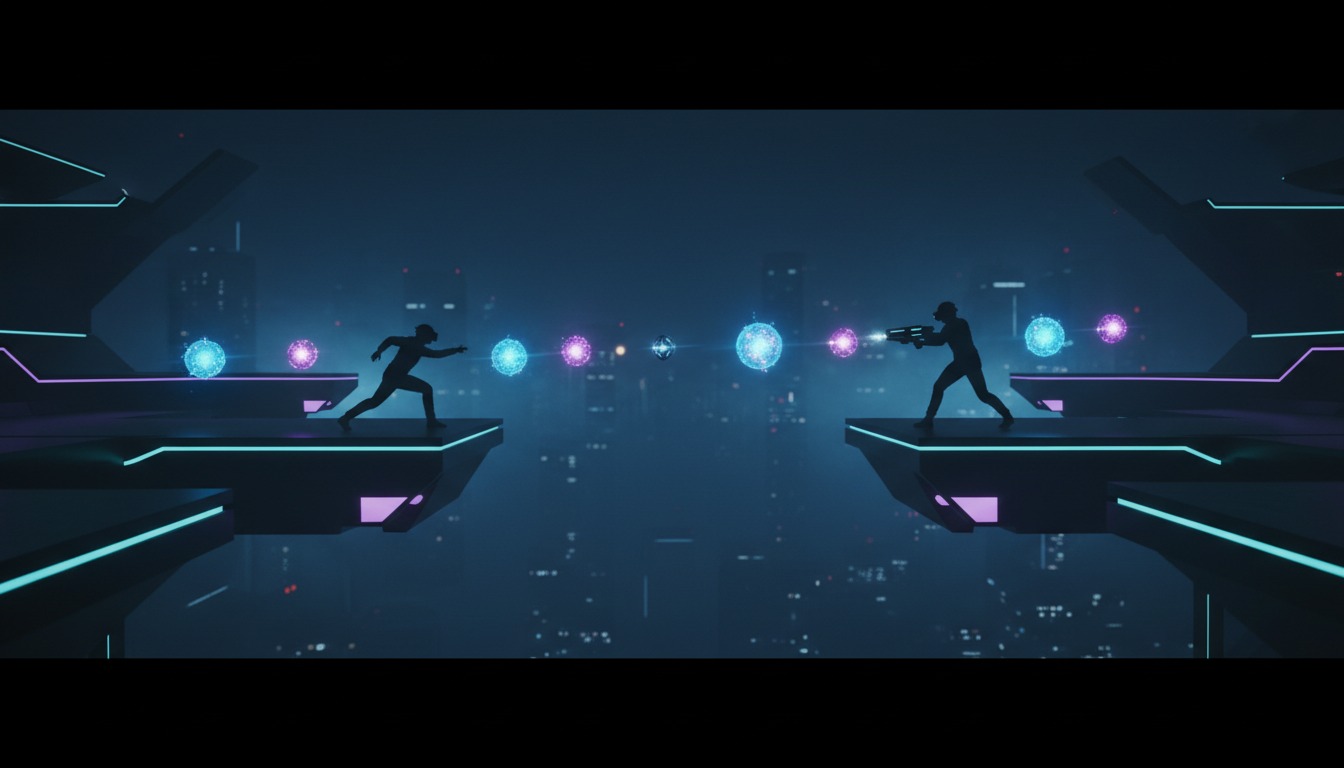
The first thing that separates Blaston from every other VR shooter is not its weapons, its arenas, or its scoring. It is the speed at which nothing moves. Bullets do not scream toward you — they float, lazily, like dandelion seeds caught in a draft, and your job is to contort your body around them while building a cage of returning fire for your opponent.
Resolution Games released Blaston in October 2020 as a native VR competitive dueling game built entirely around this conceit. Two players stand on opposite platforms in a futuristic arena. Each selects a loadout of six weapons and defensive tools. When the round starts, those weapons materialize around the platform at intervals, and both opponents begin firing slow-moving projectiles across the gap. Victory goes to whoever empties the other’s health bar first, or whoever has more health when the timer runs out.
The genius of the design is that the projectiles are slow enough to see, track, and physically dodge, but fast enough that standing still is fatal. A single well-placed shot might force a lean; a barrage from multiple weapon types forces a full-body weave, a duck, a sidestep, a desperate backward bend. On Quest, where the headset is untethered, players can spin freely and use their entire play space as a defensive tool. On PCVR, the same mechanics apply, though cable awareness adds a small but real friction to the 360-degree dodging that the game implicitly demands.
Blaston is not a reflex test in the traditional shooter sense. It is a spatial puzzle that happens to involve guns. Success comes from reading your opponent’s patterns, controlling the geometry of the arena with deployed shields, and using weapons with complementary bullet speeds and trajectories to cut off escape routes. One weapon might fire a wide, slow wall of energy that forces a dodge in a specific direction, setting up a faster, narrower shot from a different gun that catches the opponent mid-dodge. The skill ceiling is genuine, and the physicality of the dodging — actually moving your head and body rather than twitching a thumbstick — makes every clean evasion feel earned.
The VR implementation is exactly what you would hope for from a native competitive title. Motion controls handle aiming and weapon swapping naturally. The platform-based format eliminates artificial locomotion entirely, so there is no nausea risk from smooth movement. The UI is clean and functional in-headset. Passthrough modes on Quest allow the arena to float in your real room, which is a nice touch for accessibility and spatial awareness.
Since transitioning to a free-to-play model in late 2022, Blaston has removed the price barrier entirely. Cross-play between Quest, Steam, and Pico means the theoretical matchmaking pool spans all major VR platforms. The game also added a single-player campaign and various cosmetic unlocks post-launch, giving solo players something to do between matches.
But the population problem is real, and it is the single biggest factor tempering the recommendation. Steam concurrent player counts have been in the single digits for extended periods, with an all-time peak that barely cracked two dozen players. Quest numbers are harder to verify, but the Steam figures suggest the overall player base is thin. Cross-play helps, but it cannot fully compensate for a niche 1v1-only format in a market where most VR multiplayer games already struggle to maintain healthy populations. You may wait longer than you would like for a match, especially outside of peak hours or if you are playing on PCVR.
The content depth is also limited by its own focus. Blaston does one thing — 1v1 slow-motion dueling — and it does that thing exceptionally well. But it offers no team modes, no co-operative play, and no broader metagame beyond ranked matchmaking and the lightweight single-player campaign. If you burn out on the core loop, there is nowhere else to go.
This is a game for competitive VR players who want something physically engaging and intellectually distinct from the flatscreen shooter formula they have already memorized. It is for players who value body movement as a mechanic, who want to feel the geometry of a firefight rather than just click on it. It is not for players who need reliable matchmaking at odd hours, who want team-based chaos, or who prefer their shooters to reward twitch aim over tactical positioning.
Blaston is a native VR design that could not exist on a monitor. The slow-motion dueling format turns your entire body into a hitbox and a weapon, and the result is one of the most mechanically inventive competitive shooters in the headset. The tragedy is that a game this smart, this physically engaging, and this free to try still struggles to find an audience large enough to sustain itself. It is absolutely worth downloading — just go in knowing that the best opponent might be a matchmaking timer.