
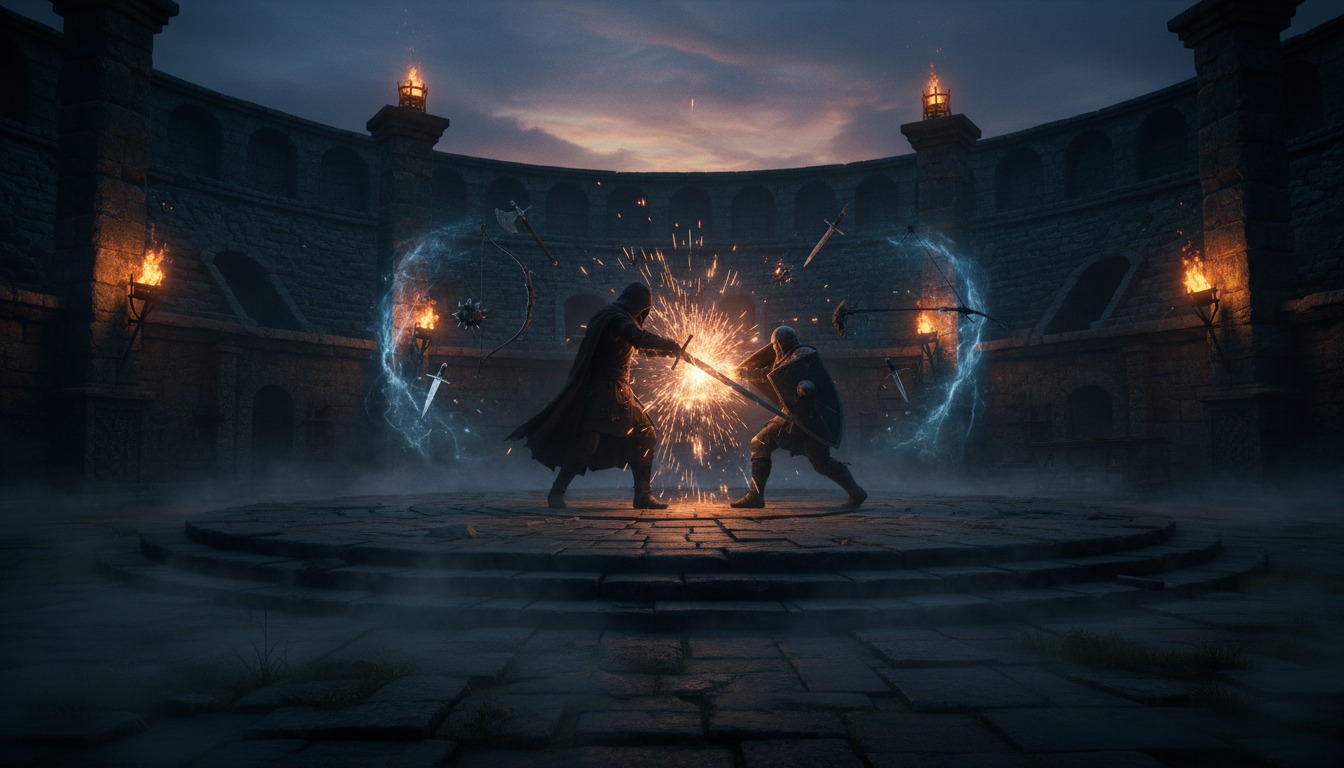
You swing a longsword at a raider’s head and something unexpected happens: the blade catches on his shield, slides along the rim, and bites into his shoulder with the awkward, messy physics of real metal hitting real bone. In most VR games, that collision would have ghosted right through. In Blade & Sorcery, it stops. It bounces. It behaves like an object with mass, and that single difference rewrites what melee combat feels like in a headset.
WarpFrog’s Blade & Sorcery arrived on Steam Early Access as a PCVR-native medieval combat sandbox, and its selling proposition is brutally simple: weapons have weight, edges cut where edges should cut, and the entire design flows from that foundation. There is no campaign here, no skill tree, no narrative justification for why you are standing in a stone courtyard surrounded by people who want you dead. You are here because the combat is the game, and for once, the combat justifies the admission price.
What the Combat Actually Feels Like
What makes the moment-to-moment play compelling is the collision system. Swords, axes, daggers, and polearms all carry momentum that your arm must generate. Waggle a blade limply and it taps harmlessly against armor. Put your body behind a swing and it cleaves through flesh. Stab someone in the leg and they stumble. Crush a skull with a mace and the impact feels thuddy and correct, not pre-canned. The absence of pre-baked attack animations means every fight is a mess of improvised geometry: you might hook an enemy’s helmet with a halberd, lose your grip when they yank the shaft, or accidentally lodge a thrown knife in a wooden beam two feet left of your target.
This is the first commercial VR melee system that treats your weapons as physical objects rather than wands with hitboxes. It demands you respect length, angle, and follow-through. You cannot simply flail your controller and win. A spear kept at range is devastating; brought in close, it becomes a liability. A dagger requires you to get inside an enemy’s guard. A greatsword needs space to build momentum. The game does not explain this in a tutorial — it teaches through the physics itself, and the learning curve is part of the satisfaction.
The magic system layers on top of this physicality with surprising coherence. Telekinesis lets you pluck weapons from the ground or choke an opponent from across the room. Lightning chains between clustered enemies. Fire ignites cloth and spreads realistically. Each spell is gesture-activated and governed by the same physics logic as everything else, which means a telekinetically lifted crate has real inertia, and a lightning bolt can strike your own sword if you are careless. It feels less like casting from a hotbar and more like manipulating a dangerous toolset that happens to respond to hand movements.
The Walls of the Sandbox
The structure, however, is where the Early Access label bites hardest. Blade & Sorcery offers a handful of arena maps and two primary modes: wave-based survival and a free-for-all sandbox where you spawn enemies at will. That is the full menu. There are no objectives, no persistent progression, no unlocks, no story beats to chase. You fight until you die, restart, and fight again. For some players, this is a feature — a pure, distilled combat loop with no filler. For others, it is a narrow package that runs out of new experiences within a few hours.
Enemy variety is thin at launch, and while the AI is aggressive enough to keep you honest, it does not exhibit much tactical depth. They rush, they swing, they die. The sandbox tools help extend the lifespan — you can spawn ten enemies, give yourself only daggers, or turn off gravity and see what chaos unfolds — but the playground itself is small. The modding community is already picking up considerable slack, building new weapons, maps, and gameplay tweaks at a brisk pace — a guide to the best Blade & Sorcery mods covers the Outer Rim Star Wars conversion and the 400-weapon Medieval MegaPack worth starting with. Still, buying a game on the promise of future community content is a gamble Early Access asks you to make explicitly, and the base offering is lean.
Stability, Performance, and Comfort
Performance and stability carry the usual Early Access caveats. On reasonable hardware the game maintains its framerate well enough for a smooth VR experience, though dense enemy clusters and heavy physics calculations can introduce hitches. Physics glitches occasionally launch bodies into orbit or cause weapons to vibrate themselves loose from your grip. None of it is frequent enough to ruin a session, but all of it reminds you that this is a work in progress.
Comfort is worth a blunt warning. This is an intense, room-scale combat experience. You are ducking, sidestepping, and swinging your arms with force. There is no comfort option that will save you from the fact that you are physically exerting yourself in a fight. If you are prone to VR fatigue or have limited playspace, this will push against those boundaries quickly.
Who Should Step Into the Arena
If you bought a VR headset because you wanted to feel like you were actually holding a sword, Blade & Sorcery is currently the closest thing to that fantasy working at a commercial level. It is a VR-only title — there is no flat version — and that native focus shows in how tightly the systems are built around motion controls and physical presence. If you need structure, progression, or a reason to fight beyond the pleasure of the fight itself, it is not ready for you yet, and it may never be. This is fundamentally a sandbox, not a campaign waiting to be finished.
WarpFrog has built something rare here: a combat system so physically satisfying that it papers over an otherwise barebones package. In Early Access, that is enough to recommend it to enthusiasts and anyone who has been waiting for VR melee to stop feeling like a trick. Just know you are buying a playground, not a kingdom.