
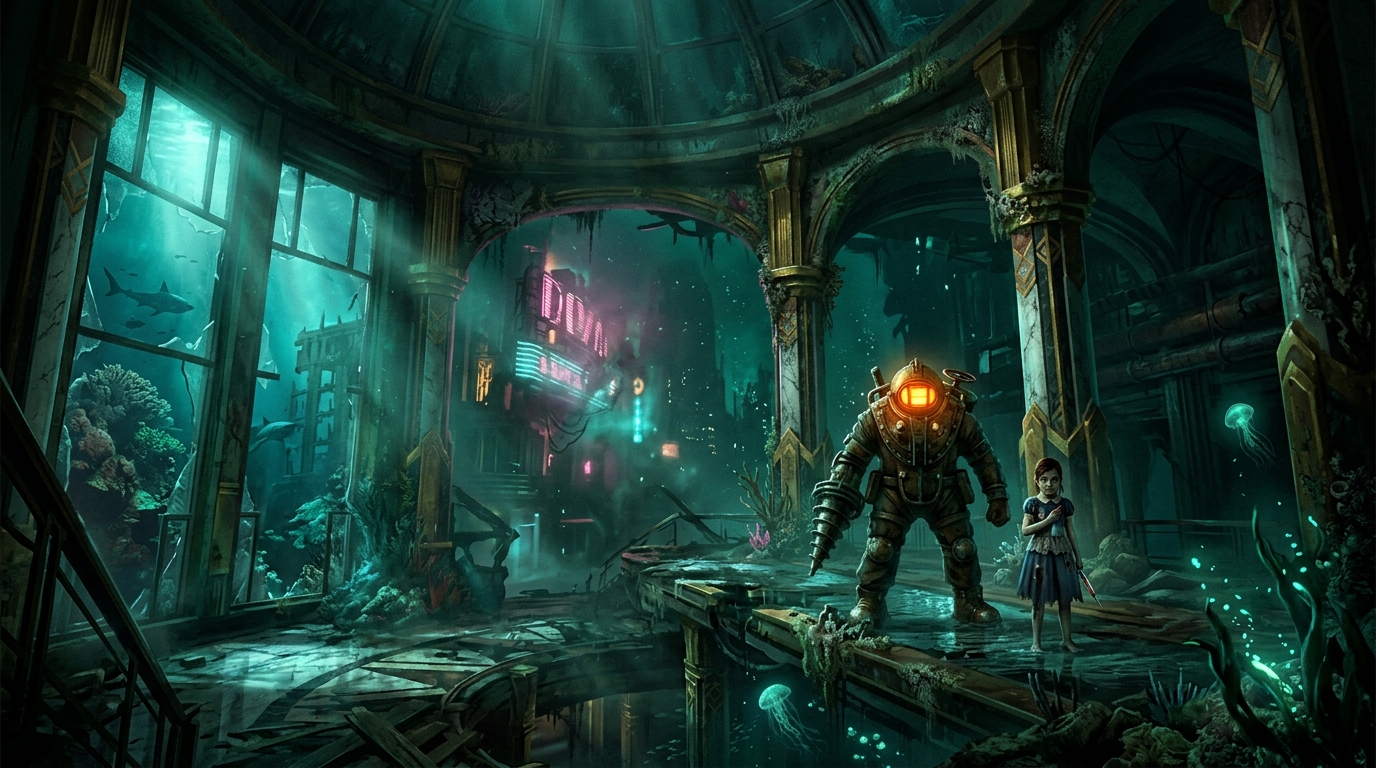
There’s something genuinely unsettling about looking down at your own riveted diving suit in VR, drill arm humming, while a Little Sister cowers in the corner. BioShock 2 always cast you as Subject Delta, a prototype Big Daddy; with VorpX, you’re actually inside the helmet, and Rapture’s art-deco decay surrounds you in three dimensions.
This is an injection-driver experience — stereoscopic 3D and head tracking through VorpX, with no motion controls and no hand presence. You play with a gamepad or mouse and keyboard, exactly as the flat game intended, but now the city looms around you rather than sitting flat on a monitor. The original 2010 release is strongly preferred over the Remastered edition: the remaster is a clunky DirectX 9-to-11 conversion that introduces unnecessary overhead, and reports consistently describe jittery, inconsistent frame rates in VR even on powerful hardware. The original, by contrast, can achieve stable performance in Geometry 3D mode and preserves the lighting and atmosphere that made Rapture memorable.
The catch — and it is significant — is that official VorpX support for the BioShock series was removed from the cloud service after a DMCA notice from Take-Two Interactive. What this means practically is that new VorpX users cannot simply download an optimized BioShock 2 profile. If you already have the profile from before the removal, it reportedly still functions. If you don’t, you’re looking at manual configuration or community-sourced alternatives, which is a substantially higher barrier to entry than most injection-driver titles.
Assuming you clear that hurdle, the experience itself is compelling. Rapture’s corridors benefit enormously from depth and scale. The city’s towering statues, leaking tunnels, and flooded atriums feel physically present in a way the flat version never quite managed. Combat, already refined from the first BioShock with dual-wielding plasmids and weapons, gains an extra layer of immediacy when enemies are literally in your face. The drill dash — charging forward with your arm-mounted bore — is genuinely startling in a headset. Big Sister encounters, already tense, become genuinely stressful when you can feel the scale of these armored figures hurtling toward you.
That said, this is still an injection driver, not a native VR adaptation. The HUD is fixed to your view and cannot be repositioned or scaled in BioShock 2 the way it can in the original BioShock, which means some UI elements may feel intrusive. Controls remain entirely flat-game: no aiming with your hands, no physical interactions, no motion-controller gestures. You’re playing a 2010 first-person shooter with a gamepad, just with your head serving as the camera. For some, that’s enough — the atmosphere carries it. For others, the absence of VR-native interactivity will feel like a missed opportunity.
Comfort is manageable but not gentle. BioShock 2 is a first-person shooter with fast movement, sudden enemy spawns, and occasional underwater walking sequences that can disorient in VR. The game’s jump scares and audio design — already effective — hit harder when you’re wearing a headset. If you’re sensitive to horror or sudden motion, this will test you. The original game’s field of view can be adjusted, which helps, but expect a moderate-to-intense ride.
Stability is the other concern. The original BioShock 2 is a 32-bit application, which means it hits memory limitations on modern systems — particularly at the high resolutions that make VorpX’s Geometry 3D mode look its best. Users report occasional crashes when saving, interacting with vending machines, or running at very high resolutions. The GOG version in particular benefits from a large-address-aware patch to extend its RAM ceiling, and some users have found relief by adjusting texture streaming limits in the game’s configuration files. None of this is plug-and-play.
So who is this actually for? If you purchased VorpX years ago and happen to have the BioShock 2 profile sitting in your local database, this is one of the most atmospherically rewarding ways to revisit Rapture. The world holds up, the combat is tighter than the first game, and the stereoscopic presentation adds genuine presence. If you’re a dedicated BioShock fan with the patience to tinker, the original release plus VorpX offers something no flat replay can match.
For everyone else, the barriers are real and growing. The removed official profile, the 32-bit memory constraints, the need to source the original instead of the more widely available remaster, and the occasional stability issues add up to a project rather than a pickup-and-play experience. There is no motion-controlled future here, no hand presence, no VR-native UI. You’re getting a very good flat game with very good stereoscopic depth, wrapped in a layer of technical friction that most casual VR users will find unreasonable.
BioShock 2 in VR is a beautiful, compromised thing — like Rapture itself. The city is still magnificent. The question is whether you’re willing to swim through the debris to see it.