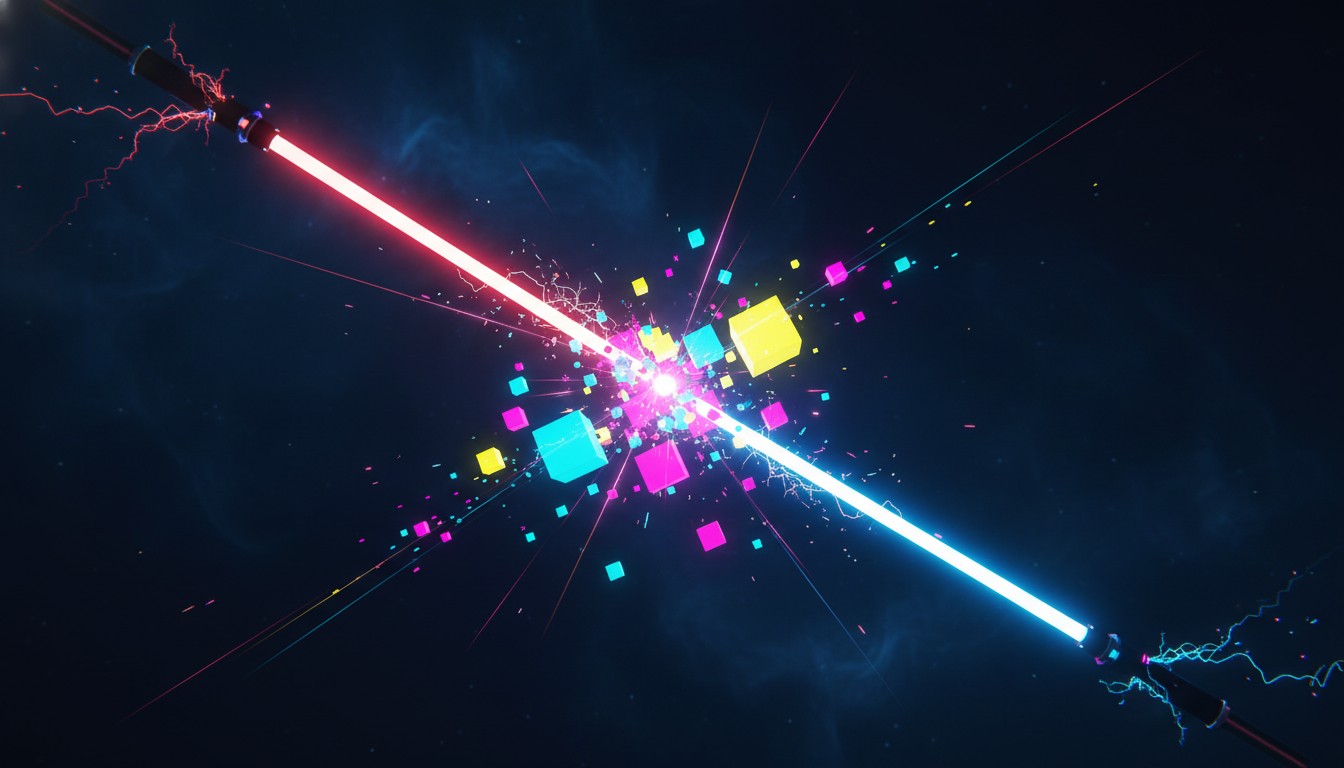
Here’s the thing about Beat Saber: it’s not trying to be a world. There’s no open landscape to explore, no lore to uncover, no crafting system or dialogue trees or side quests. You stand in a dark void, two glowing sabers materialize in your hands, and blocks fly at your face in time with the music. You slice them. That’s it. That’s the whole game. And somehow, it’s still the best argument for owning a VR headset.
Look, I’m not gonna lie — the first time you see it, it looks ridiculous. Neon blocks, cartoon sabers, EDM thumping in your ears. It looks like a tech demo that got out of hand. Then you play it. Ten minutes in, you’re sweating. Twenty minutes in, your shoulders are burning. Thirty minutes in, you realize you haven’t thought about your grocery list, your email inbox, or the fact that you look like a flailing traffic conductor to anyone watching from the couch. You’re just there, arms moving on pure muscle memory, completely locked into the beat.
Beat Saber is a native VR game, built for headsets from day one. There’s no mod to install, no injection layer to configure, no prayer that your controller bindings will map correctly. On Quest, you buy it from the store and it runs on the headset itself — no PC required. On PCVR, it launches from Steam or the Meta store like any other game. On PlayStation, it’s a standard PSVR and PSVR2 title. The setup burden is basically zero, which already puts it ahead of most VR experiences where you spend the first hour troubleshooting before you see a menu screen.
Okay, so what does it actually feel like? Each hand holds a colored saber — red in one, blue in the other. Blocks approach on a conveyor belt from the horizon, color-coded to match your blades, with arrows indicating the slash direction. Up, down, left, right, diagonal. You swing. When it works, the feedback is immediate and deeply satisfying: the block splits with a crisp sound, the controller rumbles in your palm, and the score ticks up. When you miss, the block shatters past you, the combo breaks, and the music keeps going. There’s no hiding. The game is a pure, unfiltered test of reflexes and rhythm.
The difficulty curve is genuinely well-designed. Easy mode is approachable enough that my mother could pick it up and feel competent within a song. Normal and Hard start layering in more blocks, faster speeds, and directional complexity. Expert turns you into a frantic windmill of precision, and Expert+ is where the game separates the casual players from the people who treat this as a sport. At those highest difficulties, the tracking quality of your platform matters enormously. PCVR and Quest handle the speed reliably. PSVR and PSVR2 can start to struggle when sub-frame precision becomes the difference between a hit and a miss — not a dealbreaker for most players, but noticeable if you’re pushing for leaderboard scores.
The physicality is what makes Beat Saber stick. This isn’t “immersion” in the sense of believing you’re in another world. It’s immersion in the sense that your body is the controller, and after a solid session your body knows it. Play on Hard for forty minutes and tell me your deltoids don’t feel it the next day. It sits in that rare space between game and workout, where you’re having too much fun to notice you’re exercising until you take the headset off and realize you’re drenched.
That said, the core loop is the core loop, and not everyone lasts. The campaign mode strings together increasingly difficult song sequences with special modifiers and challenges, but it’s more of a structured playlist than a narrative — it teaches you the game and scales the challenge, it doesn’t transform what Beat Saber fundamentally is. If the rhythm-slashing concept doesn’t hook you in the first hour, the next twenty won’t change your mind. The base game ships with a solid track list, but the real longevity comes from building out your library. Official DLC music packs expand the catalog significantly, though buying them adds up if you want breadth.
On PC, a custom song community has existed for years, extending the game’s life far beyond official content. On Quest, the situation has shifted over time as platform policies evolved. The specifics change, but the broader point is this: Beat Saber’s longevity depends on having songs you actually want to slash to, and the official DLC model is the supported path across all platforms. (Note: PlayStation support for new content ended mid-2025, and PS multiplayer shuts down in early 2026; Quest and PCVR are unaffected.)
So who is this really for? Honestly? Everyone who owns a VR headset and hasn’t played it yet. It’s the default answer to “what should I play first?” It’s the game you hand to a VR skeptic to convert them. It’s a legitimate fitness tool disguised as an arcade game. It’s the experience that justifies the hardware for people who don’t care about sci-fi exploration or horror immersion or whatever else VR promises.
Who should skip it? If you fundamentally hate rhythm games, Beat Saber won’t perform alchemy on your tastes. If you want narrative, mechanical depth, or progression systems, this is a dessert, not a meal. And if you have shoulder or mobility limitations, the physical demands are real — though lower difficulties keep the arm movement manageable.
Beat Saber isn’t the most ambitious VR game ever made. It’s not the prettiest, the deepest, or the most technically impressive. But it’s the most honest — a game that knows exactly what it wants to be and executes it with near-perfect precision. Two sabers. Blocks. The beat. No setup. No compromise. Just you, the music, and the satisfying crunch of a perfect slash.