
The first time I leaned into Gale’s face in Baldur’s Gate 3 VR, I genuinely laughed. Not because he said anything funny — he was mid-lecture, because of course he was — but because there I was, inches from a Tiefling wizard’s eyebrows, inside one of the best RPGs of the last decade. For about ten seconds it felt like magic. Then the camera whipped across the map for the next combat turn and my stomach reminded me that this game was never designed for a headset.
That is the whole story of Baldur’s Gate 3 in VR: a staggering game world briefly, occasionally made more intimate by a headset, held together by a workaround that bumps against the same problem every few minutes. BG3 is an isometric, party-based, menu-heavy CRPG built on Larian’s custom Divinity Engine 4.0. It is not Unreal, so UEVR is off the table. There is no official VR support. If you want it in a headset, the practical option is Luke Ross’s R.E.A.L. VR framework mod, distributed through Patreon.
R.E.A.L. VR on Larian’s Engine
Luke Ross’s R.E.A.L. VR mod is the closest thing BG3 has to “real” VR. The install follows Ross’s familiar pattern, and it is not a one-click affair. After that, the game renders in stereoscopic 3D and the camera becomes your headset viewpoint. You can lean forward, tilt down over the battlefield, and peer at companions like they’re miniature figures on a diorama. The UI reportedly stays intact, which is impressive given that Ross was trying to wrap a full-VR frame around an isometric camera.
But this is still a framework injection into a flat game, not a native VR mode. There are no motion controls, no hand presence, no rebuilt interaction. You are playing Larian’s PC game through a stereoscopic lens, and the engine knows nothing about VR. The mod has to trick the camera, the UI, and the rendering pipeline into behaving like a headset experience. That it works at all is a testament to Ross’s framework; that it still feels like a compromise is the fault of the source material.
There is a lighter fallback if the framework mod sounds like too much: vorpX’s immersive-screen profile puts the game on a large virtual monitor with stereoscopic depth, not a transformed VR experience. It does not solve the camera problem; it simply makes it bigger.
A Pulled-Back Camera, Forced Forward
The interesting question is not whether BG3 can run in VR. It can. The interesting question is what VR does to a game built around a pulled-back tactical camera. BG3 wants you floating above the battlefield, rotating around the party, pulling back to read the whole scene. R.E.A.L. VR puts your eyes where the camera used to be. The world is suddenly at room scale, and Faerûn goes from a beautifully rendered board game to a place you feel you could walk into.
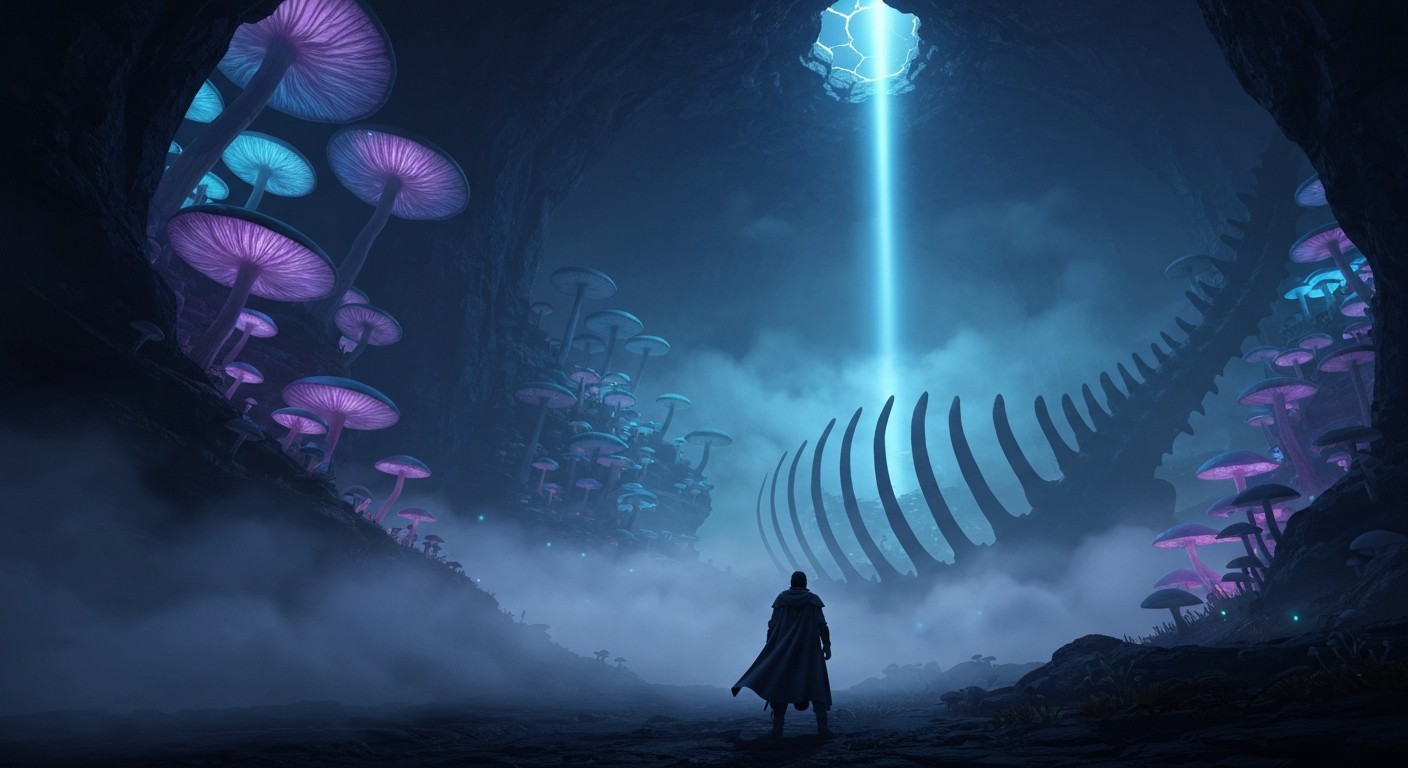
That transformation is exactly what makes the mod tempting. Standing in the Emerald Grove and looking up at the trees, or leaning over a cliff to see the Underdark below, gives the world a physical presence that the flat version cannot match. The art direction — already one of BG3’s strengths — gains weight when it surrounds you. Conversations with companions become closer, more theatrical, almost intrusive in the best way.
But the same camera that works beautifully on a monitor becomes a liability in a headset. In exploration you can look around freely, but the game still expects to control framing for dialogue and cinematics. The result is a constant negotiation between your head and Larian’s direction: sometimes the mod wins and you get a moment of real presence, sometimes the game wins and yanks your view where it thinks the camera should be.
Turns at Eye Level
Combat is where the friction turns into a real design problem. BG3’s turn-based battles were designed to be read from above. You need to see positioning, area-of-effect shapes and elevation. R.E.A.L. VR lets you lean in and study the diorama, which is genuinely cool for the first few encounters. You can peer at spell effects, watch a Fireball bloom at eye level, and feel the scale of a Mind Flayer up close.
The trouble starts when the game snaps the camera between turns, or re-centers on the active character, or swings to a cinematic kill animation. In flat BG3 those transitions are clean and readable. In VR each cut lands like someone grabbed your skull and pointed it elsewhere. After an hour of this, the discomfort stacks up. Players with strong VR legs report treating combat like a slow strategy session rather than an action sequence, which is honest to the turn-based design but also means you are spending a lot of time waiting for the camera to stop moving.
Tactical readability suffers too. The UI is built for a monitor at arm’s length, not a display floating in space. Ross’s framework keeps it functional, but tracking four party members’ cooldowns while your head is the camera tires faster than it sounds — and once the novelty fades, most players drift back to a traditional camera distance anyway, at which point you are wearing a headset to play flat BG3.
Gamepad Commands in a Headset
Controls do not help the case. R.E.A.L. VR is gamepad-first, full stop. There is no pointing at menus, no gesture casting, no physical looting. You still select actions, move characters, and manage inventory with a controller or keyboard-and-mouse setup. Your head tracks the camera, but your hands stay on the pad.
For a game this menu-heavy, that is a serious mismatch. A CRPG lives in its radial menus, character sheets, and dialogue choices. In VR you want to reach out and touch those systems. Instead you are thumb-sticking through layers of UI while wearing a display that already makes fine text harder to read. It is playable — the game was built for gamepads — but it never feels like VR was the intended way to interact with Faerûn.
The absence of motion controls removes much of the fantasy too. In a native VR RPG you might point at a companion or flip through a spellbook; here you are still pressing buttons to make characters act on your behalf. The headset adds presence, not physicality.
The Frame-Time Tax of a 100-Hour Campaign
Performance is the final tax. BG3 was already demanding on flat hardware, especially in Act 3’s crowded city zones. Running it through R.E.A.L. VR adds stereoscopic rendering, injection overhead, and the need to maintain consistent frame times for headset comfort. Community reports describe high-end hardware running at 45 fps and leaning on async spacewarp or frame generation to hit 90 Hz. Mid-range PCs are going to struggle.
Comfort is highly variable. Some players find the diorama view pleasant, almost like a tabletop RPG come to life; others tap out after the first combat encounter. A 100-hour campaign that keeps jerking the camera is a recipe for fatigue.
Then there is the support question. Ross has faced DMCA takedowns for other games, and the Patreon distribution model means your access to updates depends on a single paywalled channel. As of the research window the BG3 mod is still available, but “still available” is not the same as “stable long-term.” If the Patreon goes dark or the framework stops updating, the mod could break with a future patch and leave you without a fix.
The Version Larian Built
Baldur’s Gate 3 is an exceptional game. Its writing, reactivity, and world-building justify dozens of hours on their own. The R.E.A.L. VR mod gives you flashes of what it would mean to stand inside that world — a conversation at eye level, a battlefield viewed from the ground, a sunset over Faerûn that fills your periphery. Those moments are real.
But they are moments. The rest is compromise: a camera that fights the format, controls that ignore the headset, performance that demands top-end hardware, and a long campaign that wears out the novelty before it wears out the content. The flat version is still the correct version for almost everyone. If you already love BG3 and you treat headset experiments as a hobby in their own right, there is enough here to justify an afternoon. For anyone else, the best way to experience one of the great CRPGs is the way Larian built it.