
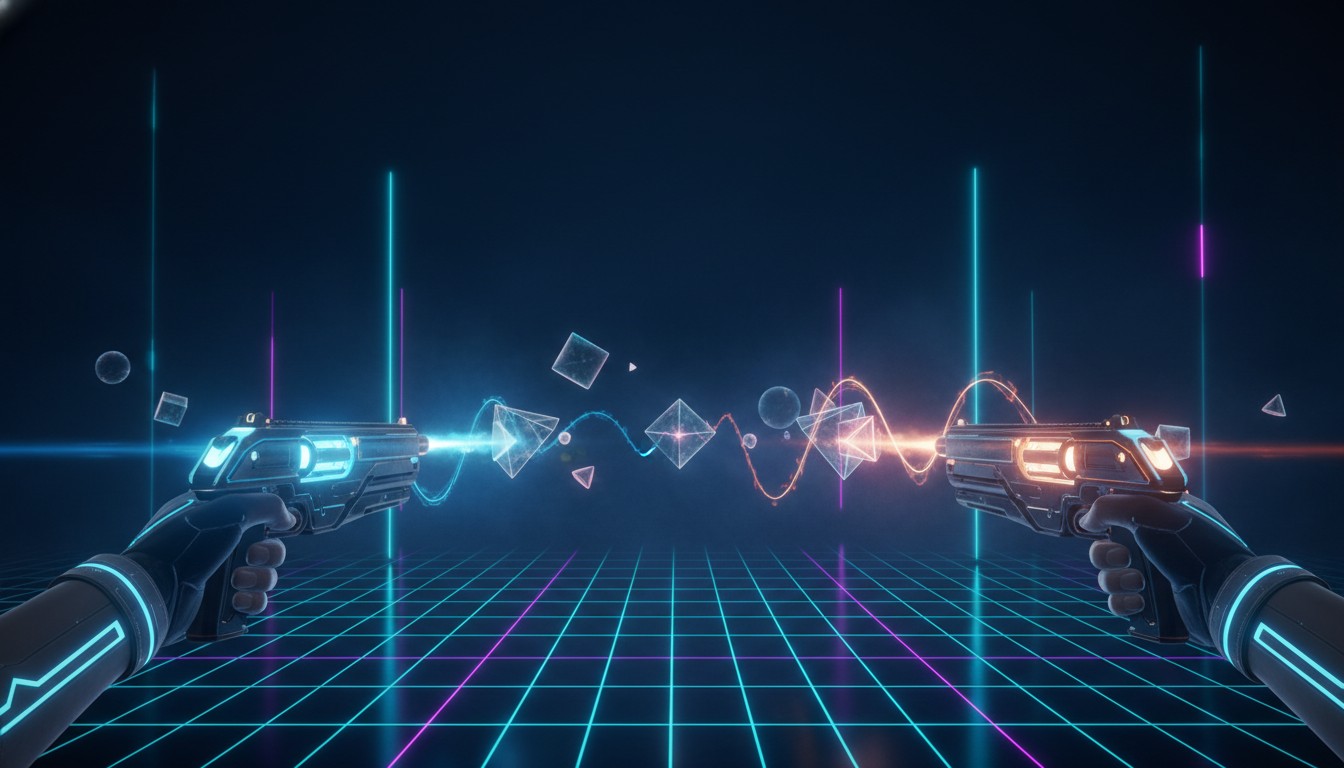
The first thing Audica teaches you is that a gun can be as precise an instrument as a guitar. Harmonix — the studio that turned plastic peripherals into cultural phenomena with Guitar Hero and Rock Band — has brought that same obsessive attention to timing and feedback to VR, only this time your hands are holding pistols instead of strumming fretboards.
Audica is a rhythm shooter, pure and simple. Targets float toward you in time with the music, colored blue and orange to match your left and right controllers, and you shoot them. On-beat shots score higher. Off-beat shots still connect but feel sloppy, like missing a drum fill by half a step. The concept is so immediately readable that you understand it before the tutorial finishes — and the tutorial is about thirty seconds long.
Where Beat Saber asks you to slash through blocks with lightsabers, Audica asks you to aim, squeeze, and reload. That shift from melee motion to ranged precision fundamentally changes the rhythm-game calculus. Beat Saber rewards broad, committed arm swings; Audica rewards economy of movement and snap accuracy. A perfect run in Audica feels less like dancing and more like conducting a gunfight with supernatural reflexes. The recoil feedback in the controllers, the crisp pop of targets shattering, and the way the world pulses around the beat — it all adds up to a feedback loop that’s unmistakably Harmonix in its polish.
The soundtrack leans heavily into electronic music, with tracks from artists like deadmau5 and KDA anchoring the early lineup. It’s curated rather than sprawling, which is both a strength and a limitation. Every track has been authored with specific target patterns that exploit drops, build-ups, and tempo shifts. The result is levels that feel authored, not algorithmically generated. But it also means the song library is slimmer than Beat Saber’s at comparable points in its lifecycle, and the genre focus is narrow. If you don’t like four-on-the-floor electronic music, Audica doesn’t have much to offer you yet.
Mechanically, though, Audica is tighter than almost anything else in VR. The hit detection is generous where it needs to be and punishing where it counts. The scoring system rewards chaining perfect shots and punishes panic fire, which gives dedicated players a genuine skill ceiling to chase. There’s already a small but fierce competitive community forming around full-combo runs and score attack optimization, and Harmonix’s leaderboard infrastructure is robust enough to support it.
Comfort is worth noting. Audica doesn’t force artificial locomotion on you — you’re stationary, shooting targets that approach from the front — but the intensity ramps quickly on higher difficulties. Targets fly faster, appear from wider angles, and demand you track multiple lanes of incoming rhythm simultaneously. By the time you’re playing on Expert, the screen is alive with motion and your arms are burning. It’s not uncomfortable in the traditional VR sense — no smooth turning, no cockpit disorientation — but it is physically demanding and visually busy in a way that might overwhelm rhythm-game newcomers.
The Quest version holds up surprisingly well against PCVR. The visual downgrade is noticeable — simpler particle effects, flatter environments — but the core timing and feel remain intact, which is what matters. On PCVR, the game runs efficiently and maintains the rock-solid framerate that rhythm games demand. There’s no excuse for dropped beats or stutter when your entire design hinges on audio-visual sync, and Harmonix clearly knows it.
The honest comparison everyone makes is to Beat Saber, and Audica suffers a bit from arriving second in a genre it arguably does more sophisticated work in. Beat Saber has the simpler hook, the broader song library, and the cultural momentum. Audica has the deeper mechanics, the more interesting scoring system, and the pedigree of a studio that has been building rhythm games since before VR existed. Whether that tradeoff favors Audica depends on what you want from a rhythm game: the visceral satisfaction of slashing through a beat, or the sharpshooter’s thrill of nailing a perfect string of headshots to a bass drop.
For rhythm-game enthusiasts who have already exhausted Beat Saber’s catalog and want something that demands a different skillset, Audica is an easy recommendation. For competitive players who want a leaderboard to climb with genuine mechanical depth, it’s arguably better. For casual players looking for their first VR rhythm game, Beat Saber’s broader appeal and lower physical barrier to entry still win — but Audica is close enough that it’s worth trying if the gunplay hook sounds more appealing than swordplay.
Harmonix didn’t invent the VR rhythm game, but with Audica they’ve proven they might perfect it. The soundtrack needs to grow, and the game needs to find the audience its quality deserves. But the foundation is unshakeable: this is one of the most mechanically satisfying experiences in VR, and it’s only going to get sharper.