Assetto Corsa in VR: Why a 2014 Sim Still Owns the Genre
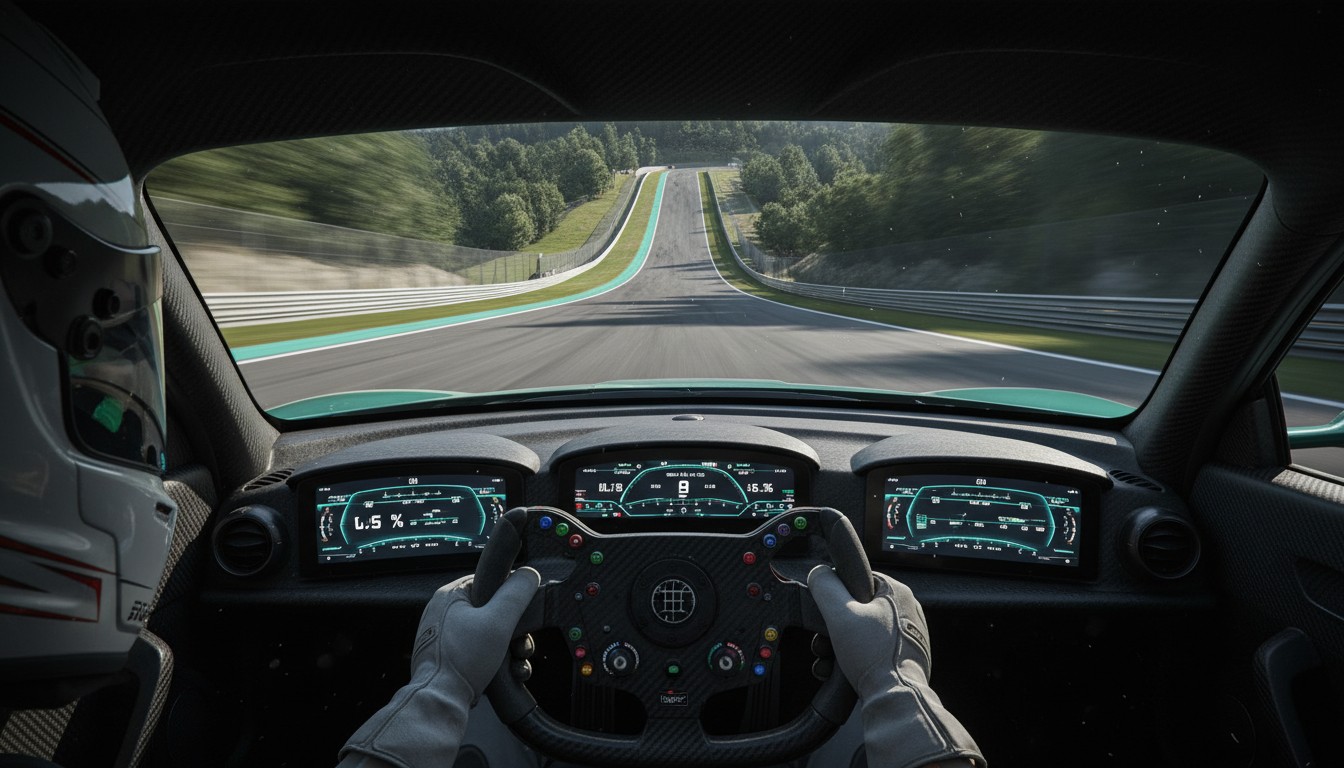
There is a moment in Assetto Corsa VR that explains why people still talk about a game from 2014 like it came out yesterday. You’re cresting the hill at Eau Rouge — full throttle, fifth gear, barely breathing — and the compression at the bottom of Raidillon shoves you back in your seat. On a monitor, this is geometry and math. In VR, it’s depth and terror. You see the track drop away. You feel the elevation change in your gut. You understand, physically, why real drivers lift there even when the data says they shouldn’t.
Here’s the thing: Assetto Corsa shouldn’t still be the best sim racing VR experience. It’s old. The UI is a flat-screen artifact. The base graphics look dated. The career mode is functional at best. And yet, when you strap into a modern headset with the right mods configured, nothing else in sim racing delivers this combination of performance stability, driving fidelity, and pure presence. Not its prettier sibling Competizione. Not the new EVO early-access build. Not anything on a console.
Look, I’m not gonna lie — getting there takes work.
The Setup Reality
Assetto Corsa launched in 2014 with a custom in-house engine that, crucially, was not Unreal Engine 4. That matters more than any marketing bullet point because it means the game runs well in VR on hardware that exists in the real world. Native Oculus Rift support arrived early, and OpenVR/SteamVR support followed, making it broadly compatible with modern PCVR headsets.
But nobody runs vanilla Assetto Corsa in VR. The community rebuilt this game so thoroughly that the 2014 release is essentially a platform now. To get the VR experience people actually talk about, you need three things layered on top: Content Manager, Custom Shaders Patch, and Pure.
Content Manager replaces the stock launcher with something that doesn’t feel like a Windows 98 shareware installer. It handles VR rendering modes, resolution scaling, and the mod pipeline. Custom Shaders Patch is the engine overhaul — dynamic shadows, improved physics, real-time weather, AI behavior fixes, and specific VR optimization modes. Pure is the weather and lighting mod that turns the sky from a painted backdrop into something resembling an actual atmosphere.
Installing all three is manageable if you’re comfortable dropping files into folders and editing JSON configs. If that sentence made you anxious, this is where you should pause and consider whether you’re ready for a sim that demands tinkering. The community has done incredible work documenting every step, but the process is still DIY. No one-click installer. No official hand-holding. You are assembling a race car from a crate of parts, and the manual is a Discord thread.
The payoff, though, is substantial. Once configured, Assetto Corsa runs at solid framerates on mid-range hardware in a way that Competizione simply cannot match. The custom engine is lightweight, predictable, and forgiving. You spend your time racing, not praying your GPU doesn’t choke on a full grid in the rain.
What It’s Actually Like to Drive
Okay, so — controls. This is a sim, not an arcade racer. You want a force-feedback wheel and pedals. Gamepad support exists and works for learning tracks, but the intended experience is a wheel. In VR, that matters more than usual because you can see your virtual hands on a virtual wheel that matches your real ones, and the spatial alignment makes everything feel grounded. The cockpit reference frame keeps you comfortable even during aggressive driving because your brain has a stable anchor.
The car list is absurd. Between official content and the modding community, you can drive pretty much any significant race car from the last sixty years. Same for tracks — laser-scanned Nürburgring, fantasy Touge routes, classic F1 circuits, whatever you want. In VR, the variety matters because each car has a distinct cockpit personality. The cramped visibility of a vintage prototype. The glass greenhouse of a modern GT3. The terrifying forward placement in an open-wheeler. You sit in these things rather than viewing them.
Head tracking is rock-solid. The stereoscopic 3D gives you real depth perception for braking points, apexes, and traffic gaps. You can look through corners the way actual drivers do. The mirrors work in 3D. The dash is readable if you lean in slightly. It’s not a polished VR-native UI — it’s a flat UI rendered in 3D space — but it works.
Comfort is a non-issue for anyone with basic VR tolerance. You’re seated. The world moves around a stable cockpit. There’s no artificial locomotion, no snap-turning, no camera abuse. Extended sessions are limited by your neck muscles and your back, not by motion sickness.
Performance is where the age of the engine becomes a genuine advantage. On a mid-range PC, you can run high settings with supersampling and maintain stable framerates. The game doesn’t punish you for wanting things to look good. Even the most demanding mod combinations — Pure weather, dense AI fields, complex tracks — are more forgiving than a single-car hotlap in Competizione.
The Caveats
First: this is PCVR only. No Quest native version. No PSVR. You need a gaming PC, a headset, and the patience to configure both.
Second: the base game shows its age. Without mods, the visuals are flat, the UI is archaic, and the feature set is thin. The magic is entirely in the community layer. If mods ever stop being maintained — unlikely given the active ecosystem, but not impossible — the value proposition changes dramatically.
Third: setup is real work. Content Manager, CSP, Pure, car packs, track packs, shader tweaks, foveated rendering configs. It’s a hobby in itself. The kind of person who enjoys this usually already owns a wheel and has strong opinions about tire compounds. If you just want to plug in and race, this is probably the wrong game.
Fourth: multiplayer VR is fully functional but you’re racing against a mixed field of flat-screen and VR users. There’s no parity issue — everyone sees the same physics — but the social experience is through external apps like Discord, not in-game VR presence.
Who This Is For
If you own a wheel, a PCVR headset, and you care about driving feel more than career modes or flashy graphics, Assetto Corsa is essentially mandatory. It is the sim racing VR benchmark for a reason. The physics, the performance stability, the mod depth, and the sheer volume of content create an experience that newer, prettier sims haven’t matched for pure VR drivability.
If you don’t have a wheel, or you want something that works out of the box with minimal fuss, or you’re on Quest standalone — skip it. Competizione looks better. EVO might get there eventually. But for the specific intersection of VR, sim racing, and willingness to tinker, Assetto Corsa remains king despite every reason it shouldn’t be.
The one-line takeaway? A decade-old sim with a custom engine and a community that refused to let it die — and in VR, that stubbornness paid off better than anything Kunos has shipped since.