
Assetto Corsa Competizione in VR: Authentic GT3 Atmosphere at a Price
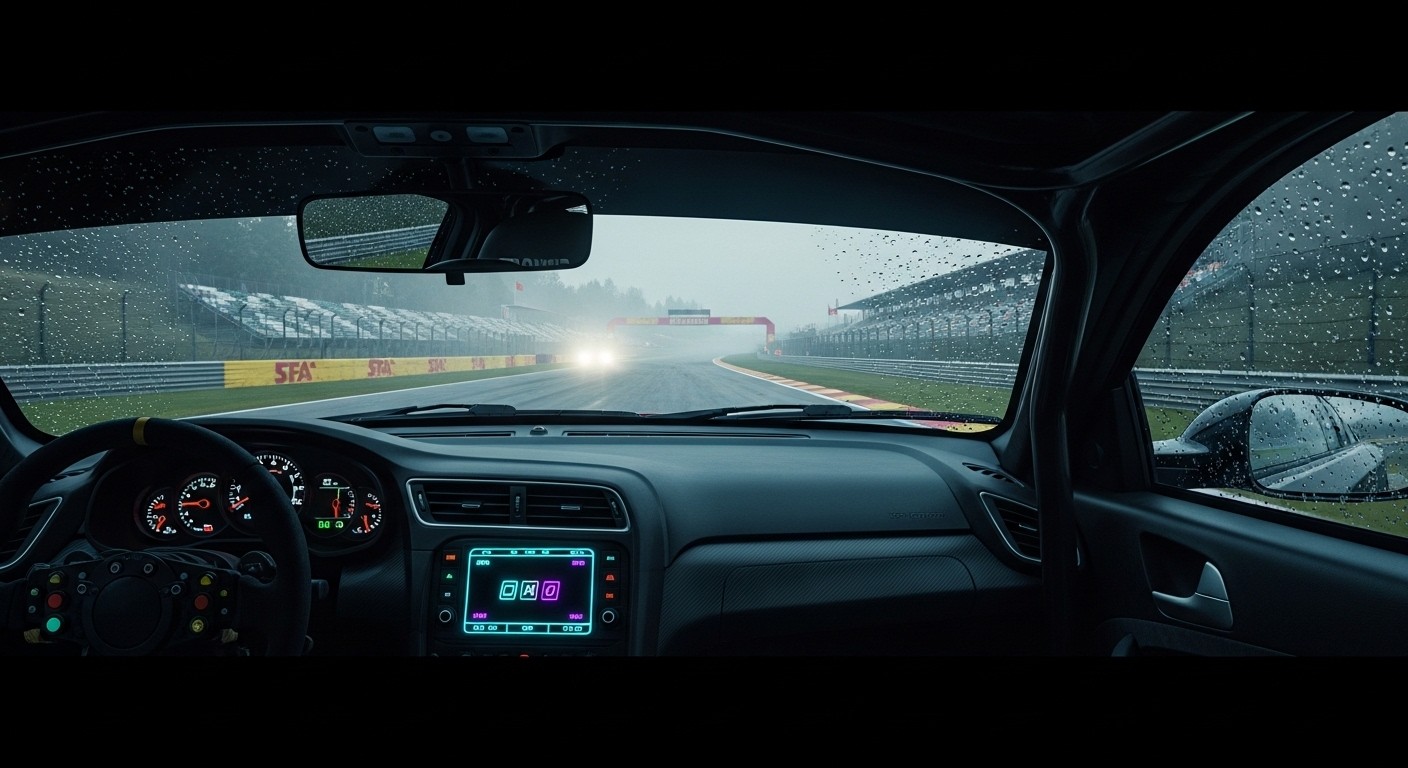
There is a moment in Assetto Corsa Competizione VR that no other racing sim replicates. You’re sitting on the grid at Spa-Francorchamps, rain starting to fall, surrounded by the interiors of other GT3 cars rendered with photorealistic fidelity. The lights go out, and the field surges toward Eau Rouge — and you feel the gradient of that climb in your body because VR gives you proper depth perception on one of motorsport’s most terrifying corners. The track surface, the tire spray, the cockpit vibrations through your wheel — it all converges into something that feels less like a game and more like being there.
This is ACC’s VR promise, and when it delivers, nothing else in sim racing comes close to this level of atmosphere. The catch is that “when it delivers” carries a lot of weight. Unreal Engine 4 is not kind to VR, and ACC’s visual ambition frequently outpaces what current hardware can sustain at VR framerates. The result is an official VR implementation that is genuinely excellent in design but frequently compromised in practice.
What This VR Option Actually Is
Assetto Corsa Competizione launched with official VR support built in. This is not a mod, not an injection driver, not a community hack. Kunos Simulazioni implemented native SteamVR and OpenXR support from early access onward. You select VR mode from the in-game menu, and it works. The cockpit is rendered in proper stereoscopic 3D with full head tracking. The mirrors work. The HUD sits where it should. This is as official as it gets.
The VR support covers the entire game — all tracks, all cars, all modes including multiplayer, championship seasons, and special events. Nothing is gated behind a “VR compatibility” wall. If the game has it, you can do it in VR.
Kunos has been quiet on major updates to ACC since shifting focus to Assetto Corsa EVO, but the existing VR implementation remains stable and functional. It is not abandoned; it is mature and no longer under active development.
How It Plays
Controls: Wheel or Gamepad
ACC is a sim first and a game second. While gamepad support exists and works, the intended experience is a force-feedback wheel with pedals. In VR, this matters more than usual because the cockpit interaction — looking at your mirrors, checking your dash, feeling the wheel turn — is a significant part of the immersion.
Motion controllers are not supported and would be inappropriate for a sim of this type. You’re a racing driver, not a VR tourist. The wheel is your interface with the car, and VR makes that relationship feel more physical because you can see your virtual hands matching your real ones on the wheel.
Comfort: Surprisingly Manageable
Racing games are among the most VR-friendly genres because the cockpit provides a stable reference frame. Your body is seated, the car’s interior doesn’t move relative to your head, and the world moves around you in a way that matches physical intuition. ACC benefits enormously from this. Even extended sessions are manageable for most users, provided framerate stays stable.
The one comfort risk is framerate drops. When ACC stutters — and it will — the mismatch between expected and perceived motion is uncomfortable. This is not a comfort design problem; it’s a performance problem masquerading as comfort.
Performance: The Elephant in the Engine Bay
This is where ACC VR lives or dies, and for many users, it dies.
Unreal Engine 4 was not designed with VR performance as a priority, and ACC pushes visual quality hard. The result is a game that looks stunning in VR but demands hardware that barely exists. Even top-tier GPUs struggle to maintain consistent frame rates at high settings with the full grid of cars, night racing, and rain effects all active simultaneously.
Common mitigation strategies include:
- Dropping to low or medium visual settings
- Reducing the AI grid count
- Avoiding rain/night combinations
- Using OpenVR Foveated or other third-party performance tools
- Capping settings strategically to maintain framerate over visual quality
The original Assetto Corsa — built on a custom in-house engine — runs significantly better in VR while delivering comparable driving feel. This comparison haunts ACC’s VR reputation. If Kunos had built their own engine for ACC rather than adopting UE4, the VR story might be very different.
Users with mid-range hardware should expect significant compromise. Users with high-end hardware should expect to compromise less but still compromise. The performance ceiling on ACC VR is genuinely punishing.
What Works Well
Cockpit presence is unmatched. The interior of each GT3 car is modeled with obsessive detail — every switch, every display, every surface. In VR, you sit inside these spaces rather than viewing them through a window. The sense of actually occupying the driver’s seat is the single strongest argument for ACC VR.
Track atmosphere is transformative. Spa in the rain, Monza under floodlights, Bathurst at dawn — these environments gain dimensions in VR that monitors simply cannot convey. The elevation changes, the trackside detail, the sense of speed through proximity to barriers all benefit enormously from stereoscopic depth.
Official support means reliability. No mods to break, no injection drivers to update, no community patches to chase. VR mode is in the menu, you click it, it works. For a sim where consistency matters — you want your setup to be stable across practice, qualifying, and race — this is valuable.
Multiplayer VR works. You can race online in VR against flat-screen players with no disadvantage or special configuration needed. The competitive integrity of the sim is preserved in VR mode.
Sound design in VR is exceptional. Engine notes, tire sounds, rain on the windshield, radio chatter — spatial audio in a cockpit environment adds information and immersion simultaneously. You can hear where opponents are relative to you.
What Doesn’t Work
Performance is the defining limitation. ACC VR is one of the most hardware-demanding VR experiences available, full stop. The gap between what the game looks like and what it runs like is enormous. Users expecting to max out settings on any current GPU will be disappointed.
UI is monitor-native, not VR-native. Menus, setup screens, and the browser interface are flat panels rendered in VR space. They work, but they’re not optimized for headset resolution. Reading tire pressures and setup values requires leaning in or accepting small text.
The original Assetto Corsa exists. This is an external problem, not an internal one, but it matters. AC1 with its custom engine runs VR far more efficiently while delivering comparable driving physics and mod support. ACC offers better graphics, official GT3 licensing, and superior atmosphere — but if raw VR performance and mod flexibility are priorities, AC1 remains the stronger choice.
Night and rain compound performance issues. The weather system and lighting model that make ACC special are also the things that tank framerates. Running a wet night race at Spa with a full grid is essentially a stress test for your hardware, not a smooth experience.
Development has shifted to AC EVO. Kunos is focused on their next project. ACC receives maintenance updates but no significant VR improvements are expected. What exists now is likely the final state of ACC VR.
Who This Is For
Good for:
- Sim racing enthusiasts with high-end PCs who prioritize visual fidelity and atmosphere
- GT3 racing fans who want the official licensed experience with proper driver perspective
- Players already invested in a racing wheel setup who want to add VR immersion
- Those who can tolerate visual compromise for stable framerates
- Endurance racing fans — the cockpit presence over long stints is compelling
Not for:
- Users with mid-range or lower hardware expecting smooth performance
- Players who want to max out visual settings — you will not
- Those primarily seeking the most efficient VR sim racing (AC1 exists for that)
- Anyone without a wheel — gamepad is functional but misses the point
- Competitive drivers who need every frame consistent — the performance variance can be a liability
The Verdict
Tier: B
Game Quality: A Assetto Corsa Competizione is the definitive GT3 racing sim. The physics, the tire model, the track accuracy, the official licensing — it sets the standard for what a serious sim racing product should be. Kunos built something special for the flat screen.
VR Implementation Quality: B The VR support is official, stable, and well-designed. Cockpit presence, head tracking, mirror rendering, and full content access all work correctly. But UE4’s performance overhead drags the implementation down from what it should be. A great VR implementation hampered by its engine.
Overall Tier: B ACC VR is recommended with real caveats. When your hardware can sustain it, the experience is superb — the best GT3 cockpit presence in sim racing. But the performance ceiling is genuinely brutal, and the existence of the original Assetto Corsa with its superior VR efficiency makes ACC’s compromises harder to accept. This is the right choice for players who want maximum atmosphere and official GT3 content. It is the wrong choice for players who want maximum VR performance. Know which camp you’re in before you buy.