
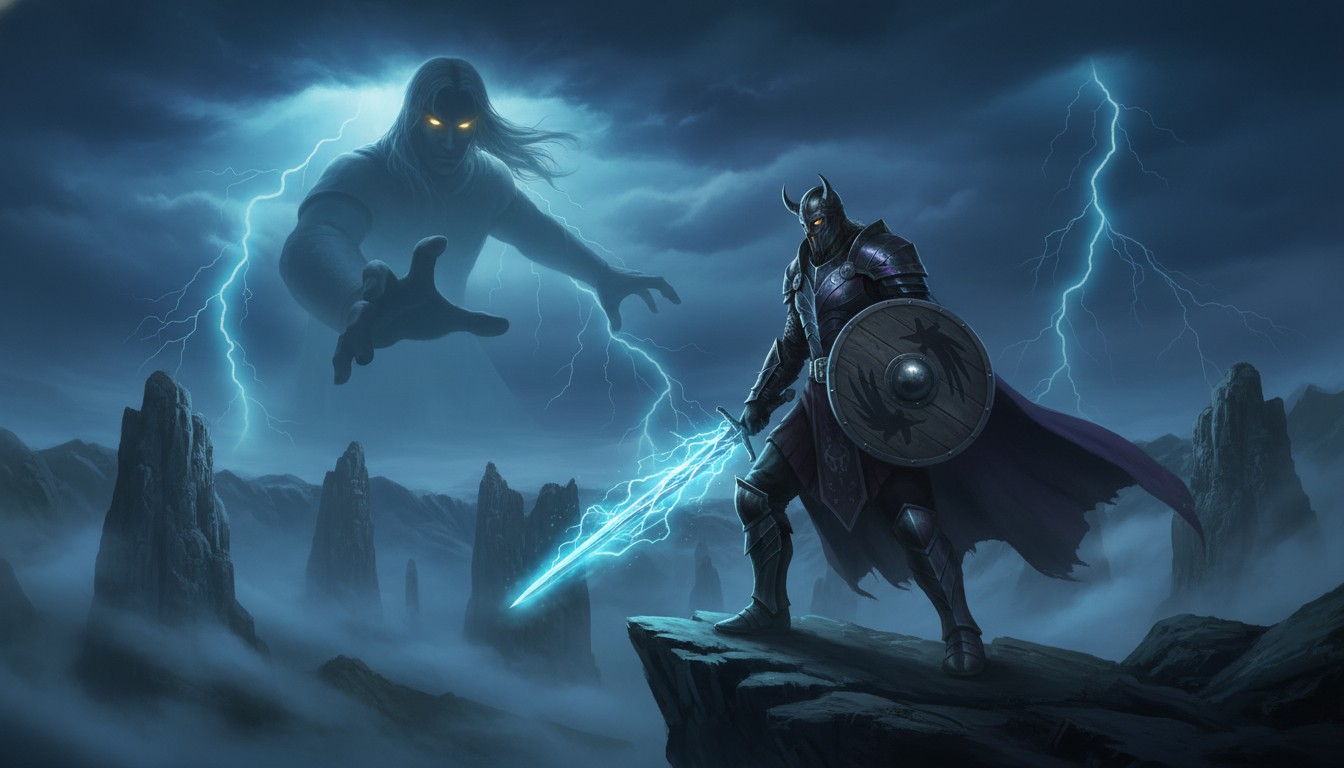
Standing atop a cliff overlooking a fjord in Asgard’s Wrath, you reach up and press a button. The world shrinks. Mortals become ants. You are no longer a sword-swinging hero — you are a god, and the puzzle in front of you is now a toy. That moment, switching between human-scale combat and deity-scale environmental manipulation, is the signature trick of one of the most ambitious native VR RPGs ever built. It’s also the best argument for what AAA funding in VR actually looks like when a studio commits.
The God-Scale Mechanic That Actually Works
Asgard’s Wrath was designed for headsets from the start: full motion controls, physics-influenced melee combat, weapon throwing and recall, and a 30-plus-hour campaign that actually justifies the hardware investment. In a VR landscape dominated by short, cartoony experiences, this is the real deal — a fully-funded action-RPG with production values to match. You play as a fledgling god under Loki’s dubious mentorship, guiding mortal heroes through a Norse mythology campaign that spans multiple protagonists, each with their own weapons, fighting styles, and story arcs. The body-possession mechanic isn’t just narrative dressing — it fundamentally changes what you’re doing from hour to hour.
The mortal combat is where you’ll spend most of your time, and it’s deliberately physical. Swords, axes, and shields respond to your actual swings and blocks. Weapons can be thrown and magically recalled, including some with elemental properties. The parry system demands timing and attention: enemies telegraph with colored cues — blue means parry, red means dodge. Get it right and the enemy staggers, opening them up for punishment. Get it wrong and your weapon goes flying or your stamina bar evaporates. It feels weighty and intentional, though the system has a learning curve that some players find punishing before it clicks.
Then there’s the god mode. Scattered throughout the world are altars where you can shift to a towering perspective, manipulate massive objects, solve architectural puzzles, and occasionally swat away threats on a completely different scale. It’s not just a gimmick — the game uses the size contrast to make you feel the power differential between a mortal adventurer and an actual deity. The mechanic also pairs with the follower system: animal companions you recruit can be transformed into humanoid warriors, each filling a combat role (brawler, defender, specialist) and bringing environmental talents like breaching barriers or raising shields against traps. Managing these followers adds tactical variety that the base combat sometimes lacks.
Playing on Non-Oculus Hardware
Asgard’s Wrath was published by Oculus Studios and remains in the Oculus PCVR ecosystem. If you own a Quest with Link or an original Rift, installation is straightforward. If you’re on a Valve Index, HTC Vive, or other SteamVR headset, you need Revive — the unofficial compatibility layer that injects Oculus titles into SteamVR. Revive works well; many Index users report the experience feels close to native thanks to the controller similarity between Index knuckles and Oculus Touch. There is some CPU overhead, and performance hiccups can occur on mid-range hardware, but it is fully playable end to end.
Comfort is worth noting: this is a smooth-locomotion, free-movement game with no teleport option. There are comfort settings — vignetting, snap turns, adjustable movement styles — but the core experience expects you to handle traditional first-person locomotion across a 30-hour campaign. Newer VR users or those prone to motion sickness should know what they’re signing up for.
Where the Fatigue Sets In
For all its scope, the combat can feel repetitive in the back half. Shielded enemies force a predictable loop of block-break, chip damage, repeat, and the enemy variety isn’t deep enough to sustain the full runtime without some fatigue. Some dungeon layouts recycle assets. The inventory and menu systems feel rooted in flat-screen conventions — managing gear, crafting, and follower loadouts involves a lot of UI navigation that doesn’t fully exploit VR’s spatial strengths. The opening hours are particularly tutorial-heavy, front-loading mechanics before the world opens up.
But these are the trade-offs of ambition. Asgard’s Wrath attempted something few VR studios could afford to — a full-length, multi-protagonist campaign with AAA production values — and it mostly delivered. The game has not received meaningful updates since 2019; what you get is what was shipped. Stable, complete, frozen in time.
That said, when Asgard’s Wrath is firing on all cylinders, there’s still nothing quite like it in PCVR. The sense of holding a shield in one hand and a lightning-charged sword in the other, parrying a charging draugr and throwing your axe across a chasm before recalling it — that sequence is genuinely great. The campaign pacing, outside of the slow start, balances exploration, puzzle-solving, and combat well enough that the hours don’t feel wasted. And the god-mode perspective shifts genuinely reframe how you interact with the environment in ways that few VR games have attempted since.
Asgard’s Wrath is a milestone — one of the only AAA-budget native VR games ever made, and it still holds up. The core design — god-scale perspective shifts, physical combat, a 30-hour Norse campaign — remains compelling. Minor repetition in the back half and some UI roughness don’t change what this game is: proof that a fully-funded, fully-committed VR RPG can deliver the goods. If you own PCVR hardware and have any interest in action-RPGs, this is essential.