
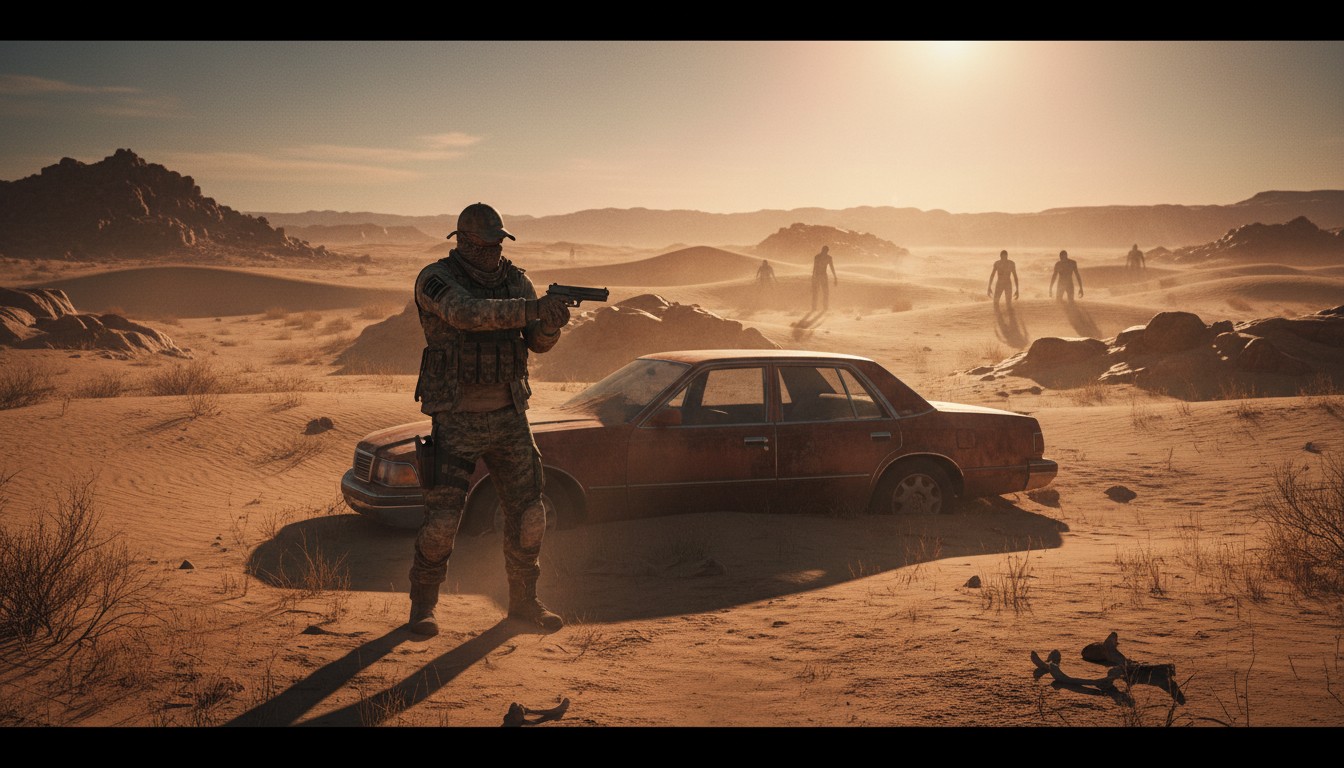
The original Arizona Sunshine arrived in 2016 when VR was still figuring out what a “full game” even looked like. It was one of the first titles to prove that shooting zombies in a headset could feel like more than a tech demo — that it could sustain a campaign, support co-op, and deliver the kind of gunplay that made you want to tell your friends. Eight years later, the Remake doesn’t just honor that legacy. It replaces it.
If you’re looking at Arizona Sunshine for the first time, here’s the thing: the 2016 original is historically important but practically obsolete. The October 2024 Remake, rebuilt on the Arizona Sunshine 2 engine, includes the full campaign, both DLC episodes, the Horde mode, and enough modernized systems that the original has no reason to exist anymore. This isn’t a remaster — it’s a full rebuild with modern physics, manual reloading, melee combat, and a gore system that makes headshots feel as gross as they should. Play the Remake. Full stop.
The Gunplay Is Still the Whole Point
Arizona Sunshine has always been about one thing: the guns. The Remake preserves what worked — a healthy arsenal of pistols, shotguns, SMGs, and rifles — and wraps it in interactions that finally match the fantasy. Weapons can be held two-handed for stability. Reloading now has a manual option where you eject magazines, insert fresh ones, and rack the slide. It’s fiddly at first, and you’ll fumble reloads under pressure, but that’s the point. Panic is part of the design.
Melee combat is the most meaningful addition. Borrowed directly from Arizona Sunshine 2, it lets you bash zombies with crowbars, machetes, and whatever else you find. It doesn’t revolutionize the game, but it solves a problem the original never addressed: what happens when you’re cornered with an empty magazine. The answer used to be “die.” Now it’s “swing.”
The gore system adds dismemberment and more detailed damage modeling. Shooting a zombie’s arm off before finishing it with a headshot isn’t subtle, but it is satisfying. The sound design is punchy and directional — you’ll hear groans behind you before you see them, and gunfire has the kind of weight that makes you feel every round.
What You Actually Get
The campaign runs about three hours. That’s not a typo. Three hours of linear desert environments, abandoned mines, and military compounds, bookended by voiceover from a protagonist who talks too much and says too little. The narrative has never been the draw, and the Remake doesn’t fix that. What it does is include both DLC episodes — “The Damned” and “Dead Man” — which extend the runtime meaningfully, though “Dead Man” leans heavily on repetitive timed encounters that wear thin.
Where Arizona Sunshine actually lives is in its co-op and Horde mode. The campaign supports two-player co-op, and Horde mode supports four. This is where the game justifies its price tag. Fighting off waves of zombies with a friend, sharing ammo, calling out flankers, and reviving each other when the horde breaks through — that’s the experience people remember. The single-player campaign is a tutorial for the real game.
Horde mode is endlessly replayable by design. Limited arenas, escalating waves, and a scoring system that rewards efficiency over spray-and-pray. It won’t replace dedicated wave shooters, but as a bundled extra, it’s substantial.
The 2016 DNA Still Shows
For all the modernization, the Remake can’t fully escape its origins. Some interactions remain stubbornly janky. Players report getting stuck on opened doors, struggling to pick up specific ammo boxes, and accidentally grabbing unintended objects in cluttered environments. Ladders are physically climbable now, which is an improvement, but climbing them can still feel imprecise. Head-clipping through walls produces a black screen — a bug inherited directly from the original.
Weapon handling has its quirks too. Some rifles feel floaty, and the sniper rifle’s handling is awkward enough that you’ll probably avoid it. One assault rifle in particular carries an unrealistically small magazine, forcing constant reloads that break rhythm rather than build tension.
Performance is another caveat. On PCVR, intense horde sequences can introduce choppiness, particularly on higher settings. PSVR2 players have noted blur due to the absence of dynamic foveated rendering. The game is playable across all platforms, but it’s not the polished, optimized experience you’d expect from a 2024 rebuild. It runs like a game that was rebuilt on a newer engine but not fully re-architected.
Co-op stability deserves specific mention. Connection issues, long lobby waits, and occasional desync have been reported across platforms. The workaround — creating a public lobby and sharing a code — is functional but shouldn’t be necessary. When it works, co-op is the best way to play. When it doesn’t, it’s frustrating enough to make you wish for a flat-screen fallback.
Who This Is Actually For
Arizona Sunshine Remake is a $30 VR zombie shooter that delivers excellent gunplay, solid co-op, and enough jank to remind you it was built on 2016 bones. It’s not a must-play on the level of Half-Life: Alyx or Walking Dead: Saints & Sinners, but it doesn’t need to be. It occupies a specific niche: the social VR shooter you fire up with a friend, blast through a few Horde mode waves, and put down satisfied.
If you’re a solo player looking for a meaty campaign, look elsewhere. Three hours of adequate zombie shooting isn’t worth the admission. If you want polished, narrative-driven VR horror, this isn’t it. But if you have a co-op partner and you want something straightforward to drop into — something that doesn’t require modding, framework setup, or tolerance for injection-driver weirdness — Arizona Sunshine Remake is one of the more accessible options in the standalone VR catalog.
The original earned its place in VR history. The Remake earns its place in your library — with the understanding that you’re here for the gunplay and the company, not the campaign.