
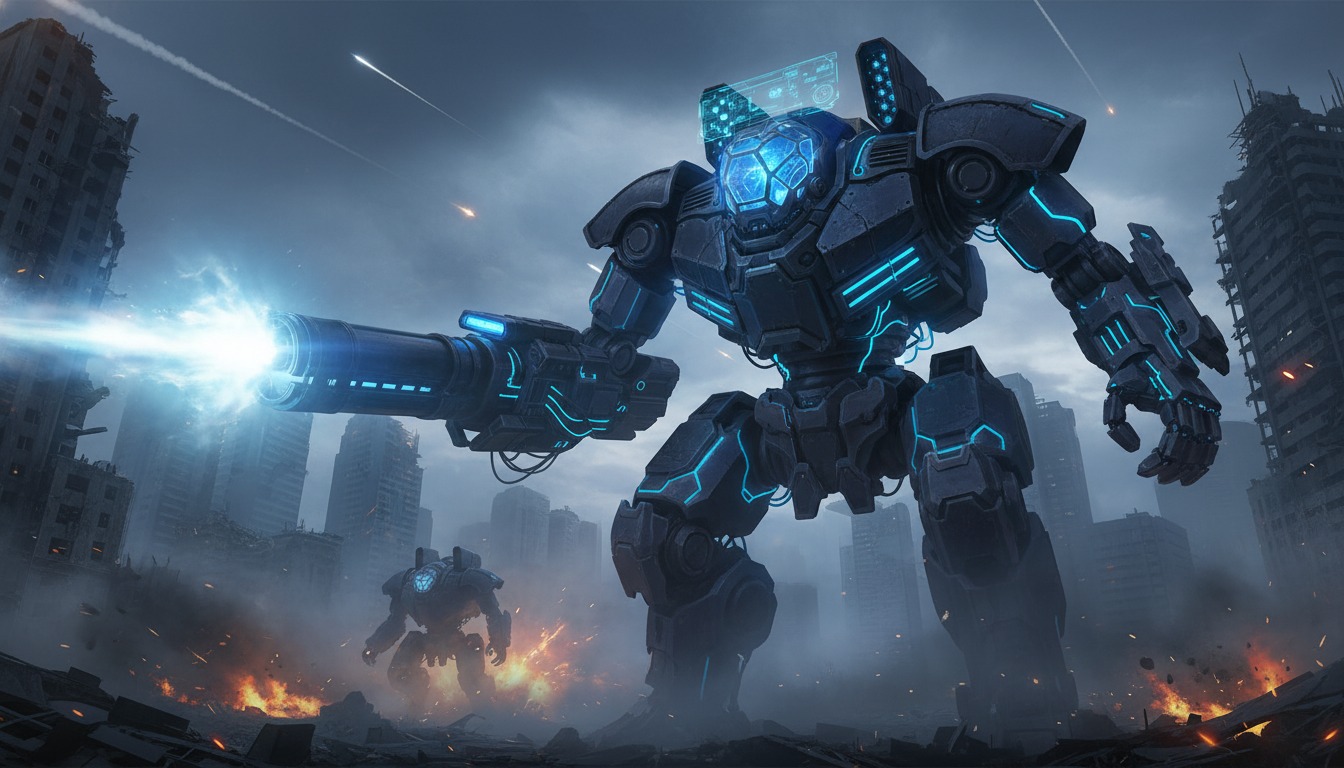
Every VR platform needs its power fantasy. For Skydance Interactive, that fantasy was six stories tall, armored in steel, and armed with enough firepower to level a city block. Archangel: Hellfire is not a conversion, a mod, or an afterthought — it is a VR-native mech combat game built from the cockpit up, and it understands exactly why people strap on headsets in the first place.
The original Archangel arrived in mid-2017 as a polished but deliberately restricted experience: a seated, on-rails shooter that let players man the guns of a walking tank while the machine lumbered forward on autopilot. It looked impressive and felt appropriately weighty, but the design kept the training wheels on. The Hellfire update, released in June 2018, tore those wheels off. Free locomotion, competitive multiplayer, and PvE horde modes transformed Archangel from a cinematic shooting gallery into a full-fledged mech arena game. Existing owners received the update at no cost. For newcomers, the package offered the complete single-player campaign alongside the expanded multiplayer suite.
Sitting in the cockpit is where Archangel: Hellfire earns its credibility. The perspective is fixed — this is a seated experience through and through — but the physical interaction design is sharp. Motion controllers map directly to the mech’s massive arms, letting players reach out, grab weapon systems, raise shields, and manually target ordnance. The sensation of physically raising a gauntlet to block incoming fire, then swinging the same arm to unleash a missile barrage, bridges the gap between abstract input and mech pilot fantasy more effectively than any gamepad mapping could manage.
Combat carries genuine strategic texture beneath the surface-level spectacle. Three distinct mech classes — the agile Scout, the balanced Walker, and the hulking Tank — each carry different weapon loadouts, mobility profiles, and ability cooldowns. Between matches, players can tweak chassis stats, trading health for speed or damage output to suit their approach. The result is a multiplayer loop that rewards positioning and team composition more than twitch reflexes, which suits the deliberately ponderous pace of mech warfare. A Scout that overextends into Tank range will be scrap in seconds. A well-coordinated pair of Walkers locking down a choke point can dominate an entire match.
The PvP mode is the star. Maps are sized to emphasize the scale of these machines, with verticality and sightlines that make the class distinctions matter. Team Deathmatch flows well, and the physicality of the controls adds a layer of presence that flat-screen arena shooters cannot replicate. Raising a shield to deflect a salvo while charging a railgun with the other arm is the kind of multi-limb coordination that only works in VR, and Hellfire leverages it consistently.
The co-op PvE horde mode, while functional, suffers from thin content. A single map and straightforward enemy waves make it a competent training ground rather than a lasting draw. The mode teaches the basics of weapon management and positioning, but it does not offer the emergent chaos that makes the PvP worthwhile.
Single-player remains a known limitation. The campaign that shipped with the original release is present and intact, but it is a brief, linear journey. Players looking for a substantial solo mech narrative will find the experience ends sooner than expected. The Hellfire update did not meaningfully expand the campaign; it simply gave players better reasons to keep the software installed after the credits rolled.
Comfort is handled sensibly. As a seated cockpit experience with no artificial locomotion beyond the mech’s own deliberate stride, Archangel: Hellfire avoids the nausea triggers that plague many early VR shooters. The tradeoff is a lack of room-scale presence — players will not be ducking behind cover or leaning around corners. The mech is the body, and the body is a chair.
Performance on contemporary hardware of its era was generally stable, though the visual spectacle of exploding war machines and dense particle effects could strain lesser systems. Modern PCVR setups run it without issue, but PlayStation VR players occasionally reported minor tracking inconsistencies during the most chaotic multiplayer exchanges.
Population is the quiet concern. As with any multiplayer-focused VR title from this era, matchmaking reliability depends on a player base that has inevitably thinned over time. The PvE mode offers a fallback, but Archangel: Hellfire is at its best when two teams of human-piloted mechs are trading ordnance across a ruined cityscape.
This is a game for a specific appetite. If the idea of manually operating a giant combat mech in VR appeals to you, Archangel: Hellfire delivers one of the most convincing executions the medium has produced. The controls are smart, the combat has depth, and the production values are notably higher than the novelty projects that flooded the market in 2017 and 2018. But players who demand a meaty single-player campaign, room-scale physicality, or a bustling competitive community should look elsewhere. For the mech-curious with a headset and a willingness to climb into the virtual cockpit, it remains a worthy ride.