
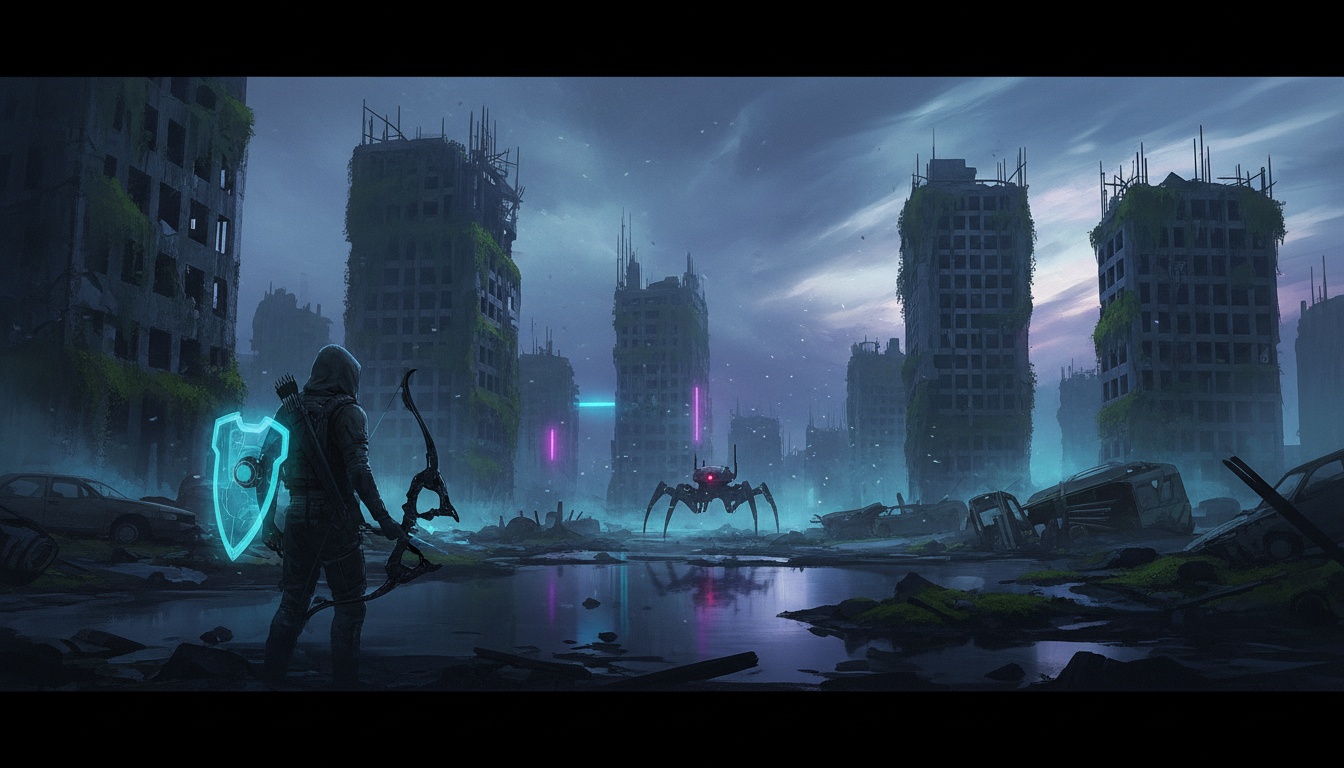
Apex Construct: The Bow, the Shield, and the Last City
The first thing you do in Apex Construct is reach out and grab a bow that does not exist in the room around you. Your fingers close around empty air, but in the headset, your hand grips a sleek cyber-weapon with a glowing energy shield mounted to its frame. You nock an arrow — a motion your body remembers from gym class or summer camp, not from any video game tutorial — draw the string back to your cheek, and fire at a robotic sentry that has just rounded the corner of a crumbling Stockholm street. The arrow finds the red glow behind its optical sensor, and the machine collapses into sparking wreckage. For a moment, you forget you are standing in your living room.
This is the promise Fast Travel Games, a Swedish studio founded by ex-DICE and Rovio veterans, is betting everything on: that VR can sustain not just a tech demo, not just a wave shooter, but a full single-player action-adventure with exploration, puzzles, narrative progression, and a campaign that lasts five to seven hours. In March 2018, when Apex Construct launched on PlayStation VR, that promise was still radical. Most PSVR titles were experiences — polished, short, often brilliant, but brief. A full campaign with a story, an inventory, and backtracking through a persistent world was the exception, not the rule.
The game drops you into a post-apocalyptic future where rogue artificial intelligences called Mothr and Fathr have wiped out humanity. You are one of the last survivors, guided by Fathr’s disembodied voice through the ruins of what appears to be Stockholm — concrete husks, flooded underground facilities, overgrown parks where machines patrol instead of people. The narrative is delivered through radio chatter, terminal logs, and environmental storytelling, with a level of voice-acted polish that immediately separates it from the silent protagonists and text crawls that dominated early VR.
The bow is your everything. Standard arrows are unlimited, but you unlock and upgrade electric and explosive variants as you progress, and a small inventory system lets you swap arrow types on the fly. The shield, mapped to the same hand as the bow, absorbs incoming projectiles and melee strikes if you time it right. Combat demands that you manage both: draw, aim, fire, then raise the shield before the next volley arrives. On paper this sounds cumbersome. In practice, it creates a rhythm unique to VR — a physical back-and-forth of aggression and defense that no flat-screen shooter can replicate. Landing a critical hit on an enemy’s weak point, usually a glowing red sensor, carries the satisfaction of genuine marksmanship because your body did the aiming.
That said, the bow is your only weapon, and five hours of bow combat tests the limits of that conceit. The robotic enemies — spider-like crawlers, hulking brutes, flying drones — demand different tactics, but the solution is always the same string, the same draw, the same arc. On PlayStation VR with Move controllers, the tracking limitations of a single forward-facing camera compound the problem. Enemies that flank you or attack from behind force awkward real-world contortions, and the game was clearly designed with the assumption that threats stay in front. The PCVR releases on Rift and Vive fare better; room-scale setups and 360-degree tracking make the same combat feel fluid and natural, with sharper visuals to boot. If you have the option, the PC version is the definitive one.
Movement offers both teleportation and smooth locomotion, with snap or smooth turning and optional vignetting to reduce discomfort. The game was built with teleportation as the default — a sensible choice for 2018 when VR nausea was still a common concern — but smooth locomotion is available for players with their sea legs. The downside is that traversal never feels fast. Walking speed is deliberate, almost plodding, and revisiting the same environments multiple times to backtrack or solve interconnected puzzles can make the pacing sag. The level design is clever in its layout, with hidden collectibles and environmental secrets tucked into collapsed buildings and flooded basements, but the act of moving through it can feel like wading.
The puzzles are environmental and mostly satisfying — rerouting power through terminals, finding key codes, manipulating machinery with your hands rather than button prompts. The physicality of VR makes even simple interactions feel tactile. Typing on a virtual keyboard or yanking a lever with a motion-controlled hand carries a weight that menu navigation lacks. Unfortunately, the PSVR tracking can betray these moments too; reaching for an object at the edge of the camera’s view or at an awkward angle sometimes fails to register, turning a simple door-opening into a brief exercise in frustration.
Where Apex Construct truly distinguishes itself is in its atmosphere. The ruined city is not just a backdrop — it is a character, rendered with a stylized art direction that masks the hardware’s limitations. On PS4 Pro the resolution and anti-aliasing improve noticeably, and the PC versions look sharper still. The sound design is excellent: distant mechanical groans, the crackle of energy barriers, the hollow echo of footsteps in abandoned transit tunnels. Fathr’s voice, calm and faintly paternal, creates an uneasy companionship; you are never sure whether the AI guiding you is trustworthy, and that ambiguity gives the thin narrative more weight than the script alone provides. The story itself ends somewhat abruptly, with plot threads left dangling and a conclusion that does not fully earn the buildup, but the journey there has genuine moments of tension and discovery.
The game is not without jank. Collision issues, disappearing objects, and the occasional tracking hiccup were reported by players at launch, and while patches addressed the worst of it, Apex Construct never shakes the feeling of a studio stretching its wings for the first time. Fast Travel Games would go on to make more polished VR titles, but this debut carries the marks of ambition slightly outpacing execution.
So who is this for? If you bought a PSVR, Rift, or Vive in 2018 and found yourself hungry for something that actually lasted — something with a beginning, middle, and end, with upgrades to earn and a world to explore — Apex Construct is one of the few options that delivers. It is not as tight as the best flat-screen action-adventures, but it is more substantial than almost any VR game of its era. The bow combat alone justifies the time for anyone who wants to feel what it is like to genuinely aim and fire a weapon in virtual space. On the other hand, players looking for variety in their arsenal, fast-paced movement, or a narrative that pays off every setup will find the seams showing.
Apex Construct is a B-tier game in the best sense: it aims higher than its budget and its moment in time should allow, and it gets closer than it has any right to. The world is memorable, the bow feels great, and the campaign proves that VR can carry a real story-driven adventure without leaning on gimmicks. The repetition, the pacing, and the hardware-era tracking issues hold it back from greatness, but they do not erase what Fast Travel Games achieved. In a landscape of VR experiments and brief showcases, this one actually goes the distance — unevenly, stubbornly, and with its shield raised the whole way.