
American McGee’s Alice in VR: Wonderland’s Darkest Corners, Now Larger Than Life
There are games that deserve to be remembered, and then there are games that claw their way into your memory whether you want them to or not. American McGee’s Alice is firmly in the latter camp—a 2000 release from Rogue Entertainment that took Lewis Carroll’s whimsical Wonderland and twisted it into something genuinely disturbing. Fire-scarred asylum inmate Alice returns to a psychological landscape where the Cheshire Cat drips sarcasm like venom and the Queen of Hearts has become something far worse than a petty tyrant.
The question isn’t whether this game is worth experiencing. It’s whether experiencing it in VR through VorpX adds something meaningful, or if you’re better off admiring its grotesque beauty on a flat screen.
The short answer: VorpX brings Wonderland closer, but it doesn’t fix what was always broken about the game underneath. The atmosphere benefits enormously from stereoscopic depth and the sense of occupying the same space as Alice’s nightmares. The platforming, unfortunately, remains as finicky and frustrating as it was in 2000—and that’s a problem when you’re trying to judge distances in three dimensions.
What This VR Option Actually Is
This is a VorpX injection driver experience, which means you’re getting stereoscopic 3D rendering and head tracking but no motion controls, no native VR UI, and no room-scale support. American McGee’s Alice is officially supported in VorpX’s game database, which means the injection driver recognizes the game and applies appropriate stereoscopic settings automatically.
Here’s what that translates to in practice:
- Stereoscopic 3D: The game renders with genuine depth separation, making Wonderland’s twisted architecture feel more physically present
- Head tracking: Your headset tracks head movement, though in a third-person game this primarily allows you to look around the virtual environment rather than controlling Alice’s camera directly
- No motion controls: You’ll be playing with a gamepad or keyboard/mouse—VorpX doesn’t add VR hand presence to games that weren’t built for it
- No VR UI: Menus, inventory screens, and HUD elements appear as flat overlays within the 3D space
The game runs on id Tech 3—the same engine that powered Quake III Arena—which actually works in VorpX’s favor. The engine’s clean rendering pipeline and predictable camera behavior mean the injection driver can produce a stable stereoscopic image without the visual artifacts that plague some more complex modern engines.
How It Plays
VorpX offers two primary modes for third-person games: Full VR mode and Immersive Screen mode. For American McGee’s Alice, the recommendation is clear—Immersive Screen mode is the way to go.
Why Immersive Screen Mode Wins
In Full VR mode, third-person cameras become disorienting fast. The camera orbits Alice as you rotate your head, creating a sensation that feels less like “being there” and more like “being a ghost tethered to a very confused cameraman.” The disconnect between your head movement and the camera’s behavior can trigger motion sickness in ways that native VR titles avoid.
Immersive Screen mode sidesteps these issues entirely. The game displays on a large, curved virtual screen that wraps around your field of view—think IMAX theater meets personal cinema. You get the stereoscopic depth of VR without fighting against the game’s inherent third-person camera design. Head tracking lets you look around the virtual space, but the game’s camera behaves exactly as the developers intended.
The result is something closer to “Wonderland viewed through a very good 3D window” than “being inside Wonderland itself.” That’s not a failure—it’s an honest assessment of what injection drivers can deliver for third-person titles.
Controls and Input
American McGee’s Alice supports both keyboard/mouse and gamepad input, and the VorpX experience doesn’t change either option. You’ll want a gamepad for the best experience—the original 2000 release predates modern analog stick precision, but the 2011 HD re-release (the version most players will have access to) added proper controller support.
The gamepad gives you:
- Analog movement for Alice’s platforming sections
- Camera control via right stick
- Quick access to weapons and abilities via face buttons
- More comfortable long-session play than keyboard/mouse
Keyboard and mouse remains viable, particularly for players who want pixel-perfect aiming for the game’s ranged weapons. Either way, you’re not getting VR hand presence—you’re playing a 2000 platformer with a traditional control scheme, just in a headset.
Comfort Considerations
Immersive Screen mode is significantly more comfortable than Full VR for this particular game. The camera remains locked to Alice’s position, eliminating the disorientation that comes from independent head tracking in third-person titles. However, the game still contains moments of intense visual motion:
- Platforming sections require precise jumps with a sometimes uncooperative camera
- Combat encounters can involve rapid camera swings as Alice auto-targets enemies
- The asylum flashback sequences feature jarring visual transitions
Players sensitive to motion in VR should start with shorter sessions. The atmospheric dread is potent enough that you may find yourself wanting breaks anyway.
Performance
American McGee’s Alice is not a demanding game by modern standards. The id Tech 3 engine was cutting-edge in 2000, but even integrated graphics from the last decade can push it to high framerates. In VorpX, this translates to:
- Stable 90fps+ on mid-range hardware from the last five years
- Minimal stuttering or frame drops
- Fast load times even from mechanical drives
- Low thermal footprint—your GPU won’t break a sweat
The VorpX overhead is minimal for this title. The injection driver’s performance impact is most noticeable in modern AAA games with complex rendering pipelines; for a 2000 release using DirectX 9, the additional processing burden is negligible.
What Works Well
The Atmosphere Transforms
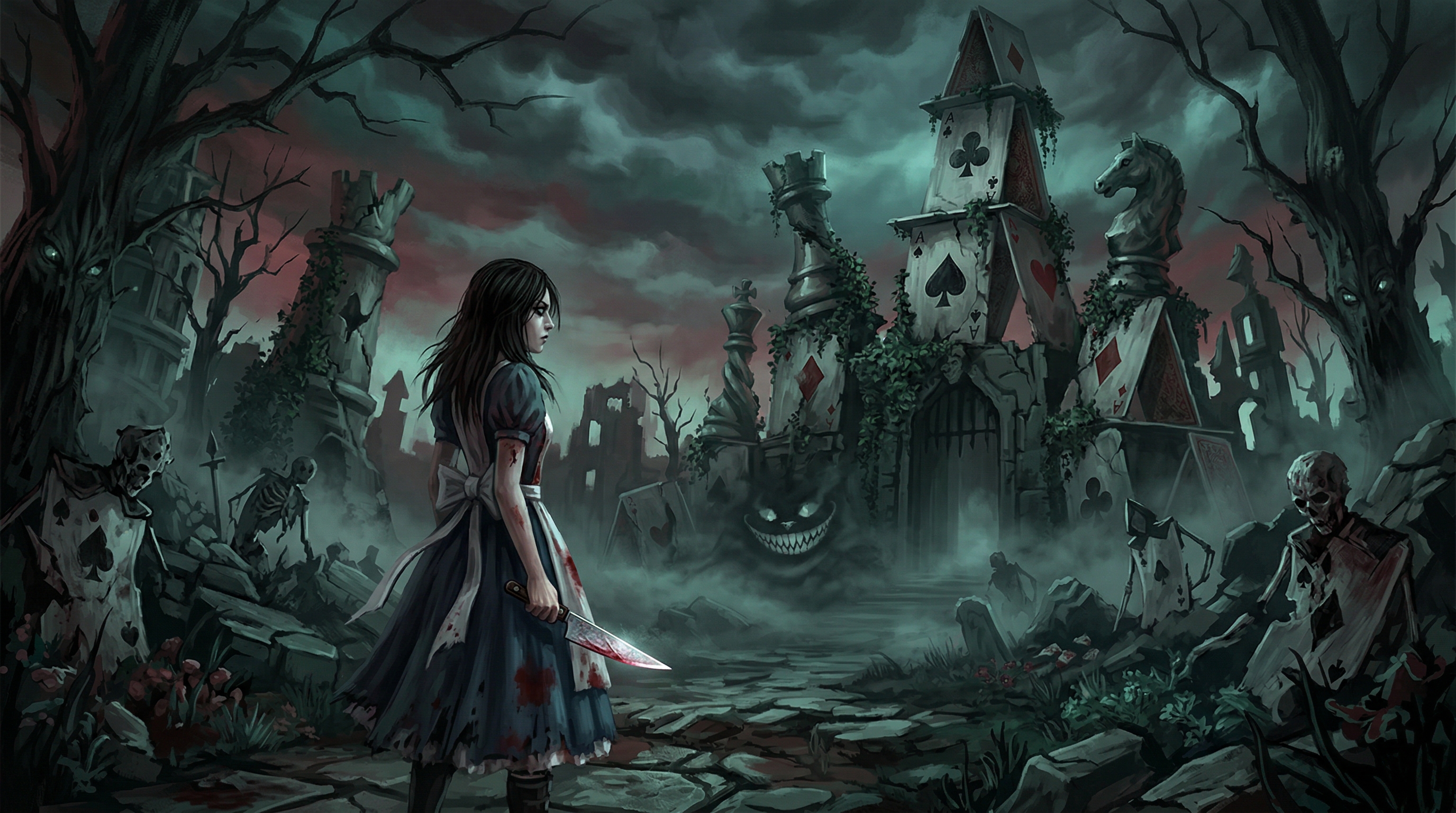
This is the primary reason to play American McGee’s Alice in VR. The game’s art direction—gothic cathedrals built from playing cards, industrial hellscapes overseen by the Mad Hatter’s ruined factory, the creeping corruption of the Red Queen’s domain—benefits enormously from stereoscopic depth. Environments that felt like backdrops on a monitor feel like spaces you could step into.
The game’s psychological horror elements land harder too. When the Cheshire Cat materializes from shadows, he doesn’t just appear on screen—he manifests in your peripheral vision. The sense of being watched, of occupying the same space as these grotesque reimaginings of childhood characters, amplifies the game’s unease in ways that flat-screen play cannot replicate.
Chris Vrenna’s industrial-tinged soundtrack, featuring unsettling lullaby samples and mechanical percussion, gains an almost physical presence in headphones. Combined with the visual depth, the VR experience creates a sense of oppressive atmosphere that justifies the technical compromises.
The id Tech 3 Engine Plays Nice
Older engines often work better with injection drivers than modern ones. id Tech 3’s straightforward rendering, predictable camera matrices, and lack of modern anti-cheat or DRM layers means VorpX can hook into the game without conflicts. The stereoscopic separation is clean, with minimal ghosting or artifacting.
Immersive Screen Mode Is Legitimately Good
VorpX’s Immersive Screen feature has evolved into something genuinely useful for third-person titles. The ability to curve the virtual screen, adjust its distance, and tweak field-of-view settings means you can optimize the experience for your comfort and visual acuity. For players who find traditional VR motion sickness-inducing but want the stereoscopic depth, this mode offers a comfortable middle ground.
What Doesn’t Work
Third-Person Platforming in Stereoscopic 3D
Here’s the fundamental problem: American McGee’s Alice has always had finicky platforming. The game’s collision detection is imprecise, Alice’s jump arc is unforgiving, and the camera—positioned at a fixed distance behind her—sometimes obscures the landing zone at critical moments.
These issues don’t magically resolve in VR. In fact, they arguably become more frustrating because stereoscopic depth gives you a better sense of spatial relationships, which makes it more galling when the game’s physics don’t match what your eyes are telling you. You’ll see exactly how far that gap is. You’ll still fall into it because Alice’s jump decided not to register.
The game demands frequent quick-saving, and that rhythm—attempt, fail, reload, repeat—doesn’t pair well with VR’s immersive qualities. Being pulled out of Wonderland every few minutes to reload a save shatters the atmospheric spell that VorpX works hard to create.
Combat Has Aged Poorly
Alice’s arsenal—an arsenal that includes a playing card-themed throwing weapon, a jack-in-the-box explosive, and the iconic Vorpal Blade—sounds more interesting than it plays. Combat encounters devolve into circle-strafing and resource management. The VR experience doesn’t change this; it just lets you see the repetitive animations in three dimensions.
Boss encounters, which should be highlights, often involve pattern memorization and precise timing that the game’s controls weren’t built to deliver smoothly. Again, the stereoscopic depth helps—you can judge distances to projectiles more accurately—but it doesn’t fix underlying design issues.
No Motion Controls Means No Presence
This is the trade-off you accept with any injection driver experience. You won’t reach out to touch Wonderland. You won’t physically dodge the Mad Hatter’s attacks. You’re an observer with a headset, not a participant with hands in the world. For a game that trades so heavily on immersion and psychological impact, the absence of hand presence is noticeable.
The 2011 Re-Release Has Quirks
Most players will be accessing American McGee’s Alice through the 2011 HD re-release, which was bundled with Alice: Madness Returns or made available through EA’s digital storefront. This version includes:
- Native widescreen support (though cutscenes remain stretched)
- Controller support
- Some texture upgrades
- The removal of the developer console and Cheshire Cat hint system
The lack of developer console access is particularly annoying for VR users, since console commands can sometimes help with FOV adjustments or camera tweaks. Fan patches exist to restore functionality, but they add another layer of setup complexity.
Who This Is For
Good for:
- Fans of the original game who want to experience its atmosphere in a new way
- Horror enthusiasts who appreciate psychological dread over jump scares
- VorpX owners looking for third-party titles that work well in Immersive Screen mode
- Players with tolerance for retro game jank who value atmosphere over polish
- Curious players who want to see what injection drivers can achieve with older titles
Not for:
- Players seeking native-quality VR gameplay with motion controls
- Anyone prone to motion sickness from third-person camera movement
- Newcomers to Alice’s story (the sequel, Madness Returns, is more accessible)
- Players expecting polished platforming mechanics
- Those unwilling to engage with moderate setup complexity
The Verdict
Tier: C
Game Quality: C American McGee’s Alice is a cult classic for its atmosphere and art direction, not its gameplay. The platforming is frustrating, the combat is repetitive, and the pacing drags in places. It remains worth experiencing for its unique vision, but there’s a reason this specific blend of horror and platforming didn’t spawn imitators.
VR Implementation Quality: C VorpX’s injection driver works as advertised—stereoscopic 3D is clean, head tracking is responsive, and Immersive Screen mode provides a comfortable way to experience the game. But this is still fundamentally a flat-screen game displayed in a headset. There are no motion controls, no VR-native interactions, and no solutions to the underlying camera and platforming issues.
Overall Tier: C This is a curiosity for enthusiasts, not a recommendation for general audiences. The atmospheric benefits of stereoscopic 3D are real and genuinely enhance the experience of exploring Wonderland. But the compromises—no motion controls, third-person camera limitations, and the game’s own dated mechanics—make this a niche experience. Play it if you love the original and want to see it from a new perspective. Skip it if you’re looking for polished VR gameplay or can’t tolerate retro jank.