
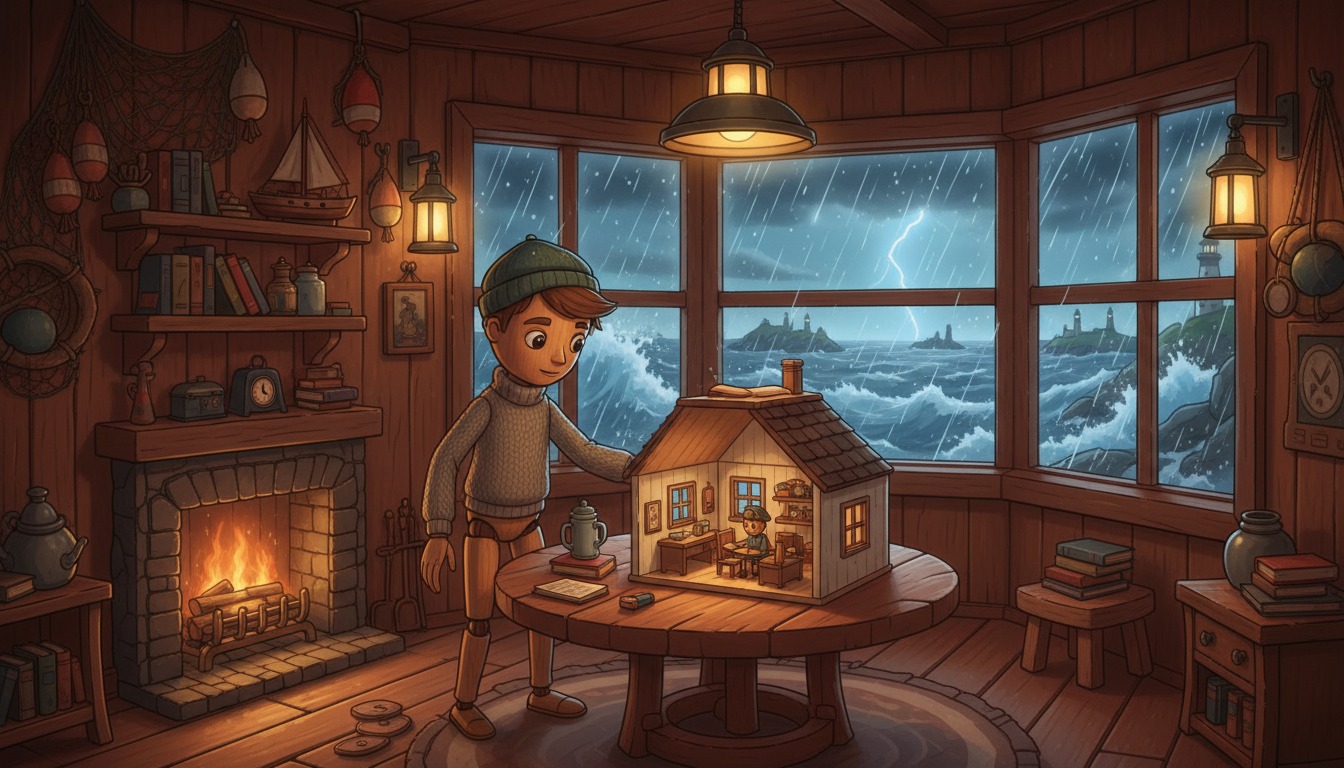
The first time you look down at the dollhouse on the table and see yourself staring back, already moving in perfect sync, something in your brain short-circuits in the best way. A Fisherman’s Tale doesn’t ease you into its central trick — it drops you straight into a recursive world where the lighthouse you’re standing in exists inside a smaller model of itself, which exists inside an even smaller one, stretching upward and downward forever. It’s a single idea, executed with such clarity that you wonder why nobody built a VR game around it sooner.
Developed by Innerspace VR and published by Vertigo Games, A Fisherman’s Tale arrived on January 22 for PCVR headsets and PlayStation VR as a native, VR-only release. There is no flat-screen version. This is a game that can only function inside a headset, because its entire design language depends on you physically occupying space, reaching out, and manipulating scale in ways that a monitor cannot replicate.
You play as Bob, a wooden puppet fisherman who lives alone in a lighthouse during a storm. The goal is simple enough: repair the broken light at the top so ships can see you through the tempest. The execution is anything but simple. Inside Bob’s cramped cabin sits a perfect miniature of the lighthouse, complete with a tiny Bob who mirrors every move you make. Look up, and you’ll see the ceiling open to a colossal version of the same room, where a giant Bob copies your gestures from above. The game calls this “single-player co-op,” which sounds cute until you realize you have to coordinate with yourself across three different scales to solve a puzzle.
The mechanics are disarming in their elegance. Need a key that’s too big for the lock? Hand it to your miniature self in the model lighthouse and watch a shrunken version clatter onto your own floor. Can’t reach a valve? Grab the giant version from the room above and pull it down to size. The game never lectures you. It trusts that the spatial logic of VR — the instinct to pick things up, peer inside containers, and stretch toward distant objects — will carry you through. It trusts correctly. These are escape-room puzzles in spirit, but the recursive framing makes them feel like genuine perceptual experiments. You aren’t just solving riddles; you’re interrogating how reality layers on top of itself.
The presentation leans hard into charm. A warm-voiced narrator guides the story with the cadence of a children’s book, which fits the stylized, toy-like art direction. The visuals are clean and optimized for VR performance — no muddy textures or aggressive post-processing to tax your GPU. The tone is gentle, even when the storm outside rattles the windows. The sound design, all creaking wood and distant thunder, wraps the whole experience in a sense of fragile isolation that bigger, noisier VR games often miss. You feel the space around you. The cabin is cluttered with objects that beg to be picked up and examined, and the game rewards that curiosity with small surprises.
Comfort is where A Fisherman’s Tale quietly excels. The game uses teleportation locomotion exclusively, with no smooth movement to trigger motion sickness. You can play seated, standing, or room-scale, and the action is contained to small, static environments. For a medium still fighting the stigma of nausea, this is a textbook example of how to design for accessibility without sacrificing ambition. It’s an ideal showcase for VR newcomers — the kind of game you hand to someone who thinks headsets are only for shooting galleries.
Controls are straightforward: grab, drop, and extend your hands to reach distant objects. The interactions are tactile and satisfying, though the limited verb set means you’re never doing anything more complex than manipulating physics objects. That’s not a criticism. The game knows its scope and stays within it.
The only real caveat is that ephemeral runtime. Two hours of inventive puzzle design is enough to leave a mark — and A Fisherman’s Tale does leave a mark — but it’s over before you’ve fully settled in. It’s a brilliant short story rather than a novel. The game doesn’t pad itself with filler, which is admirable, but it also doesn’t offer much incentive to return once the lighthouse is lit. Whether that’s worth the asking price depends on how much you value mechanical originality over raw duration.
This is one of VR’s most genuinely inventive releases. It won AIXR’s VR Game of the Year award for good reason: it’s a native VR experience that could not exist on any other screen, built around a mechanic that makes the headset feel essential rather than ornamental. If you want proof that VR can deliver ideas flat games can’t touch, this is it. Just know going in that the lighthouse is smaller than it looks.