
Luke Ross's R.E.A.L. VR: 42 Games, Zero Motion Controls, and the Flat-to-VR Ceiling
Luke Ross's R.E.A.L. VR framework brings 42 AAA games to VR with stunning polish. But one critical omission reveals the ceiling of per-game injection modding.
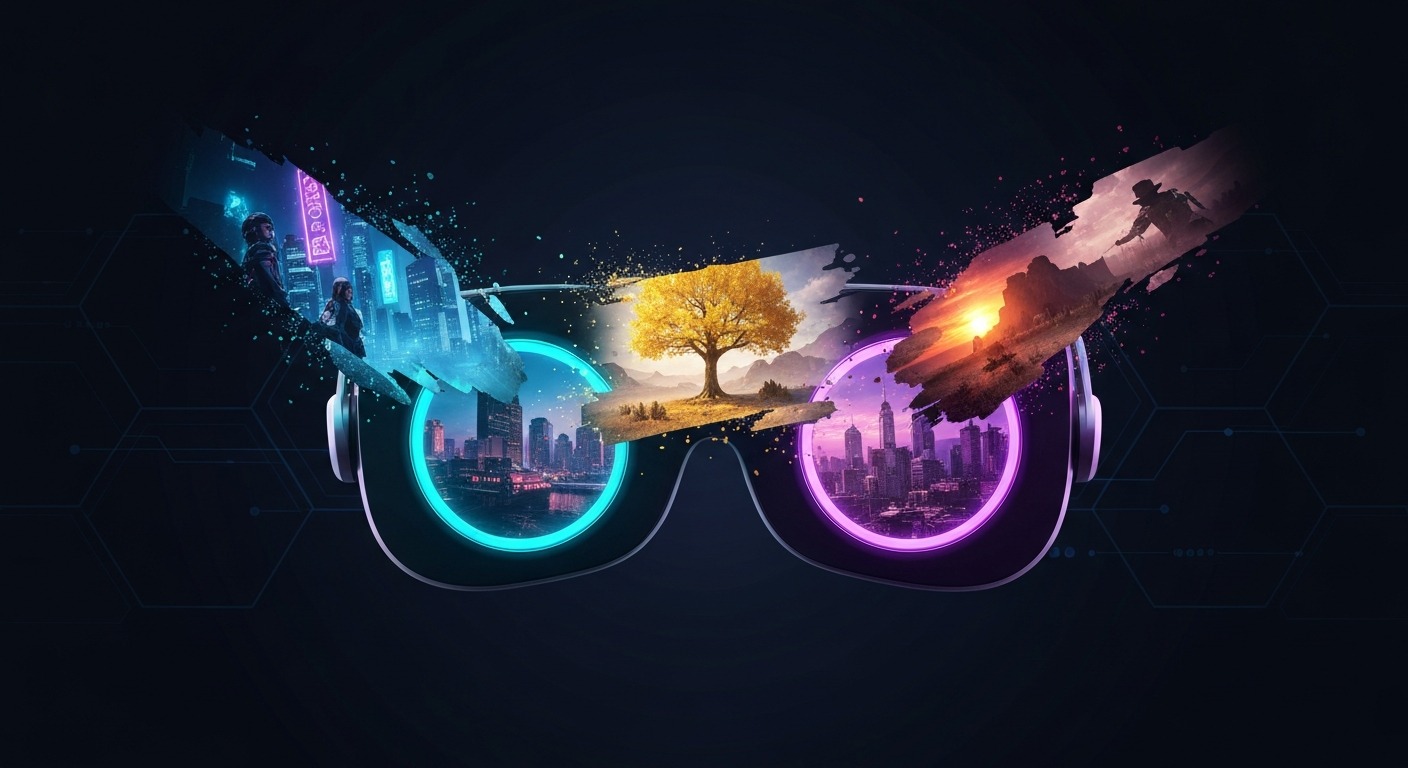
Here’s the thing: I’ve spent more hours than I’m comfortable admitting inside Luke Ross’s R.E.A.L. VR mods. Cyberpunk 2077 at night with ray tracing and a headset strapped to my face. Horizon Zero Dawn with a Thunderjaw barrelling toward my actual face. Dark Souls III where every boss towered over me like they were actually in the room. It’s genuinely impressive work. And after spending time with all of it, I can tell you exactly what R.E.A.L. is, what it isn’t, and why that distinction matters more than the 42-game catalog suggests.
R.E.A.L. stands for “Real Embodiment and Awareness for Life” — yeah, the acronym is a stretch, but the work behind it isn’t. Luke Ross reverse-engineers each game individually. This isn’t a universal injector. Every title gets custom camera hooks, custom stereoscopic rendering, custom UI fixes. When you boot up Cyberpunk 2077 in VR through R.E.A.L., you’re not running a generic wrapper. You’re running code that was specifically written for Cyberpunk’s engine, Cyberpunk’s UI, Cyberpunk’s rendering pipeline. That per-game craftsmanship shows. The 3D effect is clean. The UI is readable. The head tracking is smooth. Many profiles even support DLSS, which means you can actually hold a decent frame rate without dropping every visual bell and whistle. Compared to the jank I’ve wrestled with in other solutions, R.E.A.L. feels like a product, not a hack.
And the catalog is genuinely broad. Forty-two games as of early 2022, spanning from GTA V — the 2017 breakthrough that put Ross on the map — through Dark Souls III, DOOM Eternal, Death Stranding, Days Gone, Horizon Zero Dawn, Watch Dogs 2, and the recently PC-ported Final Fantasy VII Remake Intergrade. If you want to experience big-budget AAA worlds in stereoscopic 3D with head tracking, there is simply no other option that covers this much ground this competently.
But here’s the catch, and it’s a big one: R.E.A.L. does not do motion controls. Full stop. What you get is head-tracked stereoscopic 3D with a gamepad. You look around with your head. You play with an Xbox controller. That’s the entire interaction model.
Look, I’m not gonna lie — this is the part that breaks my brain every time I put the headset on. After playing RE Engine titles in VR with full 6DOF motion controls through Praydog’s REFramework, or even after the clumsy but genuine hand presence that VorpX has started experimenting with in newer profiles, going back to a gamepad feels like a regression. Not a small one. A fundamental one. There’s a difference between “being in the world” and “looking at the world through a window that moves with your head.” R.E.A.L. is the latter. It’s an incredibly polished, beautifully engineered window. But it’s still a window.
This isn’t idle nitpicking. It changes what games work. Cyberpunk 2077 in R.E.A.L. is stunning visually — Night City has scale and presence that the flat screen simply doesn’t convey. I spent an hour just driving through Japantown looking up at neon signs. But the moment combat starts, I’m back to thumbsticks and triggers, physically sitting on my couch while my in-game body does flips and rolls. The disconnect is real. Same with DOOM Eternal: the demons are horrifying up close, but my hands are holding a gamepad, not a shotgun. The experience hovers in this uncanny valley between immersion and abstraction.
Compare that to what Praydog’s REFramework delivers with Resident Evil 2, Resident Evil 3, and Devil May Cry 5. That work is technically rougher around the edges — you will fiddle with configs, you will have moments where the UI is unreadable, you will occasionally wonder if this was really meant for VR. But when you’re physically aiming a gun with your hand, physically peering around corners, physically reaching for items? That’s VR. The embodiment is there. R.E.A.L.’s elegance trades that away for stability and breadth.
And then there’s the Patreon question. R.E.A.L. has been paywalled for years. You subscribe to Luke Ross’s Patreon, you download the mod for the game you want, and if you cancel, you lose access to updates. In a community built on open-source tools and free mods, this model has always felt… odd. Not wrong, exactly — the man has put in thousands of hours of reverse engineering, and the results speak for themselves. But it means R.E.A.L. exists in a gated garden while the rest of the flat-to-VR ecosystem, fragmented as it is, mostly doesn’t. There’s something slightly unsettling about the best implementation of a concept being the one you have to keep paying for, indefinitely.
VorpX, the older paid alternative, has started adding 6DOF support in some profiles, but it’s VorpX — you’re still dealing with a generic driver that sometimes works and sometimes turns your UI into abstract art. R.E.A.L. is objectively better at what it does. The question is whether what it does is enough.
So who is R.E.A.L. actually for? It’s for the VR owner who wants to experience big worlds in 3D without fighting configs for six hours. It’s for the person who doesn’t mind playing with a gamepad as long as the visual presentation is clean. It’s for anyone who looked at Cyberpunk 2077 or Horizon Zero Dawn and thought, “I want to stand inside that,” even if “standing inside” really means sitting on a couch with a controller.
But it’s not for the person who believes VR without hand presence is just 3D TV with extra steps. And honestly? After forty-two games, I’m starting to think that person might have a point. R.E.A.L. proves that per-game injection can be polished, stable, and commercially viable. It also proves that polish without presence has a ceiling. You can reverse-engineer every camera system in every AAA engine, but you can’t reverse-engineer embodiment. Either the hands are there or they aren’t.
In early 2022, R.E.A.L. remains the best way to play the widest selection of flat AAA games in a headset. Just understand what you’re buying — and what you’re not.
One-line takeaway: R.E.A.L. is a masterclass in per-game VR engineering that accidentally demonstrates why universal 6DOF frameworks are the real future of flat-to-VR.